


Over the last several weeks, I’ve focused on why leaders need to develop their junior talent, and I’ve laid out a blueprint and a timeline for doing so. That’s all good from the perspective of the CPO intent on building a junior development program - one focused not only on getting their juniors up and running in an age of AI, but also building a strong talent bench over time.
The fact remains, though, that many Procurement organizations don’t have formal, structured junior development programs at all. Too many are simply brief rotation programs, while others are a few hours of in-class training. Still others are informal in nature, usually assigned to the supervisor in charge to manage in whatever way they see fit. In such organizations, juniors are effectively left to fend for themselves.
If you’re a junior in just such an organization, then today’s post is for you. I’ll focus on how you can take charge and build your own development program, so that you’re not dependent on an organization that isn’t doing enough to aid in your development.
(And if you are in a well-designed program, all of this still applies - it just means you’re pushing on an open door.)
AI as a Substitute for Thought
I’ve talked at length about the need to develop discernment - the ability to assess whether an output is sound or not - as the basis for building judgement, and how AI tools take away the very foundation we need to be able to do so.
But recent research shows another problem that is just as significant: the people who most need to build judgement are also the ones most likely to offload it. Studies have found a significant negative correlation between frequent AI use and critical thinking, as a result of cognitive offloading - and younger people (aged 17-25) show both the highest dependence on AI tools and the lowest critical-thinking scores.
In other words, AI is most seductive exactly where it’s the most dangerous - at the start of a career, before judgement has had a chance to form. Juniors end up bypassing the necessary cognitive struggle that is part and parcel of developing discernment and judgement: forming a view on how best to attack a problem, analyzing the results, and drawing conclusions for themselves.
There are a host of reasons for this: the demands placed on juniors by their organizations to get to results quickly, the desire to ‘show up well’ as compared to their peers, and also the ease with which training budgets are cut, leaving juniors with no choice but to rely on AI tools to help them think and do ‘more’. Whatever the reasons, excessive reliance on AI for complex reasoning, in the pursuit of instant answers, ultimately weakens a junior’s independence.
So you, as a junior, need to think and do things differently for yourself - which brings me to the core precept every ambitious junior needs to internalize.
Take Ownership
When you join an organization as a junior practitioner, it’s natural to assume the organization will put in the time and effort needed to facilitate your development - but most won’t.
So you cannot wait to be developed. You will have to architect your development path for yourself. And the fact is that this is something you absolutely can do: you have far more control over your situation than you think. The challenge lies not in the availability of tools and resources - those have never been more accessible - but in crafting a clear plan of action and cultivating the habits to stick to it.
(Ideally, you’ll have informal help from a supportive supervisor as well. But it isn’t a prerequisite for taking positive steps forward.)
Taking ownership of your own development is the essential foundational stance that it is built on.
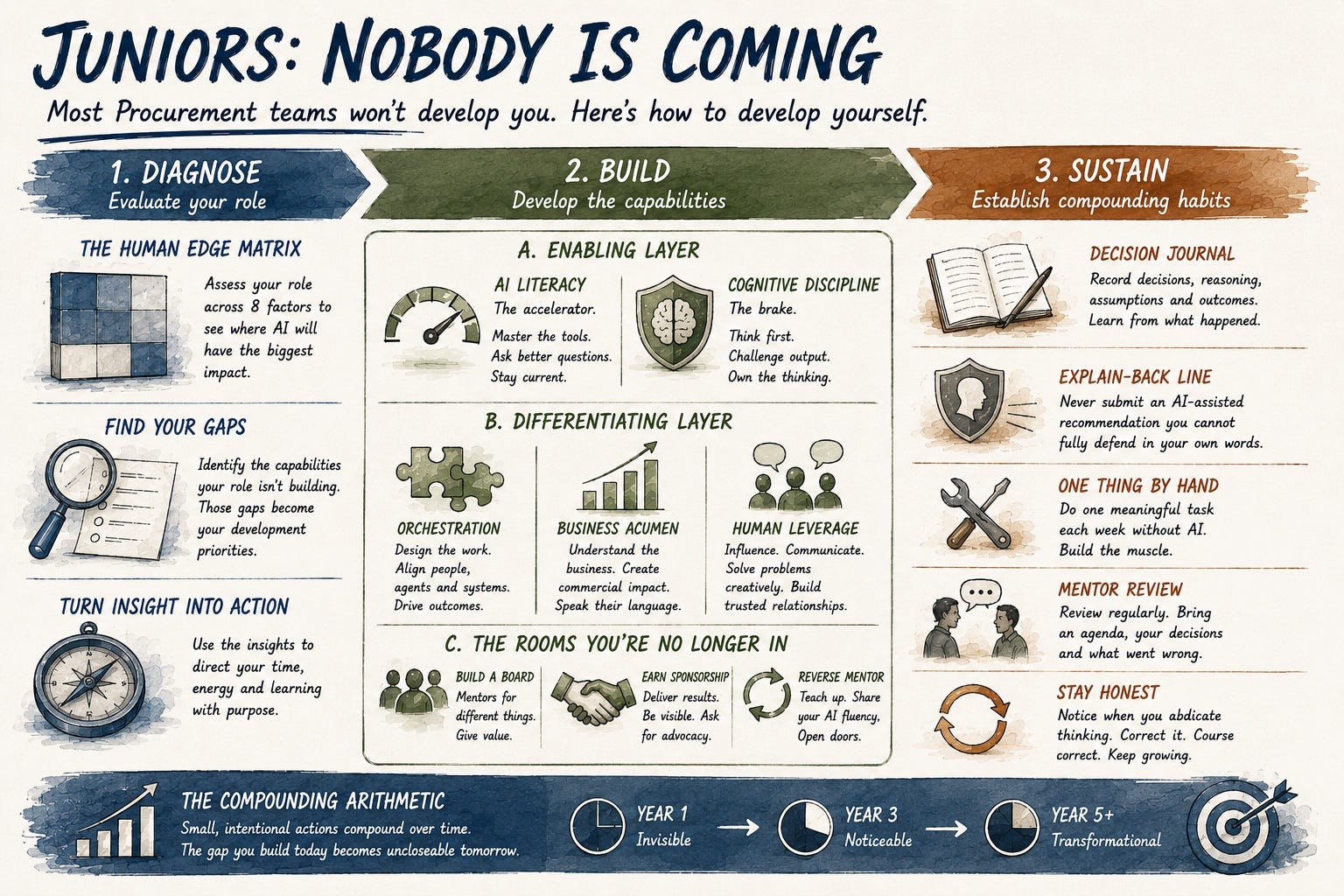
The Three-Part Plan
Once you’ve made the decision to take charge, real growth is possible. To realize this growth, you’ll need a practical, structured plan. Here is that plan, in three parts:
Diagnose - evaluate your role
Build - develop the capabilities
Sustain - establish compounding habits
Let’s look at each step in turn.
1. Diagnose: Evaluate Your Role
Back in March, I introduced The Human Edge Matrix - my framework for assessing whether, and how much, AI will impact a given role. It assesses eight factors: codifiability, ambiguity, judgement complexity, creativity, stakeholder complexity, political and organizational sensitivity, ethical and values-based reasoning, and decision risk/reversibility/ownership.
The Matrix is a good starting point for assessing the exposure of your own role today.
The point is not to alarm you. It’s to do something far more useful: to objectively assess which capabilities your current role is not developing in you.
That’s the diagnostic you actually need. Because if your day job consists largely of highly codifiable, low-ambiguity, low-stakeholder work - which is exactly what most junior roles have historically consisted of - then your role is not building the capabilities that will make you valuable in five years. The Matrix makes that visible.
To apply The Human Edge Matrix to your own role, click here. You’ll need to enter your name and email (you’ll be subscribed to my site), and then you can complete the assessment for your role at an overall level or by sub-task. Note that none of the information you input - other than your name and email - is retained in any way. This is purely for your own assessment.
Here’s what to do with the result: The gaps it surfaces are not an interesting observation to file away. They are your development priorities. Whatever your role isn’t building, you now have to build deliberately - which is exactly what the next step in the plan is for.
2. Build: Develop the Capabilities
In this step, you’re applying the components of the Future-Proofing model (detailed here) to structure and guide your own personal development. Look at the results of your assessment from the Human Edge Matrix and see where the largest gaps are and, hence, where you need to put in more work relative to other areas.
Of course, not all of the factors in the Matrix will map one-to-one with the model’s layer elements below - though a number of them will. The key is to identify if there are specific gaps that may need a bit more attention than others. All that said, the model is meant as a holistic development methodology - so both layers and all of their sub-elements must be worked on, particularly as a junior just coming up the ranks.
A. The Enabling Layer
This involves developing two skills that work in tension: AI Literacy (the accelerator that pushes you forward and helps you capture the value AI tools provide) and Cognitive Discipline (the brake that ensures you don’t go so fast that you lose your ability to think, comprehend and retain).
One point worth being clear on: AI literacy is merely the price of entry. It is not the differentiator. Every junior entering this profession will either have it or will be able to develop it very quickly. Being good with the tools will not make you valuable in the long term. What separates you is everything in the Differentiating Layer - and, ironically, the discipline to not over-rely on the very tools you’re expected to master.
That said, let’s get into it:
1. AI Literacy: The Accelerator
I wrote about how to build AI literacy in the corporate context in this article. In your context, the key is to make sure you understand the available tools and their impact:
Understand what tools are available (general and Procurement focused), and their current and future potential
Learn to think through the issue at hand, structure it appropriately and ask the right questions, with the goal of getting to quality output reliably and quickly
Learn to tell good output from plausible-looking garbage - which means never taking AI output for granted
Understand the build vs. buy trade-offs; for many simple applications you don’t need to buy, you can build quick and efficient solutions yourself
Understand how different tools work together and connect into workflows
Build the discipline to stay current and learn about new developments consistently
2. Cognitive Discipline: The Brake
I’ve discussed this at length as well in prior posts, and the same ground rules apply to juniors as to every other practitioner: use AI to supplement, not to substitute. The academic literature points consistently to the same conclusion - metacognition and self-regulated learning are the antidote to AI dependence.
The actionable implications for you:
1. Always develop your point of view first.
Think before you prompt. Before using AI, write down:
The problem statement
The desired outcome
The likely risks
Your own first-pass recommendation
Always start with the human frame - even a brief set of notes, a hypothesis, or a few framing questions will do.
2. Use AI as a sparring partner.
Once you’ve built out your human frame, even at a high level, use AI as a challenger, expander and editor.
The pattern to deploy is not “do it for me,” but to iterate with you. Ask it to work with you as a consultant or analyst. Ask it to:
Challenge your assumptions
Identify three risks you may be missing
Critique your recommendation
Offer alternative considerations
Test your logic for holes
Help you compare different scenarios
At the same time, thoughtfully evaluate what it gives you back, and test its thinking to ensure that what it’s telling you is something you actually agree with. Ask it questions, pressure-test key statements, push back where push-back is needed. Take nothing for granted.
This preserves your ownership of the core judgement task while still harvesting the benefits of the tool’s speed and breadth.
3. Build explain-back discipline.
This is a simple but powerful safeguard. For every key analysis where you’ve leveraged AI, be able to explain:
What the recommendation is
Why it makes sense
What assumptions it depends on
What the risks are, and where it could fail
What you changed from the AI output
The rule to live by:
“I will not submit an AI-assisted recommendation until I can fully defend it in my own words.”
4. Practice hard mode.
Deliberately do parts of the work without AI, purely to develop and maintain the muscle.
This means going “old school” - reading through multiple reports in detail, working with Excel spreadsheets, hand crafting RFPs, emailing suppliers directly, calling them to discuss specific topics, etc. Some of this is interesting work, while much of it is tedious and time-consuming but all of it will be valuable to help you grasp the nature of the work at an intrinsic level.
5. Engage in regular self-critique.
Reflect on your thought processes, your biases, and how you learn. Consider how you can continue to push your thinking and your ownership of your work.
Make a note of the tools you use and their relative strengths and drawbacks. Establish personal “red-flag” triggers for when to use AI and when not to. And adopt a two-source rule for anything high-stakes - verifying critical claims against primary documents or an independent reference.
B. The Differentiating Layer
The Differentiating Layer comprises three core skills. These are where your actual value gets built - and they are the ones your day job may well not be developing for you, which is precisely why you have to go after them deliberately.
1. Orchestration
Orchestration is the core skill of any good Project or Engagement Manager - the ability to design the work, allocate it intelligently across humans, agents and systems, sequence it correctly, and step in when it matters. It requires understanding the organization, the function, the tools, the people and the processes, and then tailoring the work to drive towards desired outcomes.
The core abilities: systems thinking; task decomposition; resource matching; sequencing and handoff; quality verification; exception handling.
What you can actually do to build it:
Own something end to end. Volunteer to run a small, complete piece of work - a low-value RFP, a supplier onboarding, a piece of market analysis - where you own the whole sequence, not just a task within it. Owning the steps and the required handoffs is where orchestration is learned.
Map before you work. For any process you’re part of, map it out first: who does what, where the handoffs are, where it typically breaks. You’ll be surprised how few people around you have actually done this - and how valuable it is to get a sense of the big picture.
Design a human-plus-AI workflow, explicitly. Take a piece of work and consciously decide which parts go to you, which to a tool, and which to a colleague - and be able to say why. Pilot-test and run the workflow. This is the single most future-relevant practice available to you today (and also a path that many organizations have barely embarked on to date - allowing you to show progressive value).
Volunteer for the messy stuff. Cross-functional work with unclear ownership is where sequencing and exception-handling get built. It’s uncomfortable work and that is the whole point. Take this work on and learn to structure, sequence and troubleshoot. Figure out, through trial and error and discussion, how the pieces are put together.
2. Business Acumen
This is the ability to think beyond your role and function to solve problems for the business. At its essence, it’s understanding your internal customer, their goals and the outcomes they’re seeking, so you can mediate towards the optimal solution.
The core abilities: business and financial literacy; commercial acumen; stakeholder/internal customer literacy; market and ecosystem literacy.
What you can actually do to build it:
Read the annual report. Actually read it - your own company’s, and then your key suppliers’. Then be able to explain, quickly and precisely, how your category connects to the P&L.
Ask your stakeholders what they’re measured on. Not what they want from Procurement - what they are judged on, and what would make their year. Then write down how their answer changes what you focus on. Most juniors never ask this question and yet the answer entirely changes how you work with them.
Learn the supplier’s economics. For any category you touch: what’s their margin structure, their cost drivers, where does their power come from? You can’t negotiate well against a business you don’t understand.
Translate everything into their terms. Whenever you make a recommendation, state the business consequence in the stakeholder’s language, not Procurement’s. “This saves 8%” is a Procurement sentence - but “This accelerates your launch date” or “This allows you to reduce administrative waste and focus more on higher value work” is a business one.
3. Human Leverage
This is the third core skill, focused on developing the human capabilities that drive valuable outcomes.
The core abilities: relationship and stakeholder management; influence and persuasion; narrative development and communications; creative problem-solving.
What you can actually do to build it:
Present to rooms more senior than you, regularly. Volunteer for it. Then ask for feedback on the delivery, not just the content. This is a muscle, and it only grows under load.
Apply the “so what” test. For every analysis you produce, be able to say why it matters to leadership in a single sentence.
Sit in on negotiations - and take notes on the humans. Not just the terms, but on what actually shifted the outcome: which argument landed, what was said at key moments, how stances were made to shift.
Take the uncomfortable conversation. When there’s a difficult message to deliver, do it in person rather than by email. Every single time you do this, you build a capability that no tool can ever give you or replace.
The Rooms You’re No Longer In
There’s one more thing that the model above alludes to but doesn’t cover explicitly, and it’s worth calling out.
When AI takes away the foundational work, it doesn’t just remove much needed practice, it also removes you from the rooms (and networks) that matter. Historically, a junior built their network because the grunt work put them in the meetings, on the email threads, and in the negotiations.
Remove the work, and that network no longer builds itself - which means you now have to build it deliberately. Here are three things to do:
Build a personal board of directors. Not one mentor - several. One person you go to for technical questions, another for navigating the organization, another for career decisions, another who will simply tell you the truth. Identify different people for different things - but make sure you are giving something back to each of them (see below).
Understand that sponsorship must be earned - and go earn it. A mentor will advise you while a sponsor will advocate for you in rooms you’re not in. Mentors can be assigned but sponsors cannot. When one senior leader was asked how she built relationships with three great sponsors, her answer was: “I’ve delivered.” Performance is the entry fee, but it isn’t sufficient - you also need visibility. So go and get work that is visible to the people whose sponsorship you’d want, and deliver on it. Then, when a mentor knows your work well, ask them directly (and tactfully) to advocate for you - and be specific about what for.
Use reverse mentoring as your way in. On the point of giving back value, here’s an advantage you have that you may not have considered: you are probably more fluent with AI tools than many of the senior people around you. That is genuinely valuable up the chain. Offering to help a senior leader get more out of these tools (and showing them how e.g. via the workflow example cited earlier under Orchestration) is a way to create a two-way exchange - and one of the easiest ways to open doors into a relationship that wouldn’t otherwise be possible.
3. Sustain: Establish Compounding Habits
Every successful plan requires not just diligent execution but also thoughtful reflection. The following steps are designed to help you make the learnings stick:
Keep a decision journal. For any decision of consequence, write down - at the time you make it - what you decided, why, what you assumed, and how confident you are. Then go back later and compare it to what actually happened. This is the single most effective tool I know for building judgement, because it’s the only way to separate a good decision from a lucky outcome. Take the ten minutes needed to do it.
Enforce the explain-back line. I’ve mentioned this above, but it’s worth reiterating: never submit an AI-assisted recommendation you cannot fully defend in your own words. If you can’t explain it, you don’t own it.
Do one thing a week entirely by hand. Put away the AI and pick something real to do - a piece of analysis, a model, a supplier assessment - and do it the slow way. It will feel inefficient. That’s the whole point: the struggle is what builds the mental map that lets you spot when the machine is confidently wrong.
Review with a mentor, regularly. Bring an agenda to discuss. Bring your decision journal. Bring those things you got wrong. Don’t just do it when you’re stuck. There’s value in the regular debrief.
And stay honest with yourself. At the end of the day, you will be able to tell when you’re abdicating your thinking to the tool. You’ll sense it - because you can’t recall what you produced, or you can’t explain it back easily. When you notice it, be honest about it and correct it.
The Compounding Arithmetic
None of the above tasks or habits will pay off this quarter.
They’re slow and many of them are less efficient. In fact, the colleague sitting next to you who skips all of the above will probably produce more and faster than you for a while - and that’s precisely why most of your peers won’t do any of it.
But remember the development spiral I wrote about a few posts ago: each action you take sharpens the next, such that capability doesn’t just add up, it compounds. (It works the same way in reverse: skip the reps, and you forgo the entire learning curve.)
So the fact is that true gains will only be noticeable over time. In year one, the gap between you and the colleague taking the shortcut will be invisible. In year three, it will be noticeable. In year five, it will be enormous - and by then, effectively uncloseable.
That’s the whole point - don’t let AI do the work for you, decide to use it in a way that builds you.
No one is going to make you do it - which is exactly why you need to do it for yourself.