


Over the last two posts, I laid out the rules for rebuilding junior development in a post-AI world, and then the nine building blocks themselves - the specific repairs for the threads AI is severing.
But knowing the rules and the parts is not the same as knowing how to assemble them - which is where the rubber meets the road. Drop a junior into owned, accountable work in month one and they’ll drown. Keep them in the shallow end for too long and they’ll stagnate - and, worse, the good ones will leave.
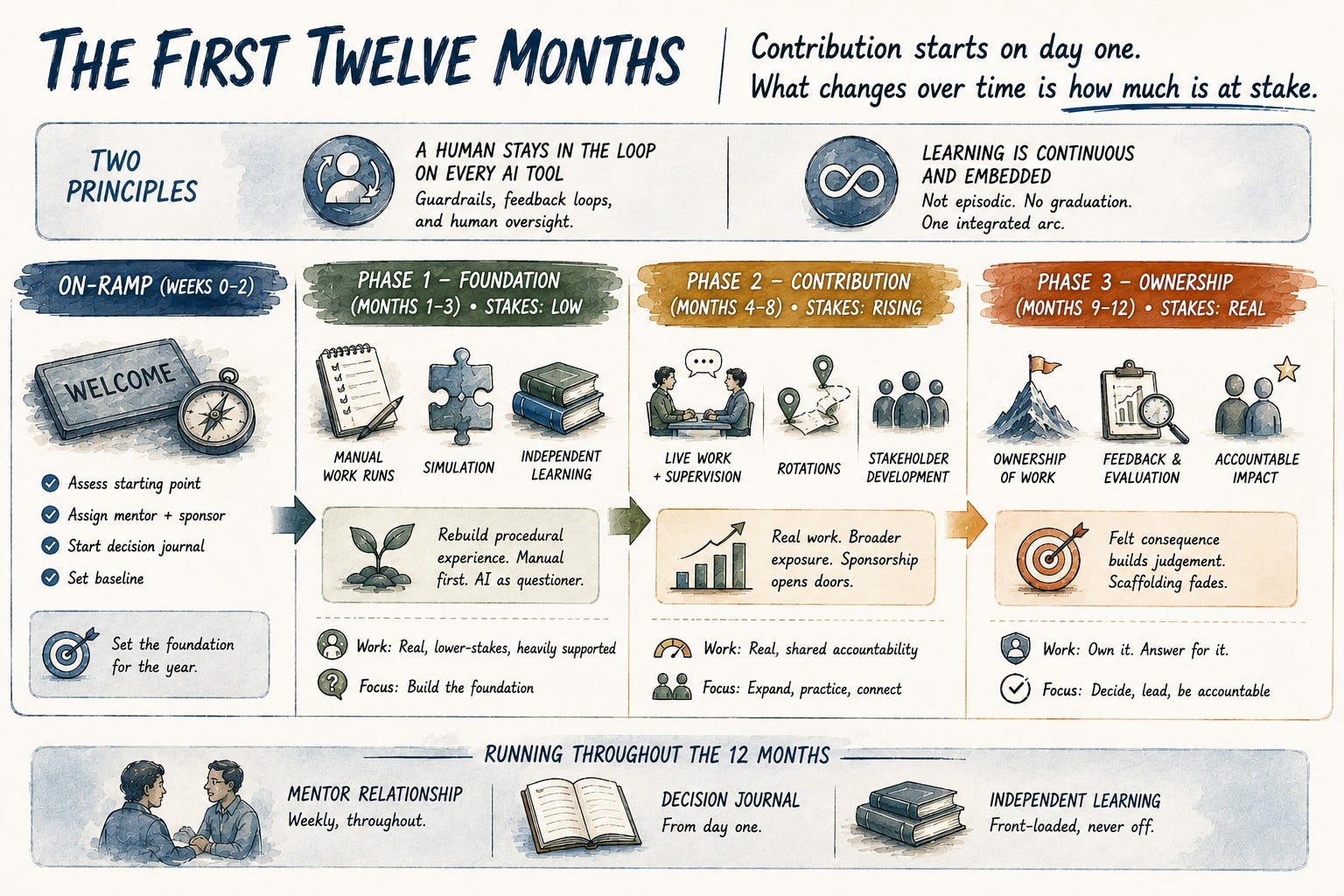
So this post is about the order - that is, what the first twelve months should actually look like, phase by phase.
A quick word on why twelve months and not longer. This development model can indeed stretch to eighteen or twenty-four months, and if you’re one of the handful of organizations with that kind of runway, have at it. But most Procurement teams don’t have that luxury - they need juniors to be contributing meaningfully, and fast. So I’m proposing twelve months as a workable, practical timeline.
That said, I appreciate even a twelve month timeline - in the context of junior development - is aggressive and, to that end, it’s worth being clear about what it does and doesn’t achieve. It will not give you a finished practitioner; as the compounding spiral showed a few posts back, real mastery takes years. What my program will give you is something more immediately useful: a junior you can trust with real, defined, accountable work - one who will compound their development from a properly built foundation rather than a hollow one.
Before we get into the phases themselves, we need to reiterate the two principles that run underneath the entire timeline.
Two Principles
A human stays in the loop on every AI tool. Last week’s rule was “AI as questioner, not answerer.” This is how you actually enforce it: every AI tool a junior touches is set up with guardrails and feedback loops, and a human - usually their mentor - is close enough to the interaction to see it and step in. The reason this has to be architected rather than left to good intentions is simple: the idea of “struggle first” will survive for about five minutes against a tight deadline if no one is watching - and unsupervised AI is how the discernment trap creeps back in.
Learning is continuous and embedded, not episodic. The phases below are not a ‘course’ the junior “completes” and “graduates from”. There’s no certificate, no point where the learning stops and the working starts. It’s one continuous, integrated, rising arc, embedded in real work throughout - which brings me to the single most important thing to understand about this whole model.
Contribution From Day One
The phased program defined below is not meant as a sequestered-trainee model (”first they learn, then they contribute”); that’s both unrealistic and wrong. No organization can afford to pull a junior out of day-to-day operations for three months, and no good junior would want you to either.
So I want to be precise about what’s actually being phased: the junior contributes real, operational work from week one; what’s graduated is not whether they do real work - it’s how much consequence rides on it, and how much support surrounds it. In the early months, the work is real but lower-stakes and heavily scaffolded (often the manual work run simply is a real deliverable - just done by hand first, then checked). As the months pass, the stakes rise and the scaffolding fades. In other words, consequence trending up and support going down, on a deliberate schedule.
One last thing before we start. The month markers below are a default for a typical junior, not a law. Leaders should flex the pace up or down against the individual’s starting capability and experience levels (exactly what the on-ramp assessment is for). But flex the pace, not the sequence. No phase should be skipped, even for your strongest hire, because the foundation is, well, foundational, and precisely what stops the junior falling back into the discernment trap.
Now, let’s get into the phases.
The On-Ramp (Weeks 0-2)
The starting point is a short assessment of what the junior actually arrives with, so that a mixed cohort doesn’t get ‘one-size-fits-all’ treatment. Weight your selection criteria towards a clear desire to learn (curiosity), strong drive (work ethic), bias for collaboration (teamwork) and a tolerance for ambiguity, over a polished CV. (This builds on the motivation constraint I wrote about a couple of posts ago.)
Then set up the scaffolding that will run all year: assign both the mentor and the sponsor, start the decision journal on day one, and record the baseline you’ll measure progress against. This is unglamorous plumbing, but it needs to be addressed, otherwise you have nothing to measure against.
Phase 1: Foundation (Months 1-3) - Stakes: Low
The emphasis here has to be on the load-bearing repair: procedural experience. Manual work runs - core tasks done by hand - and simulations are the essential tools, with independent learning (such as traditional coursework) building baseline domain knowledge underneath it all. The junior is already doing real work, but it’s lower-consequence and heavily supported, and wherever possible they do it manually first, before AI touches it. AI is present only as a Socratic questioner.
The temptation to resist: compressing or skipping this phase under the “we need them productive now” pressure. This is the single most common way the whole program fails - a junior who has never built the foundation can’t tell when the AI is confidently wrong, which means you’ve allowed for the exact trap this series exists to prevent. Three months is already a compressed timeline - don’t cut it further.
Phase 2: Contribution (Months 4-8) - Stakes: Rising
In this phase, the junior steps into live work in earnest - still supervised, but carrying real, shared accountability as the safety net loosens. Simulations, of course, continue, but with higher difficulty and their sponsors start putting them in the room for key events and initiatives. At the same time, the junior’s structured stakeholder plan also kicks in and they start actively building their network.
This is also where rotations begin. The junior spends short periods - a week or two - embedded both across different Procurement subteams, and also inside the internal functions Procurement serves. The point is to feel their pressures, their constraints, their trade-offs. This is not generalist tourism, it is to ensure they come back a more empathetic and more credible partner to Procurement’s stakeholders - and, one day, a far better category leader for that spend, precisely because they’ve spent time on the other side of the table.
The temptation to resist: getting the stakes wrong in either direction. Push too fast - load up real consequence before the foundation is ready - and you get false confidence, or a junior leaning on AI to cover the gaps. Move too slow - keeping them safe and simulated for too long without exposure to mounting stakes - and your most motivated people get bored and leave. Calibrating that balance is the core judgement of Phase 2.
Phase 3: Ownership (Months 9-12) - Stakes: Real
In this phase, the junior takes genuine ownership of a defined piece of work - building it, leading it, and being answerable for how it lands. This is where you deliberately manufacture the thing that AI removes (and that allows judgement to form): the felt cost of being wrong. The scaffolding is largely gone by this phase as the mentor shifts from catching mistakes in the moment to reviewing decisions after the fact.
Feedback and evaluation - while a part of all prior phases as well - takes on a deeper importance, via graded critiques, decision-journal reviews, and judgement assessed on the quality of the reasoning rather than the outcome, and across multiple assessors.
The temptation to resist: fake ownership. A project the junior nominally “owns” while a senior holds the real decisions is simply theatre, not ownership. It builds nothing because there is no genuine consequence. If you aren’t willing to let them own it for real, you aren’t in Phase 3 yet.
And underneath all of this, running the entire twelve months: the mentor relationship (weekly, throughout), the decision journal (from day one), and independent learning (front-loaded, but never fully switched off).
How You’ll Know It Worked
The entire argument of this series has been that the cost of getting junior development wrong is an iceberg - invisible for years, then catastrophic. The reverse is also true: the payoff from getting it right is invisible for years, too. You will not see the finished, seasoned practitioner at month twelve. You’ll see a junior you can trust with real work - and a curve bending in the right direction.
All of which is to say that, regardless of how well you implement the above program, you will not be able to fully measure its impact on the timescale your quarterly reviews run on.
So measure what you can see now: whether the reasoning is getting sharper (versus output speed); time-to-competence and error reduction (not volume of work). Make a thoughtful assessment as to whether discernment and judgement are forming - and then hold the nerve to keep investing while the lagging proof takes its time (years, often) to arrive. This nerve is the real test of leadership here - because anyone can fund a program, but far fewer can hold their conviction through the years before it visibly pays off.
Which leaves us with one last piece: everything across these last few posts has been aimed at leaders - at what the organization must build. But no program, however well-designed, works on a junior who is simply along for the ride. The spiral only turns if they push it.
So the final post in this series on junior development flips the lens entirely. Not what we must build for them - but what the early-career practitioner, sitting right at the start of all this, should be doing for themselves.