


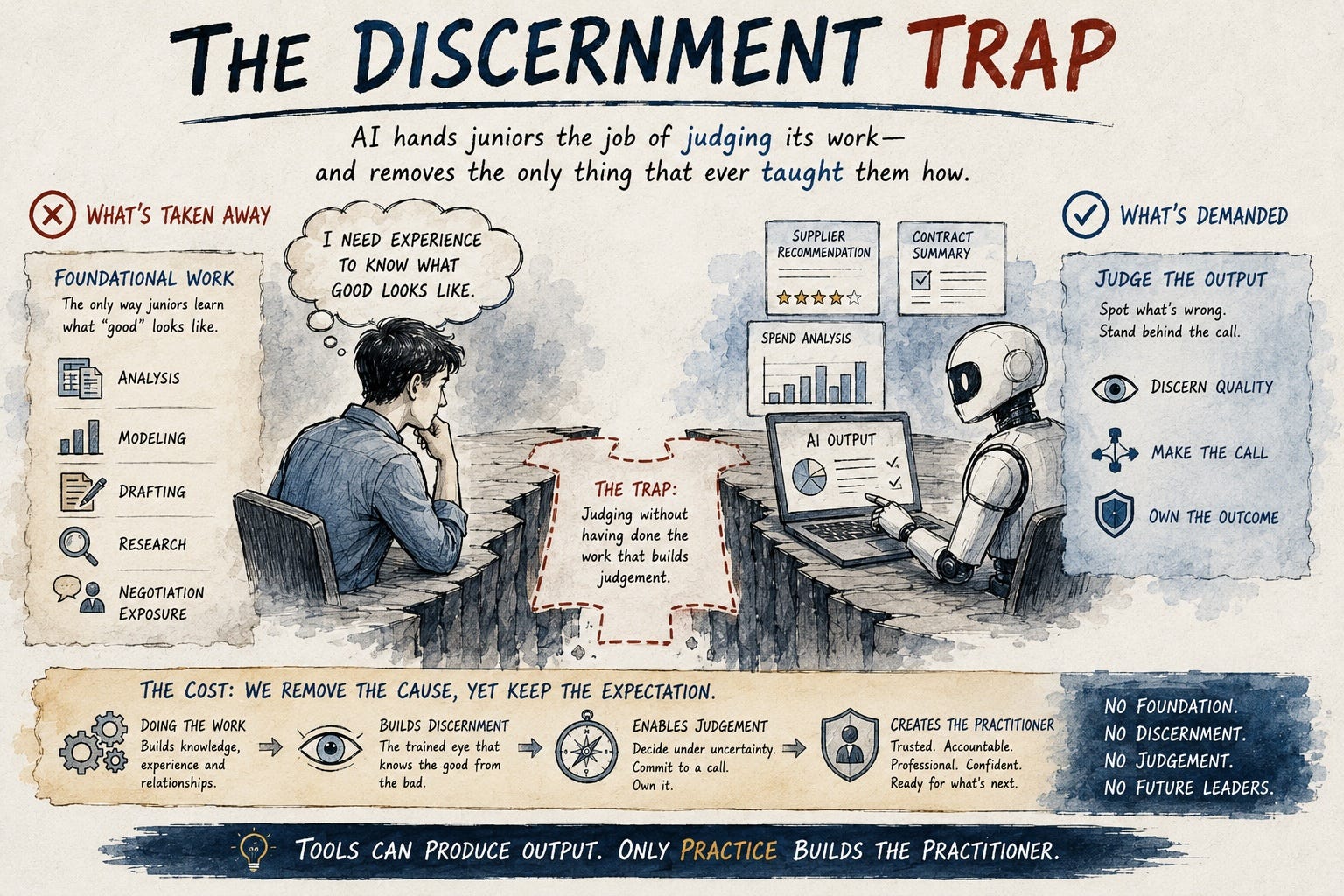
The story being sold to us right now is an appealing one.
AI takes away the drudgery and you’re freed to do higher-value work. As a result, your job shifts from doing the work to directing and checking the AI. You become the supervisor, the editor and the one applying the judgement - allowing you to get to better outcomes faster than any generation before you.
It sounds like the promotion we always wanted - free of the grunt work! - but, in practice, it can be a trap, and for no one more so than the junior practitioner.
Because to direct and check an AI’s output, you have to be able to tell the good from the bad. You have to be able to look at a sourcing recommendation, a contract summary or a supplier analysis and know, sometimes instantly, that something is off.
This ability has a name: discernment. Discernment isn’t something we’re born with, or pick up in any training course. It is the resultant artifact of having produced the work ourselves - often badly at first, then less badly, over and over again, until we’ve developed a calibrated sense of what “good” actually looks like.
And therein lies the trap:
AI hands the junior practitioner the job of judging its output, while removing the very work that built the judgement to do so.
Because supervisory roles assume a discerning eye which, in itself, was a by-product of the production work. Take away the production, and you take away the means by which a junior person can learn to do it well.
From Symptom to Cause
This is the mechanism underneath the apprenticeship crisis I wrote about in my last post. There, I argued that our junior Procurement talent is at risk - that AI is threatening to remove the foundational basis that used to build a practitioner’s judgement, and that the apprenticeship model (using that term broadly to encompass all training and development) we’ve relied on for generations is breaking as a result.
The discernment trap is why this matters so much. It isn’t simply that juniors will know less. It’s that the new role we’re handing them structurally depends on a faculty that the old work was building at a very fundamental level i.e. we are removing the cause yet keeping the expectation.
So if our goal is to produce junior practitioners who actually develop into trusted, accountable senior Procurement professionals, the kind who become our future leaders, then we have to get specific about the path that produces them. And simply focusing on broad notions of “apprenticeship” - a simple agglomeration of tactical actions and tools - is to treat it as one undifferentiated thing, making it too blunt to be useful.
We need to be clear about the different parts that need to be worked on.
The Destination: Judgement-in-Action
Let’s start with our destination.
In the conceptual framework I’ve been developing (see image below), the destination is what I call trusted, accountable judgement-in-action: a practitioner who can make the hard calls under situations of uncertainty, stand behind it, and be trusted by others to do so.
That, increasingly, is the senior practitioner’s actual job in a post-AI world. Not producing the analysis, because the machine can do that, but being the human who owns the call - not simply when the machine’s analysis is right, but especially when its recommendation is plausible and wrong.
The question, then, is how does a budding junior get there? What is the developmental flow that turns a new entrant into that caliber of practitioner? Once we understand this clearly, we can then see exactly where AI cuts - and only then can we think about what to deliberately rebuild.
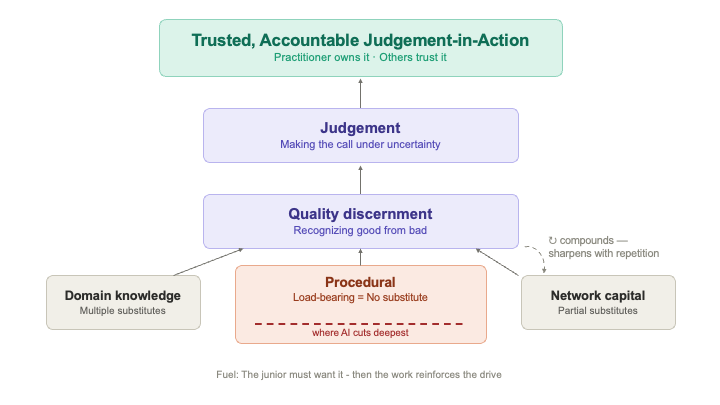
Let’s walk through this framework.
Three Unequal Inputs
At the base sit three sources of a junior’s early development:
Domain knowledge - understanding the category, the supply market, the commercial and contractual fundamentals, etc.
Procedural experience - actually doing the work: running the RFP, building the spend cube, drafting the summary, sitting in on the negotiation, and more.
Network capital - the relationships built with colleagues, stakeholders and counterparties.
All three contribute to the learning journey, and it’s tempting to treat them as three equal pillars. But they aren’t - and that inequality is the whole point.
Domain knowledge has substitutes (or multiple ways of building the capability). You can acquire a great deal of it from a training course, a category report, or a good book. Network capital has partial substitutes - relationships can be built deliberately and actively but much of it can also be formed by simply being in the room (a partial case, by the way, against remote work, but that’s a discussion for another day). But procedural experience has no real substitute. It is the one input that can only be acquired by doing. And, not coincidentally, it is the one AI removes most completely.
There’s a deeper point here, and it’s the reason procedural work is load-bearing. Doing the work was never only about building procedural skill; it was the enabling and delivery mechanism for the other two. You absorbed domain knowledge in context - not as abstract facts, but as patterns you noticed because you were elbow-deep in the actual data. You built your network because the work put you in the rooms, on the email threads and in the negotiations. If you take away the procedural work, you don’t just lose one of three inputs. You weaken all three at once.
This is also where the richer learning research points. The reason apprenticeship worked - going back to the cognitive-apprenticeship literature - is that doing real work alongside someone more expert makes their normally-invisible thinking visible to you. And the reason struggling with a problem before you are handed the answer builds deeper understanding (another robust finding from decades of “productive failure” research) is that the struggle itself is what encodes the lesson. The productive struggle is the point, as that is what rewires your neurons, allows you to build a mental map of the topic or issue at hand, and develop an intrinsic understanding of the problem at hand - so that your ultimate solutions make more meaningful sense.
When AI supplies the answer first, it closes that window. You keep the output but you lose the learning, because all you have are surface representations of the problem at hand - a ‘stab’ at an answer that is at the same level.
Inputs Become Discernment
Of course, these inputs don’t stay separate. With enough practice - including feedback, consequences, the felt cost of being wrong - they fuse into quality discernment: the trained eye that recognizes the good from the bad.
Discernment is evaluative, and it is retrospective. It judges work that already exists. It is the capacity to look at a finished piece of analysis and know that it is missing the point that actually matters (or simply naive). And, to come back to where we started, it is precisely the faculty the AI-supervision role demands, and precisely the one that only forms through the procedural work discussed above.
Discernment Becomes Judgement
Discernment, in turn, is the substrate for judgement. These two are easy to confuse, so it’s worth being exact about the difference.
Discernment, as we’ve said, is retrospective: it recognizes quality in work that exists. Judgement is prospective; it is generative. It is the capacity to decide what to do under uncertainty, to commit to a call before complete data is available. We should invest in this supplier because its capabilities will better align us with our product future, even though the incumbent is materially cheaper.
Judgement isn’t about evaluating a finished output; It’s about making a decision, and then owning it.
You cannot develop judgement without discernment. Judgement is, in large part, running your discernment standard forward - applying your hard-won sense of “good” to options that don’t yet exist. A practitioner with no calibrated eye for quality has nothing to project into an uncertain decision. They are guessing.
Judgement Becomes the Practitioner
Judgement, exercised and tested over time, is what finally produces the apex: the trusted, accountable practitioner.
This has two faces that develop together.
One is professional - others come to trust this person’s calls. They have earned a reputation and internalized the norms of the function. They have become a procurement person in the fullest sense.
The other is internal - the earned self-confidence that comes only from having made real calls, genuinely owning those outcomes, and exercizing the resilience to sit with the ambiguity inherent within them.
Neither of these can be borrowed. Confidence that was never earned is either hollow or as good as having none. Ownership you never actually felt will never parallel real ownership. And this is where some of the most striking recent evidence is worth mentioning (though I would treat it as suggestive rather than settled, given it’s early work). When researchers at MIT had people write with heavy AI assistance, the quality of the output was perfectly fine, but the sense of ownership of it simply wasn’t there. Many of the “doers” could not even recall what they had just “written”.
To reiterate, the tool produces the artifact. It does not produce the practitioner who feels responsible for it.
Why This is a Spiral, Not a Ladder
One refinement: I have described this as a sequence, and the dependencies are definitely real - you cannot develop judgement without discernment, or discernment without repetitions (doing the work).
But this isn’t a one-way escalator. It’s a spiral that compounds (see image below). Once you have a little discernment, your next experience teaches you more, because you now notice things you couldn’t see before. Once judgement begins to form, it changes what you pay attention to while you work. The practitioner that pulls ahead isn’t simply doing more work, they’re doing that work under steadily rising standards.
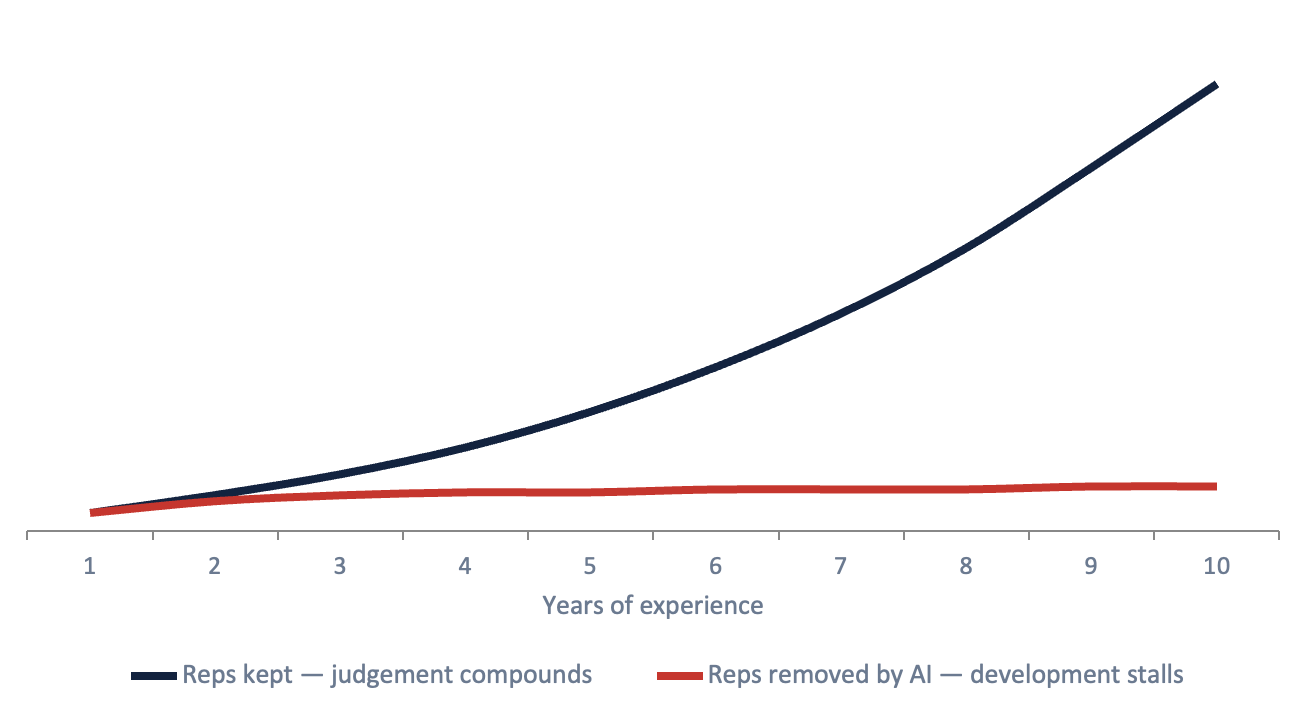
This is why removing the early foundational work does so much more damage than it first appears. You’re not simply subtracting one rung from a ladder, you’re foregoing years of compounding - a curve that was meant to bend upward but instead goes flat. And because it is a curve, the gap is nearly invisible at first. It only shows up five or ten years later, when you reach for a bench of seasoned judgement and find it was never built.
One last thing: none of this happens to a junior who doesn’t want it. The practitioner has to bring some motivation of their own - ideally an understanding of precisely the perils of over-reliance we have been describing. The work then reinforces it. The stakes, and the struggle, are part of what makes a person care enough to climb.
What Comes Next
So that is the bundle. Not “apprenticeship” as if it were one undefined thing, but a developmental chain: three uneven inputs, fusing into discernment, maturing into judgement, culminating in a trusted and accountable practitioner - and then compounding, in a spiral, the whole way up.
Seeing it this way changes how we tackle the problem. “Replace the training ground” sounds hopelessly vague, but “Deliberately rebuild each of these components, defending hardest the ones AI severs most directly” is a brief we can actually work with.
Which is exactly what the next post will focus on: a blueprint for developing junior talent in a post-AI world. How to engineer each of these effects on purpose, now that the delivery mechanism that once produced them for free is being taken away.
Great read Omer! The critical thinking aka discernment crisis is afoot. The learning, experience, exposure and the ability to work through problems is being lost to AI speed. I heard the IBM CEO talk in doubling down on the market opportunity, and instead of layoffs, they are increasing the talent, to build solutions that were costly and experience to work on. I mention it because he is not winging the AI boom. His discernment is pressing the legacy company to stronger moat.