


When I started in consulting several decades ago, a sizable part of my work as a newly minted Associate was what one might affectionately call “foundational work”. This comprised of both the cognitive - e.g. reading secondary research and preparing industry analyses - and the tactical/executional - e.g. creating PowerPoint decks, etc.
While a lot of that work was interesting and educational from a content standpoint, quite a lot of it was not. It was what you might refer to as grunt work.
But it all served a purpose: it laid the foundations for my development into a strong consultant. It taught me how to understand what was important to pick out from a research study in the context of the objectives of the engagement. It taught me how to craft the right sequence of messages and then convey them in a way that resonated with my audience. It taught me the discipline and discernment needed to deliver value as a consultant.
And on that basis, doing that work day after day, month after month, year after year, I was able to build not only my engagement delivery skills, but also the nuanced understanding and the judgement needed to progress up the consulting ladder over the following decade.
If, back then, I had the kinds of AI tools we have access to today, I would no doubt have been able to save a tremendous amount of time by having them do so much of that work for me, radically compressing the time to delivery of every engagement I worked on. So there would, no doubt, have been significant benefits for me, my team and my clients.
But I also wonder what kind of a consultant I would have become.
Because if AI could do the very work that laid the foundations of the consultant I became, what would that have meant for me and, more broadly, for the development ladder that consulting firms - and investment banks and corporations all over the world - relied on to grow their next generation of talent and develop their future leaders?
What the Grind Was Really Teaching
To be fair, today’s AI tools are genuinely valuable. As productivity enablers and thought partners, they bring a myriad of benefits to the work we do every single day, regardless of our professions. I’ve talked about these benefits, as well as the skillset implications these tools have for the Procurement practitioner in a post-AI world.
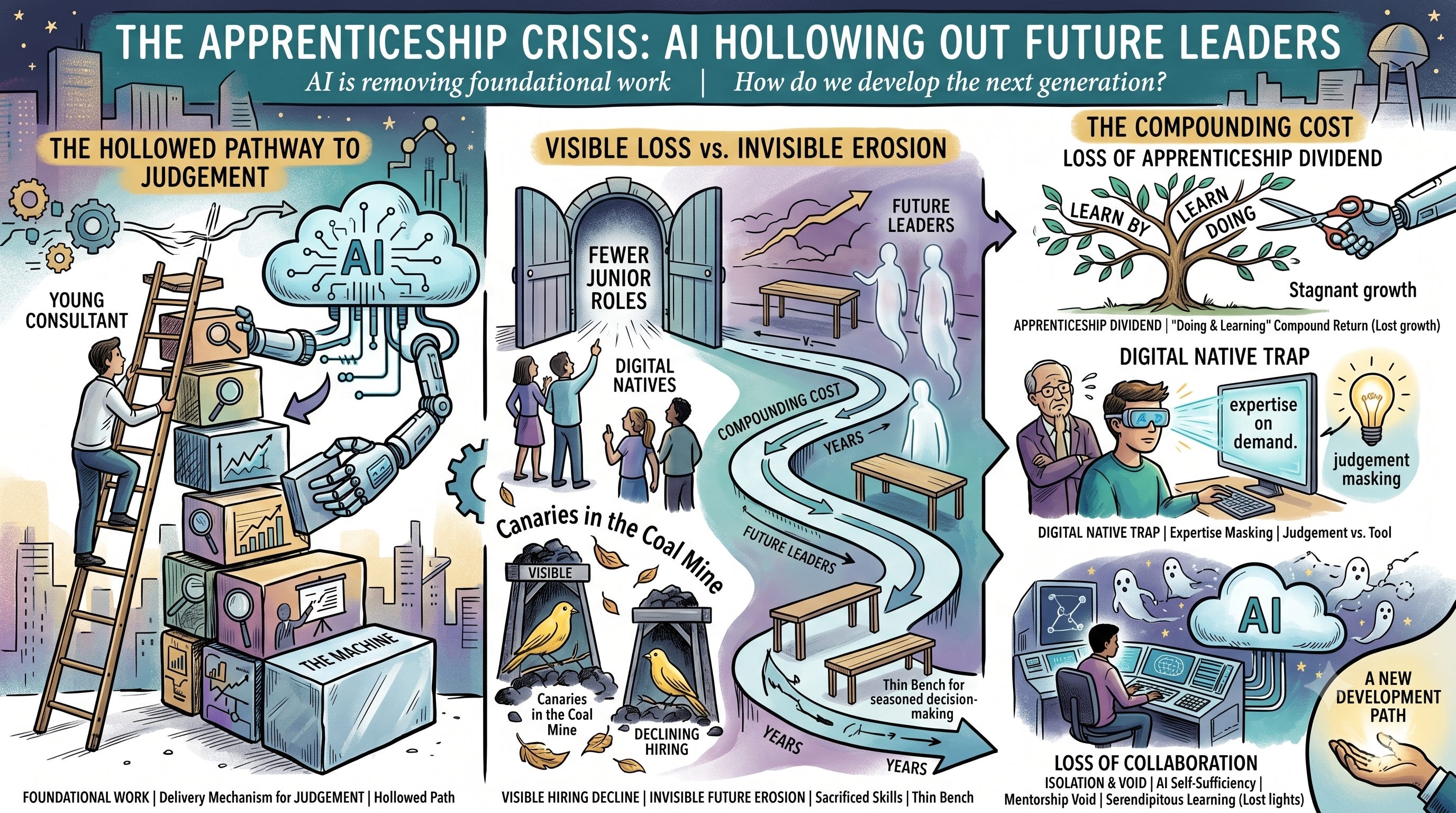
But for the junior practitioner - the new entrant into Procurement - AI poses a particularly unique problem. It is taking away the very foundational work that new entrants actually do - and this encompasses the cognitive as well as the tactical work. Historically, this work served as the training ground for junior folks to not only learn the function itself (running RFPs, building spend cubes, drafting contract summaries, doing supplier research, sitting in on negotiations) but also then develop the higher order skills needed to function effectively as a senior practitioner - skills such as judgement, relationship management, the ability to navigate ambiguity, etc. But now, the very training that taught juniors their craft is being taken away by the machines.
Of course, there are those who argue that this is actually a boon for the junior practitioner, that they’re now freed from the drudgery of the tactical work they never even wanted to do (and what was really just low-value busywork that deserved to be automated anyway). There is some merit to this argument. Juniors are often given low value busy work, and AI does indeed free them up to do higher value work.
But that argument misses the point: it wasn’t the drudgery that mattered - it was what the drudgery taught. The grind was the delivery mechanism for judgement. Running a low-stakes RFP didn’t just teach a junior the mechanics of an RFP, it taught them which suppliers were sandbagging, how different vendors negotiated and where their leverage points lay. Building the spend cube didn’t just teach Excel, it taught them how to find the opportunities buried in the data. If you remove this labor, you also lose the lessons that come from it.
Certainly AI can augment the junior in these cases - I won’t argue with that. But when the junior practitioner’s job moves from “doing the work” to “directing the AI” without the requisite foundation, I worry that they lose a key developmental pathway. They lose the grounding experience of not just the nuts and bolts of doing the work, but also the lessons that come from making mistakes while doing so, then learning to spot and fix those errors, etc.
In other words, they lose the repetition, the pattern recognition, the experience, and the acquired judgement that comes from doing that very work.
The Problem Everyone Sees
There’s another problem that AI poses for junior practitioners, and at first glance it looks like the bigger one. Corporations are noting the depth and (general) quality of what AI is capable of and many are asking themselves: Do we even need junior practitioners at all?
What’s worse, the question isn’t just being posed, there’s evidence to suggest it’s becoming a practiced reality.
A lot of this evidence is, of course, anecdotal in nature. You hear in the media about how new entrant hiring has slowed and how organizations are rethinking hiring (or at the very least, hesitating to do so) as they grapple with the changes AI will bring and how they can use these tools to drive even greater profitability by replacing people with machines.
But it also seems to be borne out by the data. A Stanford study last year - fittingly titled “Canaries in the Coal Mine?” - found tangible evidence that AI is starting to have a significant and disproportionate impact on entry-level workers in the U.S.:
“The analysis revealed a 13% relative decline in employment for early-career workers in the most AI-exposed jobs since the widespread adoption of generative-AI tools, ‘even after controlling for firm-level shocks.’ In contrast, employment for older, more experienced workers in the same occupations has remained stable or grown.”
The largest declines, the study notes, are concentrated among young, entry-level workers - those whose skills are most easily replaced by AI systems automating routine, codified tasks. Experience and tacit knowledge, in other words, are becoming the buffers against displacement.
So this hiring decline is certainly troubling. It’s the part of the story that everyone is talking about, because it’s visible. But it’s only part of the story.
The Compounding Cost
When you combine the visible (the drop in hiring) with the invisible (what happens to the juniors we do bring in), you can see the extent of the problem. This combined erosion builds over time, showing up five or ten years later, when we reach for a bench of seasoned judgement only to find it was never built.
(By its nature, this second erosion can’t yet be measured - its costs will land years downstream - but that’s precisely what makes it dangerous: it won’t show up in any dashboard until the bench is already thin.)
This plays out in three ways:
1. The Loss of the Apprenticeship Dividend
When Generative AI takes over the foundational work that serves as training for new entrants and junior practitioners - tasks such as drafting, research, modelling, and more - and we don’t provide the right roles and appropriate learning opportunities for them, we lose the apprenticeship ladder as well as what Forbes calls “the Apprenticeship Dividend”: the compound return created when people learn by doing, grow into new responsibilities, and then pass their knowledge on to others.
We need to ensure we retain the long view and provide the guidance and structure needed to not just keep but fortify that development ladder.
2. The Digital Native Trap
New entrants and fresh graduates into the function are typically far more progressive when it comes to their understanding and use of new technology, particularly AI. They are effectively digital natives. And there’s a real organizational case for that, best summed up by a recent World Economic Forum report:
“Without an influx of digital natives, organizations would experience a range of detrimental impacts: slower AI adoption and application, weakened succession plans, stalled knowledge transfer and cultures that struggle to renew themselves.”
That case is genuine - but notice what it is and isn’t.
It is an argument about organizational AI adoption: digital natives help the enterprise absorb these tools faster.
It is not an argument that solves the developmental problem. In fact, it can mask it. The same WEF report goes on to suggest that newcomers can “enjoy instant access to expertise that used to take years to gain” and “use AI to acquire skills more quickly and rapidly ascend to higher value roles.” There’s truth to this - but it’s also a seduction. Expertise you can borrow from a tool on demand is not the same as judgement you’ve built and own for yourself. That difference only becomes visible when the stakes are high and the tool is wrong.
My point is, keep hiring digital natives, but do it for the right reason (because they accelerate the organization’s AI fluency), and don’t let that benefit lull you into believing the developmental problem has been solved.
3. The Loss of Collaboration
One of the temptations of AI tools is that they make us self-sufficient: If the tool is our partner, then we don’t need to work with humans quite as much. Taken to an extreme, this creates a host of unintended consequences, especially when it comes to collaboration.
As AI takes on the foundational work, employees have less need to interact with each other - either with peers or with their senior leaders. This weakens mentorship and lessens the mutual support that is part and parcel of working with colleagues. It also reduces or eliminates the informal, serendipitous learning that simply happens when you least expect it.
Why This Matters
So the apprenticeship crisis is real and its implications are significant.
If we remove these roles - or hollow them out while keeping the headcount - and capture the savings that come from it, we will do so at significant opportunity cost: by sacrificing future skills, our talent pipeline and, ultimately, long term growth.
We need to use AI to accelerate human learning and capability, not as a substitute for it. We need to use it to free us up to become more strategic and able to do higher value, more fulfilling work.
Which brings me back to the question I started with. I wondered what kind of consultant I would have become if AI had done my foundational work for me.
The honest answer is that I don’t know - and that’s exactly the point. The judgement I rely on today was built over time, doing work I didn’t always enjoy and couldn’t have known the value of at the time. Junior practitioners entering Procurement today deserve a path to build that same judgement, especially as the old path disappears beneath them.
So it’s in all of our interests to fix this. That is what the next few posts are designed to do.