


By now, you’ve probably seen the spider chart from Anthropic (below) that plots AI’s theoretical capability against observed AI coverage by occupational category. The blue area represents the share of job tasks that LLMs could theoretically perform; the red area shows the share actually being performed by AI, based on real world usage data from Claude.
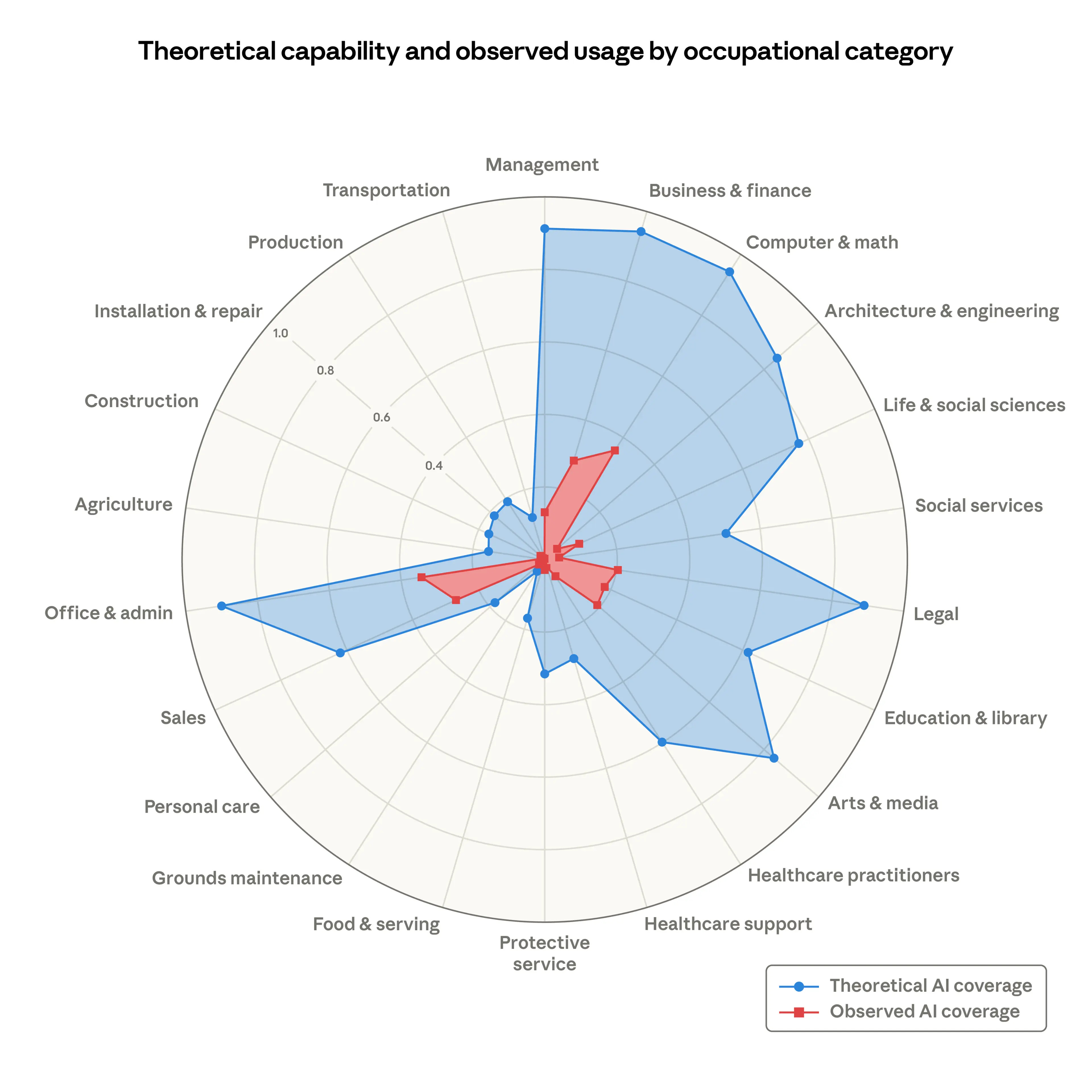
The thing about this chart that had LinkedIn and other social platforms in a tizzy was not so much the red areas but the fact that the greatest theoretical exposure was in those occupations that perhaps even 5-10 years ago, we wouldn’t have thought susceptible to “automation” (I’m using that term in its broadest sense).
But that’s one of the prime implications of AI today.
Where AI Lands First
AI usually lands first on work that is repeatable, rules-driven, text/data-heavy, and separable from messy real-world context - work that just happens to be a lot of what the average LinkedIn user does: management, finance, IT, office administration, etc. (Yes, I appreciate there’s more to it than that, but that sort of work does form the basis of these functions.)
And as AI tools continue to improve (which they will), we can expect the gap between the blue and red dots to close.
None of this should come as any real surprise. There’s plenty of research and anecdotal evidence that this will be the case:
The ILO’s 2025 exposure index assessed task-level exposure across nearly 30,000 occupational tasks and found that one in four jobs globally is exposed to GenAI to some degree, with clerical support roles still the most exposed. They highlighted that “some strongly digitized occupations have increased exposure, highlighting the expanding abilities of GenAI regarding specialized tasks in professional and technical roles”.
KPMG cites that its own analysis indicates “50-80% of current procurement work can be automated, eliminated or shifted to self-service models”.
More conservatively, McKinsey says that its analysis suggests that “technology will reshape the procurement function into an organization that is 25 to 40 percent more efficient, more agile, and increasingly agentic”.
Whatever numbers you choose to believe, it’s indisputable that AI, in one form or another, is going to change the way work is done.
For Procurement, the implications are obvious.
The earliest procurement impact is showing up in transactional and process-heavy cognitive work such as intake, data cleanup, PO support, contract reviews, supplier communications, first-pass analyses, and workflow orchestration.
But that’s just the start of it. AI is already coming for more Procurement work - including the analytical and decision support work that we previously thought would remain the domain of humans. We’re already seeing AI assist heavily with market intelligence synthesis, option generation, scenario modeling, contractual ‘red-flag’ detection, draft strategies, and negotiation preparation (though humans still own prioritization, trade-off selection, timing, and commitment).
The point is that machines are only going to get better - so the list of what AI can do will only keep expanding.
The Limits of a Task-Based View
The most fundamental takeaway for the practitioner, then, is that your role is going to change. There are (many) aspects of your role that AI will be able to do faster, cheaper and, yes, better (and not only that but it’s going to be able to do it 24/7).
But how exactly will your role be impacted?
There are plenty of institutions that have looked at specific Procurement roles and assessed the impact of AI on those jobs. Typically, they’ve taken a specific role, broken it down into its constituent tasks, and then assessed how susceptible each task is to AI.
In my view, this is useful but not enough.
Most procurement roles don’t fall into clean, well-defined sets of tasks. Practically, there are real-life complexities that force each role to morph in one way or another. These complexities can be external to the role (budget pressures, organizational or managerial demands, etc.) or specific to the individual (personal goals, expectations and desires).
As such, while these task-based analyses are helpful, the better question to ask is: how can we think differently about roles and really get to the root of what makes them human? This will allow individuals to determine for themselves why and how your particular role will be impacted by AI.
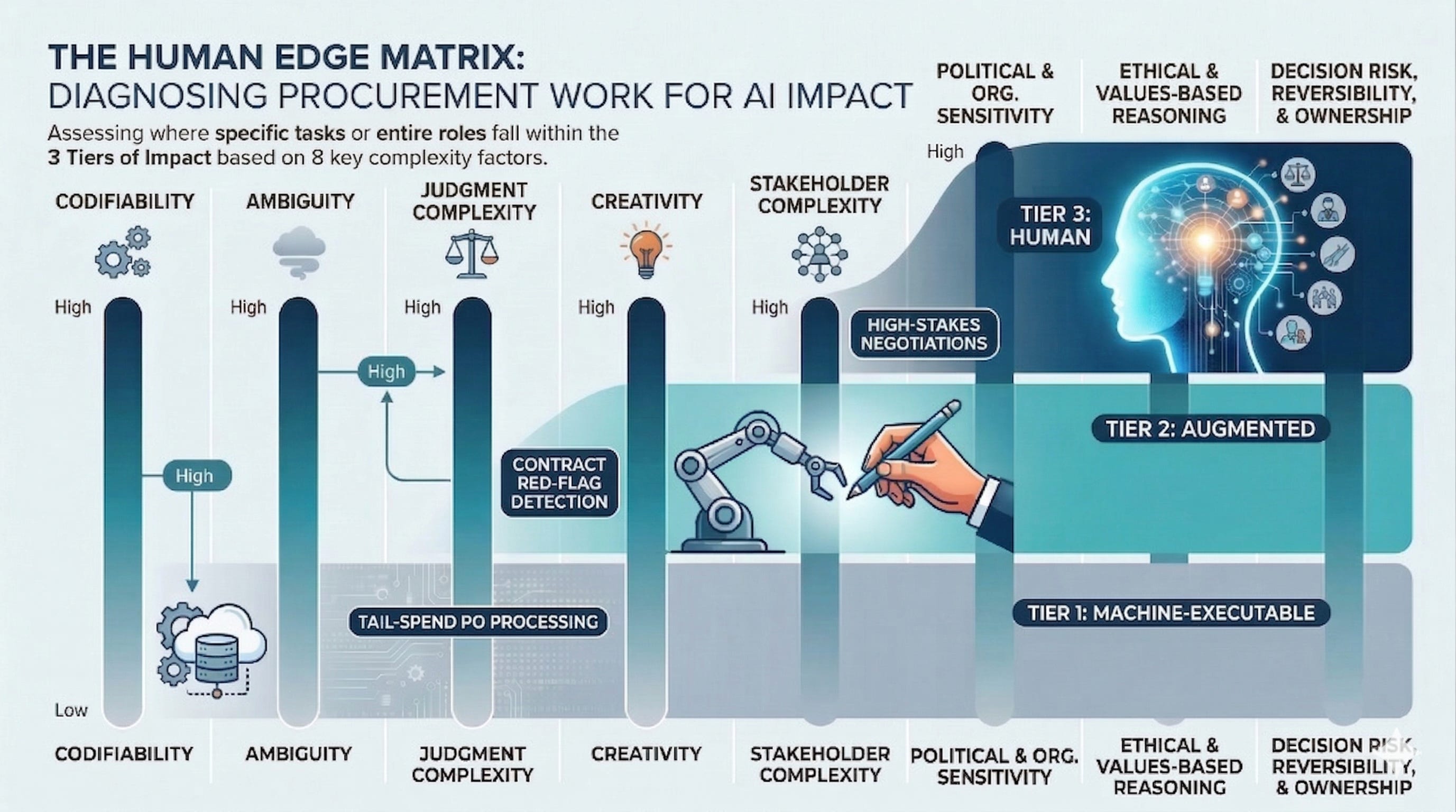
In this post, I’ll present one way to think about this: The Human Edge Matrix©.
A Better Way to Assess What Remains Human
The Human Edge Matrix provides us with a diagnostic structure, one that speaks to the nature of a given task or role and whether or not it will remain ‘human’ in the long term.
Specifically, there are two categories of analysis to consider with this matrix - the tiers of impact as well as the determining factors.
1. The Three Layers of Procurement Work
The first thing to understand is that this isn’t an “either/or” discussion. Every role won’t be either automated away or remain fully human. Work will split into three layers: Machine-Executable, Augmented and Human.
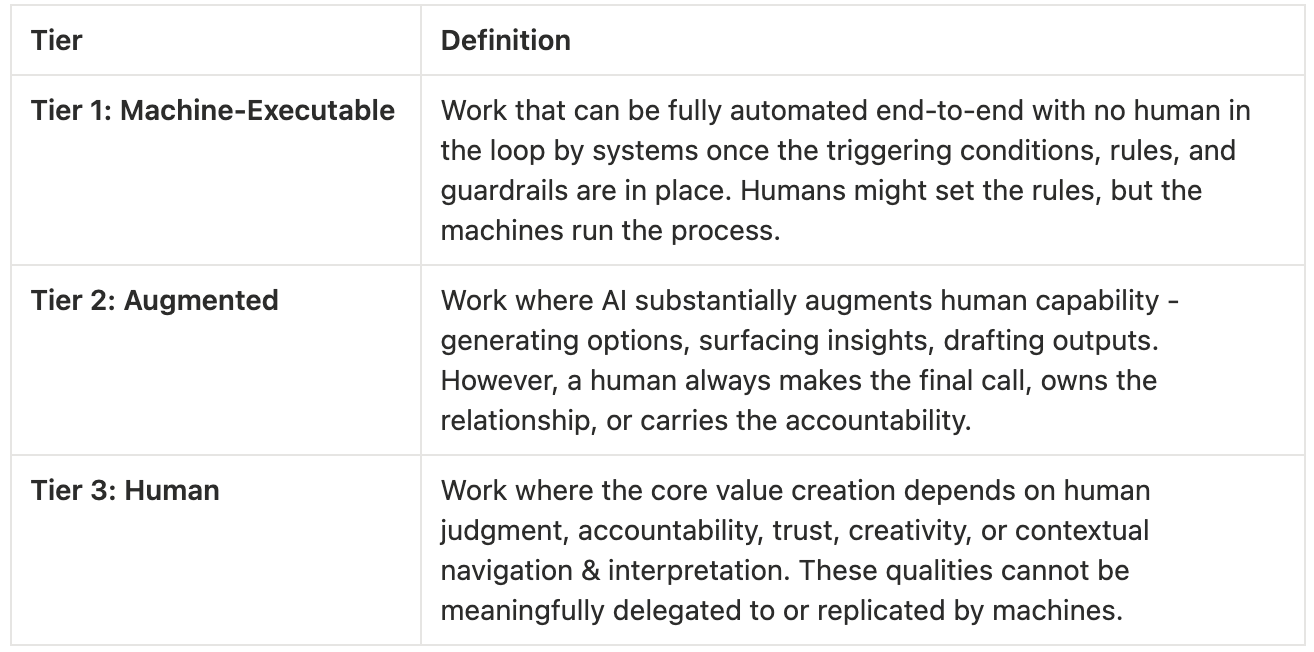
The three tier approach gives us a more realistic way to think about Procurement work.
It’s also worth noting that the assessment of what work falls within which tier is always going to be a point-in-time assessment. That is, while the 3 tiers hold, the work that falls under each tier is not static. As AI capabilities evolve, work currently in Tier 3 may migrate to Tier 2, and Tier 2 work may become Tier 1. It makes sense, therefore, to revisit any classifications periodically.
2. The Factors That Make Work More or Less Human
Within any role or set of tasks, a host of factors will determine where any given procurement activity falls in terms of the three tiers - eight to be precise.
Each of the factors operate as a spectrum, and it is the combination of factors, not just any single one, that determines classification.
These eight factors are as follows:
Factor 1: Codifiability
Can the decision logic, workflow, and success criteria be explicitly defined and systematized?
This encompasses both the structural clarity of the process (are there defined steps?) and the degree of precedent (has this been done many times before in similar ways?).
Highly codifiable work has clear inputs, known decision rules, and measurable outputs.
Example: Tail-spend PO processing against pre-approved catalogs is highly codifiable. Developing a category strategy for a new market with no prior supplier relationships is not.
Factor 2: Ambiguity
How much of the relevant context is tacit, situational, or absent from the available data? How rapidly is the relevant context shifting?
Ambiguity can be high for structural and dynamic reasons.
Structural ambiguity is high when the “right answer” depends on information that exists in people’s heads, in organizational culture, or in the dynamics of a specific moment. Hence, the the relevant context is tacit, relational, or simply not captured in available data.
Dynamic ambiguity is where the environment is changing so rapidly that the context for the decision is shifting faster than models or processes can incorporate it.
Example: A supplier’s public financials look strong, but the category manager has heard through industry contacts that the founder is planning to exit - tacit knowledge that could fundamentally change the sourcing decision. Allocation during supply crises, pricing shifts during geopolitical disruption or sudden regulatory changes create dynamic ambiguity (not because information is absent but because it’s changing in real time).
Factor 3: Judgment Complexity
Does the decision require weighing incommensurable trade-offs, interpreting incomplete signals, or making calls where reasonable people would disagree?
Note that this is distinct from ambiguity: a situation can be perfectly clear and still require sophisticated judgment. The question is whether the decision involves genuine dilemmas rather than optimization problems.
Example: Choosing between a lower-cost supplier with a questionable sustainability record and a more expensive supplier aligned with corporate ESG commitments. Both options are well-understood, but the judgment lies in how to weigh competing priorities.
Factor 4: Creativity
Is the work about optimizing within known parameters, or does it require imagining genuinely new approaches?
Optimization is AI’s strength. Genuine invention - new commercial models, unconventional partnerships, category strategies that redefine the problem - remains a human edge. The distinction is between finding the best answer within a known solution space versus redefining the solution space itself.
Example: Optimizing payment terms across a supplier portfolio is an optimization problem. Reimagining the procurement operating model to shift from transactional buying to outcome-based partnerships requires a creative rethink.
Factor 5: Stakeholder Complexity
How many stakeholders are involved, how conflicting are their interests, and how much does success depend on navigating those dynamics?
This encompasses both internal stakeholder management (business units, leadership, legal, finance) and external relationship management (suppliers, intermediaries, regulators). The underlying skills required - reading interests, building alignment, managing conflict - are the same.
Example: A routine MRO renewal involves one budget holder and one supplier. A strategic outsourcing decision involves C-suite sponsors, multiple business unit leaders with competing priorities, legal, HR, affected employees, incumbent suppliers, and potential new partners.
Factor 6: Political and Organizational Sensitivity
Is the work visible to senior leadership, does it touch on organizational power dynamics, or could it create reputational exposure?
Political sensitivity isn’t about the technical difficulty of the work but rather the organizational consequences of how the work/decision will be perceived. Identical analytical tasks carry different political weight depending on who is watching and what is at stake.
Example: Running a competitive tender for the CEO’s preferred consulting firm requires navigating political dynamics that have nothing to do with the mechanics of the RFP process itself.
Factor 7: Ethical and Values-Based Reasoning
Does the decision involve genuine ethical dimensions that require moral reasoning and alignment with organizational values?
This is less about compliance (which can be codified) and more about whether the organization’s identity and reputation are at stake. AI can flag such ethical risks, but the weighing of ethical trade-offs is fundamentally human.
Example: Deciding whether to continue sourcing from a region where labour practices are legal under local law but violate the company’s stated human rights commitments. No algorithm can resolve this as it requires a values-based judgment that the organization must own.
Factor 8: Decision Risk, Reversibility and Ownership
What is the magnitude of downside if the decision is wrong and can it be undone, and does the organization (or external stakeholder) require a human owner to stand behind it?
AI can handle high-volume decisions even if some are wrong, provided the errors are low-cost and correctable. Irreversible, high-stakes decisions demand human ownership. In addition, some decisions are auditable, require relationship legitimacy, and/or require an accountable human sponsor (even if AI did 80 percent of the work).
Example: Automatically reordering office supplies based on consumption patterns is low-risk and easily reversed. Signing a five-year sole-source contract for a critical component is high-risk and essentially irreversible. In other instances, a human will still be required to defend a decision to leadership, legal, the business, and/or a regulator.
How to Apply the Framework
Taking the three tiers and the eight determining factors together, the following matrix can be used as a diagnostic. For any procurement activity, assess where it falls on each factor. The majority of evidence will indicate its specific tier.
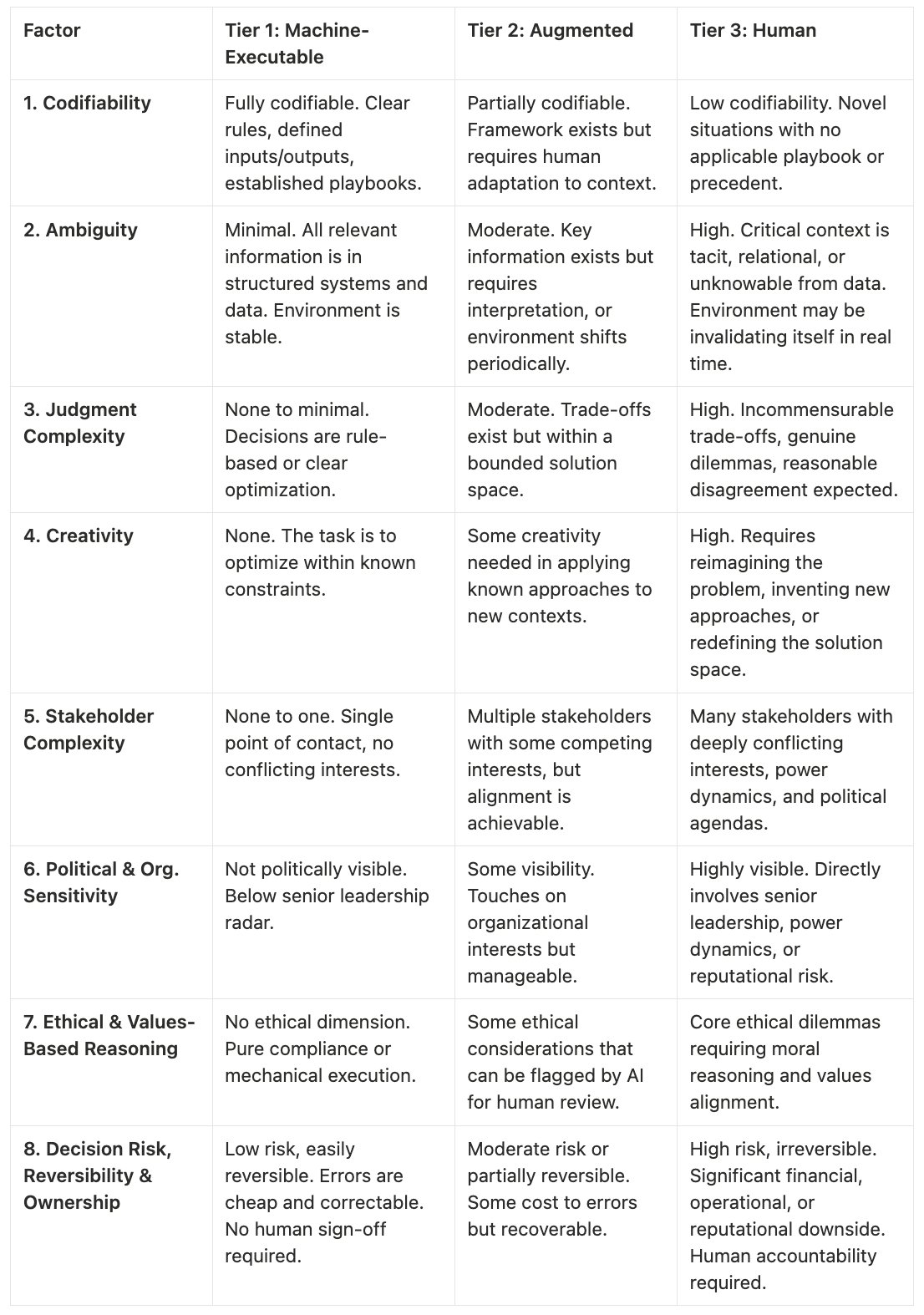
To apply The Human Edge Matrix to your own role, click the button below to access the interactive tool:
You’ll need to enter your name and email (you’ll be subscribed to my site) and then you can complete this assessment for your role at an overall level or by sub-task. Note that none of the information you input (other than your name and email) will be retained in any way. This is simply for your personal assessment.
(I’d love to get your feedback on the tool itself and whether you agree with its findings.)
What This Looks Like in Practice
The following examples show how specific procurement activities map against the framework. The tier assignment reflects the overall weight of evidence across all eight factors.
Tier 1 Examples: Machine-Executable
Catalogue-based PO creation and approval routing for pre-negotiated items
Invoice matching and exception flagging against contract terms
Supplier onboarding document collection and compliance verification
Automated spot-buy execution within pre-set parameters
Tier 2 Examples: Augmented
Spend analytics and category spend classification
Market intelligence synthesis for category strategy input
RFP development and supplier response evaluation (AI drafts, human refines and decides)
Contract redlining and risk identification (AI flags, human negotiates)
Negotiation preparation: BATNA, scenario modeling, and playbook generation
Supplier performance monitoring and scorecard generation with recommended actions
Tier 3 Examples: Human
Category strategy development for volatile or strategically critical categories
Cross-functional alignment on make-vs-buy, insource-vs-outsource decisions
High-stakes, complex negotiations (multi-year, multi-party, novel deal structures)
Strategic supplier relationship management and joint value creation
Ethical sourcing decisions involving values trade-offs and reputational risk
Caveat: It’s worth noting that some procurement work will stop being human-executed before it stops being human-owned. That is, leaders may decide that there may well be work that remains human-supervised (even if AI can do it) because the task shapes learning and judgement.
From Task Taxonomy to Role Redesign
The goal of this framework is to provide a deeper way to think about AI’s impact on current roles, both overall as well as at the task level. It serves multiple audiences:
CPOs and Procurement leaders: Use the matrix to audit your function’s activity portfolio. Identify which Tier 1 activities are still being done manually (automation opportunity), which Tier 2 activities lack AI tooling (augmentation opportunity), and which Tier 3 activities are being underinvested in because the team is trapped in lower-tier work.
Procurement practitioners: Use the Tier-Factor matrix to assess your own role’s exposure to AI. The goal is to deliberately build capabilities in those areas that keep humans essential - judgment, stakeholder navigation, creative strategy, ethical reasoning, etc.
For Procuretech leaders: Use the tier definitions to set realistic expectations for AI deployment. Tier 1 is ripe for full automation today. Tier 2 requires thoughtful human-machine workflow design. Tier 3 requires AI to serve as decision support, not decision maker.
One last point: What should emerge from this analysis is not just whether a role is at risk or to what extent - very few roles, if any, are going to survive intact in a Post-AI world.
What should emerge is a clearer indication of how to future-proof the practitioner for a post-AI world.
In addition, when you subtract tasks that will be automated - and even accounting for augmented tasks - what is left will almost certainly need to be rethought. The very nature of roles will need to be changed and, likely, rebundled across the function.
As such, Procurement roles will need to be redesigned around orchestration, exception management, business judgment, stakeholder alignment, supplier strategy, risk governance, and decision accountability, among other considerations. This will force us to move from a task taxonomy to a role redesign model. I’ll cover this topic more deeply in future posts.