


Last week, I laid out my model for future proofing the Procurement practitioner, in which I outlined its three key parts:
The Enabling Layer: AI literacy and cognitive discipline
The Differentiating Layer: Orchestration, business acumen and human leverage
The Orientation Lens: The lens through which the first two are pointed
I’ve already covered The Enabling Layer (the skills that get you in the game) in prior posts:
I wrote about how to build AI literacy in the corporate context in this article.
In terms of Cognitive Discipline, I wrote about the problem of cognitive debt here and how not to lose your cognitive agency when using AI here.
In the next three posts, I’ll dive into the three core skills that comprise the Differentiating Layer, starting with Orchestration today.
Orchestration ≠ Project Management
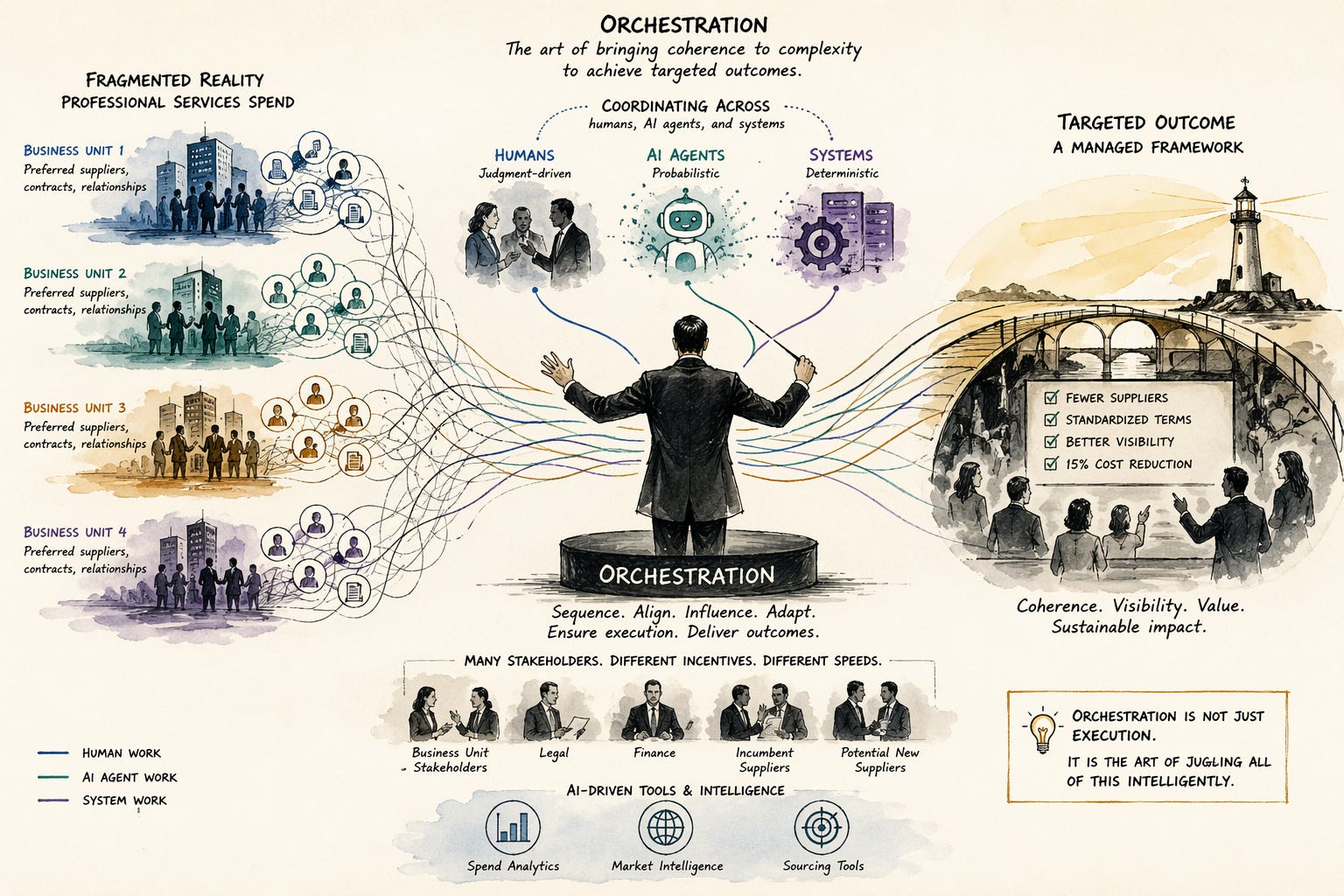
Orchestration is the first core skill within the differentiating layer because it is the skill that brings coherence across a fragmented set of capabilities, to achieve the outcomes we seek. It is the ability to organize, provide direction and ensure execution in terms of the work to be done.
Think of the film director. He or she doesn’t (necessarily) act, doesn’t operate the cameras or any of the other technical equipment, and doesn’t score the music. The director’s job is to know what each specialist can do, sequence their contributions, manage the execution, and ensure the final result delivers on its objectives.
Orchestration in the Procurement context, and applied at the practitioner level, is that same discipline, but applied to executing targeted outcomes.
You might think that this sounds like Project Management, but there’s a difference.
Orchestration in the AI era is fundamentally different because the nature of the resources being directed has changed. You’re now coordinating across humans, AI agents, and systems simultaneously. Whereas a traditional project manager sequences human work, an orchestrator sequences a mixed ensemble where some contributors are deterministic (systems), some are probabilistic (AI agents), and some are judgment-driven (humans).
To illustrate, let’s say you’re the category leader for Professional Services (PS) spend (consulting, legal, contingent staffing, IT advisory), which is fragmented across four business units, each with its own preferred suppliers, contracting practices, and stakeholder relationships. You’ve been tasked with consolidating this into a managed framework, one with fewer suppliers, standardized terms, better visibility and a 15% cost reduction target.
This initiative cannot be executed as a straightforward sourcing event. A single RFP won’t do the job and significant coordination is required across Business Unit stakeholders, legal, finance, incumbent suppliers, potential new suppliers, AI-driven tools (encompassing spend analytics, market intelligence as well as sourcing tools). All of these aspects will move at different speeds and each stakeholder will have different incentives.
Orchestration, in this context, becomes an essential skill; it is the art of juggling all of this intelligently, not simply “executing the project”.
Before You Can Orchestrate
To be an effective orchestrator, though, requires foundational knowledge that is rooted in the technical as well as the organizational. For the Procurement practitioner, this translates into the following:
Understand the organization:
This means not just understanding what your company does but more specifically the nature of the organization. How is authority and responsibility distributed? How and where do major decisions take place? What incents specific decisions to be made e.g. cost versus innovation versus speed? Where are the “organizational brakes” and blockers e.g. organizational friction, approval bottlenecks, risk aversion patterns?
This involves not simply understanding the formal organization and key players but also the informal power networks and decelerators within the organization.
In our example above, you might discover that two of the four BU heads have P&L authority over their own services spend and see consolidation as a loss of control. You might also find that the CFO supports your initiative but won’t override the BUs publicly. None of this is on the org chart but it’s a practical reality you need to grapple with.
Know Your Internal Customer:
This is the full understanding of the internal function or department you serve as a practitioner (i.e. your internal customer).
This encompasses not just the structural (how they are organized, who are the key players, etc.), but also their business dynamics (what drives value, how is work done and delivered, what is their economic model, what are the key metrics, etc.) and the political (where does the function stand in terms of corporate dynamics, who really makes the decisions, how do they do it, etc.)?
In our PS example, let’s say you find that the Engineering BU uses specialist technical consultants whose work directly affects product development timelines, whereas Corporate uses general management consultants with a range of different objectives. Combining these two would be a design error, so you need to understand each stakeholder’s differing requirements and incorporate these nuances, knowing where and what to standardize, how value will be impacted, etc.
Comprehend the Processes and Technologies:
This means developing a full understanding of the relevant processes and ‘paths to outcomes” as well as the related technologies in question.
This covers not only the formal means to get work done (in terms of the procurement process) but the informal as well (that is, the informal avenues through which the process can be accelerated, obstacles bypassed, etc.).
This also covers the technology landscape that impacts, alters and changes these procurement processes, including which AI tools, platforms, and data sources are available as well as what they can and can’t do.
Applying this to our PS example, you might understand that you have a formal procurement process that requires a business case, strategy sign-off, and competitive bids, but you also understand that key leaders will slow-walk the formal process if they feel railroaded. This could require an informal path (pre-reads, socialization, one on ones, etc.) to get each BU head to co-own the category strategy design so the formal approval becomes a formality. Separately, you will need to get smart about alternative AI tools that drive your spend analytics more quickly, leverage and organize external intelligence more deeply and then drive the sourcing process more flexibly and intuitively.
Understand yourself:
This is the art of developing a level of self-awareness so you know how to best orchestrate.
This means knowing your own strengths, biases, and blind spots. It means understanding where your time is most valuable and how and where to focus on the work yourself versus work with others to execute. The best directors know what they’re good at and what they need to trust their specialists on.
In our PS example, this means taking stock of your network of relationships, your personal biases and ideas about the “right” path forward, and then understanding the pitfalls and traps you yourself need to watch out for as you orchestrate - as well as who you might need to call in to help as you navigate. Perhaps you have strong relationships with two of your BU heads but a terrible one with the biggest BU head, who just happens to be the biggest driver of spend in this category. You may need to leverage key influencers to help with organizing your messaging and socialization with this individual, so that you can smooth out the path to outcomes.
These prerequisites form the foundational basis with which you can effectively orchestrate. They provide the map. How you navigate this terrain, though, is where a specific set of abilities come in.
We’ll focus on that next.
The Orchestrator’s Toolkit
The core abilities of the Orchestrator encompass:
Systems Thinking
Task Decomposition
Resource Matching
Sequencing and Handoff
Quality Verification
Exception Handling
Let’s dive into each specific ability.
Systems Thinking
This is the ability to understand the problem end-to-end and then the path to the solution. It encompasses the ability to:
Map interdependencies (understanding how changing one variable affects others)
Identify feedback loops (where outputs become inputs)
Distinguish root causes from symptoms, and
Hold multiple time horizons simultaneously (what needs to happen now vs. what this sets up for later).
In the procurement context, this means seeing a sourcing event not as an isolated transaction but as a node within the broader architecture of supplier relationships, business unit strategies, risk exposure, and market dynamics.
Applying this to our PS example, this involves mapping the full picture: spend data from multiple ERPs, stakeholder dynamics across BUs, supplier interdependencies, contract expiry timelines, and the CFO’s budget cycle. You would organize the data and analysis in line with stakeholder communications and buy in requirements, including even sequencing the entire initiative to ensure specific ‘easier’ BUs go first, allowing you to build momentum and political cover for the more difficult ones later.
Task Decomposition
This is the ability to break down the end goal and requisite outcomes sought into its sub-tasks and activities, which calls for:
Defining the end-state clearly (decomposition without a clear target just creates busy work)
Understanding granularity (how small is small enough? Too coarse and you can’t allocate effectively; too fine and you create coordination overhead)
Identifying dependencies between sub-tasks (what’s sequential vs. parallel), and
Determining which tasks require integrated judgment and can’t be parceled out - especially critically in the AI context.
Back in our PS world, this would mean breaking the initiative into workstreams: spend baselining and cleansing (AI-heavy), market analysis (AI-assisted with human synthesis), stakeholder alignment (entirely human), supplier evaluation design, negotiation, and transition planning. Each will have different timelines, owners, and dependencies.
Resource Matching
This is the ability to determine which tool/human/agent is best for which sub-task. Key considerations here include:
Matching based on capability (what can each resource actually do well?)
Cost-effectiveness (what’s the most efficient allocation?), and
Risk tolerance (where do errors matter most, and does that argue for human oversight?)
The added dimension here is the human/AI/system triaging i.e. understanding what AI can do reliably, what it can do with human oversight, and what still requires entirely human execution. (This is, of course, an evolving assessment as the technology continues to improve.)
Looking at the PS initiative, this could parse out as spend cleansing done by the AI analytics platform with a junior analyst validating the output, and market intelligence developed in conjunction with AI but interpreted by you as the senior category leader. Stakeholder conversations would be done by you alone as the leader.
Sequencing and Handoff
This involves ensuring each aspect of the process is seamlessly executed as needed and by the right individuals/agents. The prime considerations here include:
Defining clear input/output specifications at each stage
Managing the interfaces between contributors (handoffs where quality could degrade)
Building in checkpoints rather than only verifying at the end, and
Managing the tempo i.e. which sequences need speed, which need deliberation.
(It’s worth noting that the handoffs between AI and human work are particularly error-prone because the human may over-trust the AI output and not apply adequate scrutiny. This is worth keeping a conscious eye on - especially the idea of retaining cognitive agency of the work being done.)
In the PS context, this would mean the spend baseline must be completed and external intelligence sorted before you can have credible conversations with BU heads. It also means translating the data outputs into a narrative that speaks to each BU head’s specific concerns (versus just presenting the spend cube with key overall, corporate level insights).
Quality Verification
This means ensuring the work is done to the requisite standards and the key elements here include:
Defining “done” before work begins (what are the metrics/acceptance criteria)
Understanding where to sample versus conduct a comprehensive review (you can’t check everything so knowing where to look and which aspects to trust is a skill in itself - especially true for complex projects)
Distinguishing between quality of output and quality of process (a good result from a bad process isn’t repeatable) and
Calibrating standards to context (i.e. not everything needs to be perfect; knowing where “good enough” applies is, itself, a judgment call)
In the PS example, you might find that the AI spend classification has a known error issues when it comes to miscategorized tail spend, so you might build in a human audit of the top 20% of spend by value and a random sample of the tail to ensure quality.
Exception Handling
This involves stepping in to manage issues as and when they arise (and, to be clear, not just stepping in to do the work yourself when problems arise). The key aspects to look out for here include:
Understanding early warning signals (delays, misaligned outputs, stakeholder discomfort)
Distinguishing between exceptions that need intervention and normal variance that can self-correct
Having pre-defined escalation thresholds rather than reacting ‘in the moment’, and
Knowing when to intervene personally versus when to redirect the work to a different resource
In the PS initiative, you might find that the Engineering BU head escalates matters to the CEO, and argues that consolidation will compromise a critical product launch. You might then choose to work with key internal influencers to carve out specific launch-critical engagements from the consolidation scope for six months, preserving the overall initiative while defusing the objection.
These six abilities form the orchestrator’s toolkit - and many of its component aspects are similar to that of the Project Manager’s. But there are nuances here - and that relates to the integration of technology, agents and the discipline and care with which we integrate and deploy them across our work. These nuances are worth paying specific attention to.
That said, having the toolkit isn’t enough. We need to remain vigilant to a trap that even skilled orchestrators fall into.
Where Orchestrators Go Wrong
Great orchestration is as much an art as it is a science.
It requires marshalling your available resources to achieve your desired outcomes in a manner that is most efficient and ‘least friction’. But in trying to achieve this, we must also remain diligent to not fall into an age old trap: orchestration can become micromanagement if you don’t trust your resources, or it can become abdication if you over-delegate without verification.
In our PS scenario, this could show up as the moment when the Engineering BU pushback happens and you’re tempted to personally take over the supplier negotiations to keep timelines on track. Or it could be when, for example, you delegate the spend analytics entirely to the AI tool and a junior analyst without defining validation criteria, only to discover (two months later) that the baseline data is unreliable.
The great orchestrator lives in the productive middle, walking that fine line between abdication and micro-management. This puts even more emphasis on the prerequisites discussed above - the deeper your understanding of the terrain, the more effective you will be as an orchestrator.
Why This Matters
Orchestration is the key skill of the Differentiating Layer for a reason.
In the PS example we’ve discussed so far, the practitioner who orchestrates Professional Services consolidation per the CEO’s directive, didn’t just save 15%. They demonstrated something no AI could replicate - the ability to read an organization, sequence a complex initiative across human and machine contributors, and navigate political terrain that would have stalled a less capable practitioner.
This is the type of skill that gets noticed by leadership because it makes you irreplaceable, even as AI handles more execution. The practitioner who can orchestrate effectively across a mixed human-AI ensemble is the one who remains relevant.
So, great orchestration keeps you in the room. Business acumen, though, is what gives you a voice in it.
We’ll tackle that next week.