


Two weeks ago, I laid out my model for future-proofing the Procurement practitioner, in which I outlined its three key parts:
The Enabling Layer: AI literacy and cognitive discipline
The Differentiating Layer: Orchestration, business acumen and human leverage
The Orientation Lens: The lens through which the first two are pointed
Having covered The Enabling Layer in prior posts (here and here), last week I dove into the first key skill of the Differentiating Layer (Orchestration) in detail.
This week, I’ll discuss the second key skill: Business Acumen.
Business Acumen, Defined
Business acumen is the fundamental understanding of the entire environment that the company operates within, from macro (its market and customers) to micro (the company, stakeholders and suppliers). It is about more than simply understanding the nuts and bolts of each element; it’s about building on this understanding to be able to connect the various pieces together so that you’re able to understand the business in context.
To use the chess analogy, it’s being able to think in terms of positions on the board, not just the pieces on it. A novice thinks about each piece individually but an experienced player understands how the pieces relate, where pressure is building, and why each move is being executed.
In this way, business acumen is about more than functional competence, which, on its own, will not protect Procurement talent in the future. The new floor is enterprise-level understanding of the business and how it creates value - a floor that too many (current) Procurement careers fail to clear.
Business acumen matters more in a post-AI world for two reasons:
First, AI eats the codifiable, so what’s left for the human is judgement that requires understanding and context. Business acumen is the development of that context.
Second, AI gives every Procurement professional access to analysis they never had before. We’re no longer focused on “getting the right data” but on “asking the right questions” and “drawing the right conclusions”. This is acumen-dependent.
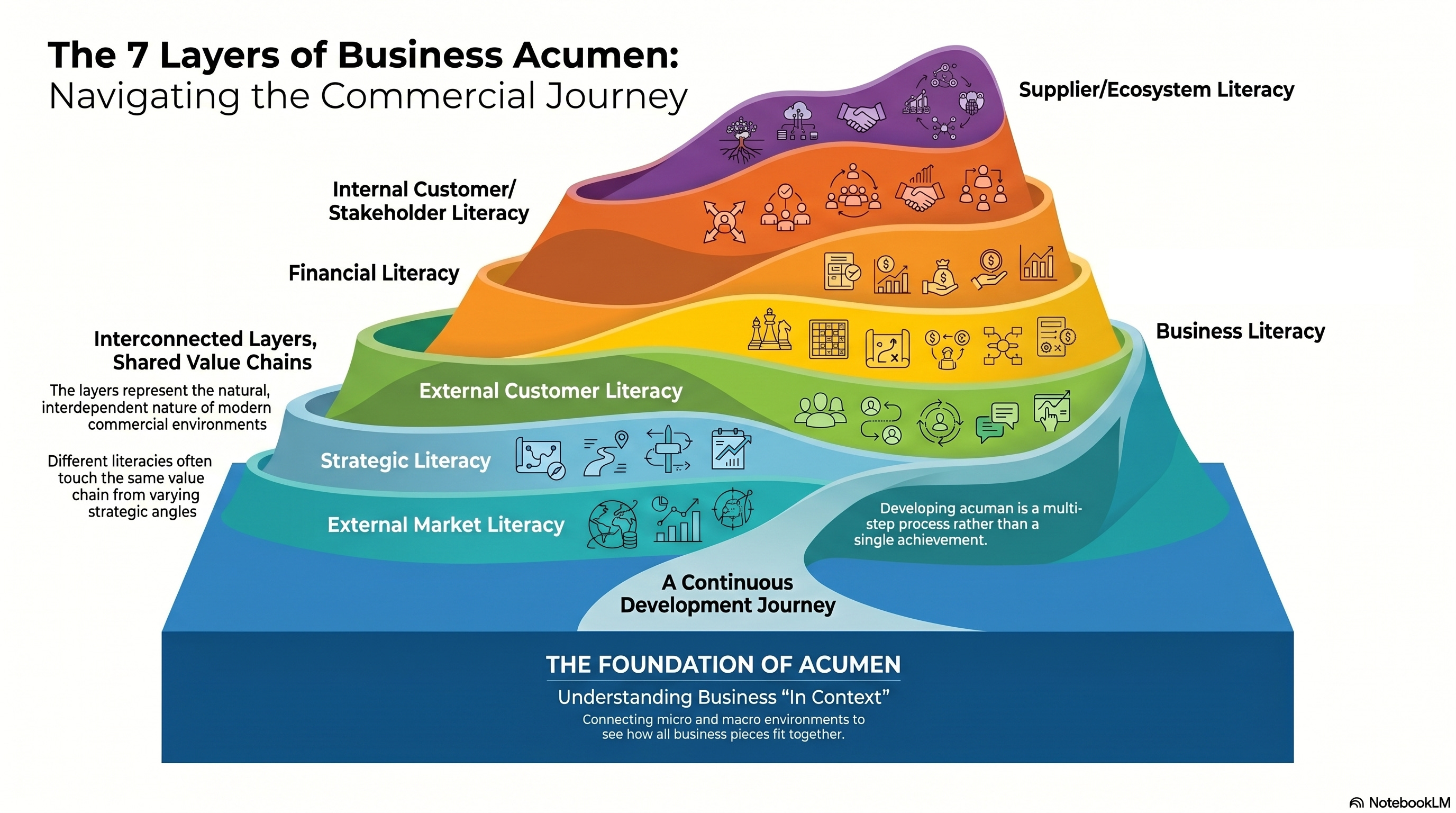
Where Acumen Begins: The Seven Literacies
Developing Business Acumen is not a simple one step process. There is no single path you can take to develop it to the level needed for a post-AI world.
Rather, it’s a journey, one that begins with literacy, specifically, seven layers of literacy:
External Market
Strategic
External Customer
Business
Financial
Internal Customer and Stakeholder
Supplier and Ecosystem
Before we dive into each one, it’s worth pointing out that these layers are not discrete. While they are each broadly distinct, there is a natural overlap, much like the natural interconnected, interdependent nature of markets and businesses in general.
For example, where does business literacy end and financial literacy begin? The corporation’s economics sit inside both. Similarly, External Market, Business and Supplier/Ecosystem literacy all touch the value chain, but from different angles.
So, as you think about each of the layers, understand that the overlap you see is natural and to be expected; it is representative of the interconnectedness of all commercial environments.
With that clarified, let’s dive into each layer in turn.
1. External Market Literacy
This is the most ‘macro’ layer and represents the system within which everything else operates. It involves understanding the industry your company competes in - its structure, dynamics, economics, and the forces shaping its future.
External Market literacy provides the context for every other literacy layer we’ll discuss.
What’s included:
Industry structure: concentration, fragmentation, key players, market shares
Industry economics: profit pools, capital intensity, scale dynamics, margin patterns
Competitive forces: rivalry, entry barriers, substitutes, buyer/supplier power
Growth dynamics and where value is migrating within the industry
Regulatory environment and direction of government influence
Technology disruption vectors and likely timing
Geopolitical exposure and macro/cycle sensitivity
Industry-specific norms (standards, distribution models, contracting conventions)
What this means for procurement. Procurement decisions don’t happen on a blank canvas - they happen inside an industry with its own particular dynamics. Knowing your industry means you can better understand why your CEO worries about what they worry about, anticipate where competitors will move next, and recognise which categories in your sector carry strategic weight in this industry versus those that are more generic. (A category that’s a back-office cost in one industry can be a competitive battleground in another.)
How to cultivate:
Build your own one-page “state of the industry” view and refresh it every six months.
Attend at least one industry (not procurement) conference each year.
Subscribe to one credible industry analyst (subsector-specific).
Read your top three competitors’ annual reports and earnings transcripts each quarter.
Most importantly, learn to read your industry through your CEO’s eyes, not your function’s i.e. how leadership thinks about industry evolution and how that influences your company’s go-to-market.
2. Strategic Literacy
This is the next key layer - understanding why your company has chosen to compete the way it has. This layer focuses on the deliberate choices your leadership has made about where to play, how to win, and what to bet on. External market literacy is the playing field, while strategic literacy tells you the game your company has chosen to play on it.
What’s included:
The “where to play” choices: which segments, geographies, channels, customer types
The “how to win” choices: cost leadership, differentiation, scale, ecosystem, etc.
Strategic priorities and the time horizon attached to each, including:
The bets the leadership team is placing
The strategic risks the company is consciously accepting
Capital allocation logic: organic growth vs M&A vs returns to shareholders
Innovation and R&D strategy
ESG, sustainability, and reputational positioning as strategic choices
What this means for procurement. Procurement that doesn’t understand strategy ends up optimizing against it - for example, achieving cost savings that erode a differentiation play, or supplier consolidation that undermines an innovation bet. Strategic literacy ensures that Procurement weights decisions correctly, knowing when to push hardest on cost, when to prioritise speed, when to protect optionality, when to pay for capability. Strategic literacy ensures that Procurement recognises when its own function-level strategy diverges from enterprise strategy and needs to be redrawn.
How to cultivate:
Read every investor day deck and CEO letter from your company over the last five years.
Find someone in the strategy team and engage with them periodically to better understand strategic and competitive choices.
Build a mental model of why the company chose its current path versus its other credible alternatives.
Pressure-test your own category strategies against enterprise strategy explicitly; if you can’t draw a clear line of sight (e.g. how it directly impacts your company’s core USP), there isn’t one.
3. External Customer Literacy
This involves understanding the company’s actual end customers - who they are, what they value, how they buy, what they’re trying to do. Most procurement people are two or three steps removed from the end customer so the progressive practioner knows that closing that distance (in any way possible) is what ensures Procurement truly supports the business and remains relevant.
What’s included:
Customer segments and their respective economics
What outcomes customers are trying to actually achieve
Buying behaviors, decision criteria, and switching costs
Channel and journey dynamics: how customers actually find, buy, and use
Brand perception, loyalty drivers, and emotional triggers
Customer lifetime value dynamics and what drives them
Emerging customer expectations
What this means for procurement. A material share of procurement spend touches the customer experience directly - packaging, retail design, marketing, digital platforms, product components, last-mile logistics, etc. Procurement that doesn’t understand the end customer in-depth will optimise for the wrong variables e.g. cheaper packaging that impacts brand equity, the consolidated supplier base that slows time-to-market, the standard component that erases the feature customers actually pay for.
How to cultivate:
Sit in on customer research sessions.
Read customer feedback reports and NPS verbatims rather than overall dashboard metrics.
Do ride-alongs with sales or store visits with retail periodically.
Talk to the people who answer customer service calls.
For B2B businesses, attend customer events and ask/listen to their feedback.
Treat any report that reveals what customers actually think as required reading.
4. Business Literacy
This involves understanding how the business itself creates value, captures it, and actually delivers it. This has two faces: the economic (how the business model works) and the operational (how the work gets done). Both are required; most procurement people have a partial view of one and little of the other.
What’s included:
Economic dimension:
The value chain: where value is created and where it leaks
The business model: how value is captured (pricing power, lock-in, defensibility)
The handful of variables that actually drive enterprise value
Revenue model and growth model
Cost structure: fixed/variable, direct/indirect, scale dynamics
Unit economics and what makes them work or break
Operational dimension:
The production/service delivery model
Supply chain architecture and footprint logic
Operating model: organizational design, decision rights, governance
Make-vs-buy choices at the enterprise level
Quality, safety, and compliance considerations
The operational KPIs the business actually runs by
What this means for procurement. Procurement is the literal interface between the external supply base and the company’s value chain (both structurally and operationally), so navigating that interface effectively is essential. Procurement that knows the economics but not the operations writes contracts that look good on paper but break in execution e.g. choosing suppliers that fit the company’s cost model but not the extent and depth of supply chain footprint required. Procurement that knows the operations but not the economics optimizes throughput while missing margin e.g. choosing suppliers that meet the current delivery model but lack the ability to adapt to alternative/emerging business and revenue models.
How to cultivate:
Learn to ‘walk the process’ before you try to source the inputs to it.
Map your company’s value chain end-to-end on one page and stress-test it with operators.
Build relationships with the heads of operations and supply chain.
Conduct plant tours, distribution center visits, store walks to better understand the operational nuts and bolts.
Read operational reviews whenever possible.
5. Financial Literacy
This involves gaining fluency in the numerical language the enterprise actually runs on - not just reading financial statements, but understanding the financial logic by which decisions are evaluated, capital is allocated, and performance is judged. This is the language of the C-suite and the board; procurement that can’t speak it gets translated for rather than spoken with.
What’s included:
P&L mechanics and what moves which line
Balance sheet basics, especially working capital and asset intensity
Cash flow: operating, investing, financing, and free cash flow
Strategic financial metrics: ROIC, EVA, EPS, EBITDA, FCF - and which ones your CFO actually cares about
Capital structure and the cost of capital
Capital allocation logic and capex vs opex treatment
The cash conversion cycle and Procurement’s instruments within it (payment terms, inventory, supplier financing)
Forecast, budget, and variance discipline
Accounting treatments that affect procurement decisions (lease accounting, hedging, revenue recognition)
Reading supplier risk and financials to assess viability and leverage
What this means for procurement. Procurement that only speaks “savings” is seen as a cost function. Procurement that translates its work into ROIC, free cash flow, working capital, and earnings impact gets seen as a value function. Financial literacy is also what lets procurement read a supplier’s accounts and form an independent view of risk, rather than relying only on third-party scores. It’s the difference between negotiating from inside the CFO’s worldview and negotiating from outside it.
How to cultivate:
Take a serious finance-for-non-finance-leaders course - the versions with real modelling, not the executive-summary version.
Partner with your FP&A counterpart on a category review and let them push back on your framing.
Reframe every initiative tracker you maintain in Finance language before Procurement’s language.
Read your top suppliers’ financials quarterly and form a view before any rating agency does.
6. Internal Customer and Stakeholder Literacy
This layer focuses on understanding the people you actually work with and serve inside the firm - what they’re trying to achieve, what they’re measured on, what threatens them, and how they make decisions. Every stakeholder is a decision-maker with its own agenda, constraints, and politics. Knowing them as individuals and as a system is the key literacy outcome here.
What’s included:
Their priorities, time horizons, and risk tolerance
Their language and conceptual frames
What each key stakeholder is:
Formally measured and compensated on
Informally judged on (the unwritten scorecard)
Decision rights, governance, and how decisions actually get made (formal versus informal)
The political realities they navigate: their standing, who they need to keep happy
Influence networks: who shapes whom, who’s rising, who’s exposed
Relationship history and accumulated trust or grievance with Procurement
What this means for procurement. Procurement that understands each key stakeholder as a co-decision-maker - with the intent of making each one successful in their terms while delivering enterprise value and pushing back when those diverge - becomes strategic. The skill is in having empathy for their individual realities while maintaning focus on enterprise priorities.
How to cultivate:
Conduct ‘listening tours’ with no agenda.
Shadow your internal customers for a full day or week, not just a meeting.
Ask each major stakeholder what they’re measured on.
Read what they read - their trade press, their conference outputs, their internal comms
Learn to speak their language, so you don’t need translation.
Map influence, not just reporting lines.
Build your relationships before you need them.
7. Supplier and Ecosystem Literacy
Last but absolutely not least is this final layer, which involves understanding the external supply base and the wider ecosystem that it sits inside - including supplier economics, market structures, power flows, technology trajectories, capital movements, and regulatory tides. This is, of course, Procurement’s home patch, but the true literacy bar is higher than most teams operate at: the shift is from “who supplies us and at what price” to “what is actually happening in this ecosystem, and what it means for the enterprise.”
What’s included:
Market structures: concentration, capacity, switching costs, substitution risk
Capital flows in the supply base: PE roll-ups, IPOs, M&A, distressed positions
Power dynamics: where leverage actually sits in each supply market
Technology disruption vectors in the supply base
Geographic and political concentration and the fragility it creates
Regulatory direction in your supply markets (trade, ESG, data, labour)
Adjacent ecosystems, substitutes, and emerging entrants
Supplier economics: how each supplier makes money, where their margins come from, where they’re squeezed
Supplier financial health and viability beyond surface ratings
N-tier visibility: your suppliers’ suppliers, and their exposure
Customer-of-choice positioning: how the market actually sees you
What this means for procurement. This is Procurement in its element - no other function has continuous, structured, daily contact with this slice of the external world. Many Procurement teams treat that contact transactionally and waste the intelligence that comes from it. Procurement that views its supply base as its value engine - and feeds its captured insights back into the enterprise (as foresight on technology, geopolitics, regulation, and capital) - becomes indispensable in a way no other function can replicate.
How to cultivate:
Insist on supplier strategy days where suppliers present their world to you, not pitch just their products.
Read your top suppliers’ financials and earnings calls quarterly.
Attend supply-side conferences, not just Procurement conferences i.e. your suppliers’ industry events.
Subscribe to analyst coverage of your major supply markets.
Build a quarterly external intelligence note for your executives even if no one’s asked for it - the simple act of producing it forces this literacy.
Literacy Is Not Enough
The seven layers above provide the foundation for developing business acumen - but that’s all they are: the foundation.
The fact is that you could spend a career on these seven and still not have business acumen. Because achieving literacy means exactly what it sounds like: it means you can read. That is, you understand the nuts and bolts, the vocabulary and the mechanics. You’re not going to be lost when it comes to understanding the language.
But it doesn’t mean you can reason: that’s acumen.
Acumen means you can think critically, spot what matters versus what doesn’t, see second-order effects, recognise patterns across situations, etc.
Literacy is something you can acquire by study, but acumen requires reps: exposure to enough situations that pattern recognition kicks in.
Once you’ve developed acumen, you can then exercise judgement - meaning you can make thoughtful decisions. You can apply your understanding under uncertainty, with stakes, and own the outcome. Judgment requires experience and skin in the game. You have to have gone through cycles, been wrong, owned it, and recalibrated.
This is particularly critical in a post-AI world because AI compresses the time to literacy dramatically, modestly compresses time to acumen, but barely touches judgment, because judgment requires accountability, which is very human.
But what does that mean in practice? Let’s take a look at an applied example - in the literacy layer that is the most relevant to Procurement (as well as the one it can most directly impact).
In Practice: When PE Buys Your Supplier
One of your top-five suppliers in a strategic category e.g. a specialist contract manufacturer gets acquired by a private equity firm. The announcement is brief with a reassuring message that the existing leadership “remains in place”. As the category leader, you need to decide what this means for your company.
Literacy. A literate procurement professional understands what just happened. PE ownership typically means a multi-year value-creation thesis built around margin expansion, cost optimization, and an eventual exit at a higher multiple. The new owners will likely take on debt to fund the acquisition, layer on financial discipline, hunt for cost takeout, and prepare the asset for sale or IPO in four to seven years. The literate professional recognises the standard PE playbook, digs into the post-acquisition debt structure in any available filings, and articulates what’s likely to happen (in broad terms) with the supplier over the medium term.
That’s the nuts-and-bolts read - what usually happens.
Acumen. Acumen is what lets you see the variation beyond the average. Not all PE plays are the same so you note that this particular PE firm has a track record of operational improvement rather than financial engineering. The leadership “remaining in place” comes with an earn-out structure that will change their incentives sharply over the next 24 months. The supplier’s customer concentration means margin expansion will land disproportionately on a small set of customers - and you’re one of them. In addition, the supplier’s last product roadmap requires capex the new owners are less likely to fund. You recognize from three previous PE acquisitions you’ve watched in adjacent markets that the first 18 months are typically stable, but the next 18 will likely see service degradation, while year four is when the asset gets dressed up for sale and customer relationships get monetized hard.
The value of acumen is in helping you understand that this isn’t a generic PE situation, it’s a this-specific-PE-firm-acquiring-this-specific-supplier-in-this-specific-market situation.
Judgment. Then comes the actual implications for you: how do you decide to react? Do you lock in current pricing on a multi-year deal before the new owners reset? Do you accelerate dual-sourcing now while the supplier still has bandwidth to support a clean transition? Do you exit entirely and absorb the switching cost? Do you lean in - sign a deeper relationship to position yourself as a customer-of-choice through the value-creation period? Each option has costs, risks, and second-order effects on the rest of your supply base. You have incomplete information but you make a call, defending it to your CFO and your operating peers, and owning what happens over the next four years.
Judgment is all of those things that AI can’t do, because it can’t take accountability for the call. The accountability is what makes the decision a decision rather than an analysis.
The Floor Has Moved
For most of procurement’s history, the function was paid for literacy: knowing the supply market, reading and managing the contract, understanding the spend. That knowledge was scarce, and scarcity created value. Most procurement careers were built on that foundational literacy.
But that era is ending: AI now delivers literacy in minutes at the push of a button so, unfortunately, most procurement careers will stall as that type of literacy commoditizes. That’s a tough thing to hear.
The new floor is enterprise-level business acumen, in the form of the seven layers above, escalating through practiced reps into judgement that can be trusted by the enterprise. And while that bar is higher than where most Procurement professionals operate today, it is very much reachable, deliberately, over time, by anyone willing to do the work.
But, of course, business acumen alone isn’t enough.
The next skill in the Differentiating Layer - human leverage - is about how procurement actually moves its organization through people and people-centric capabilities.
That’s where we’ll go next.