


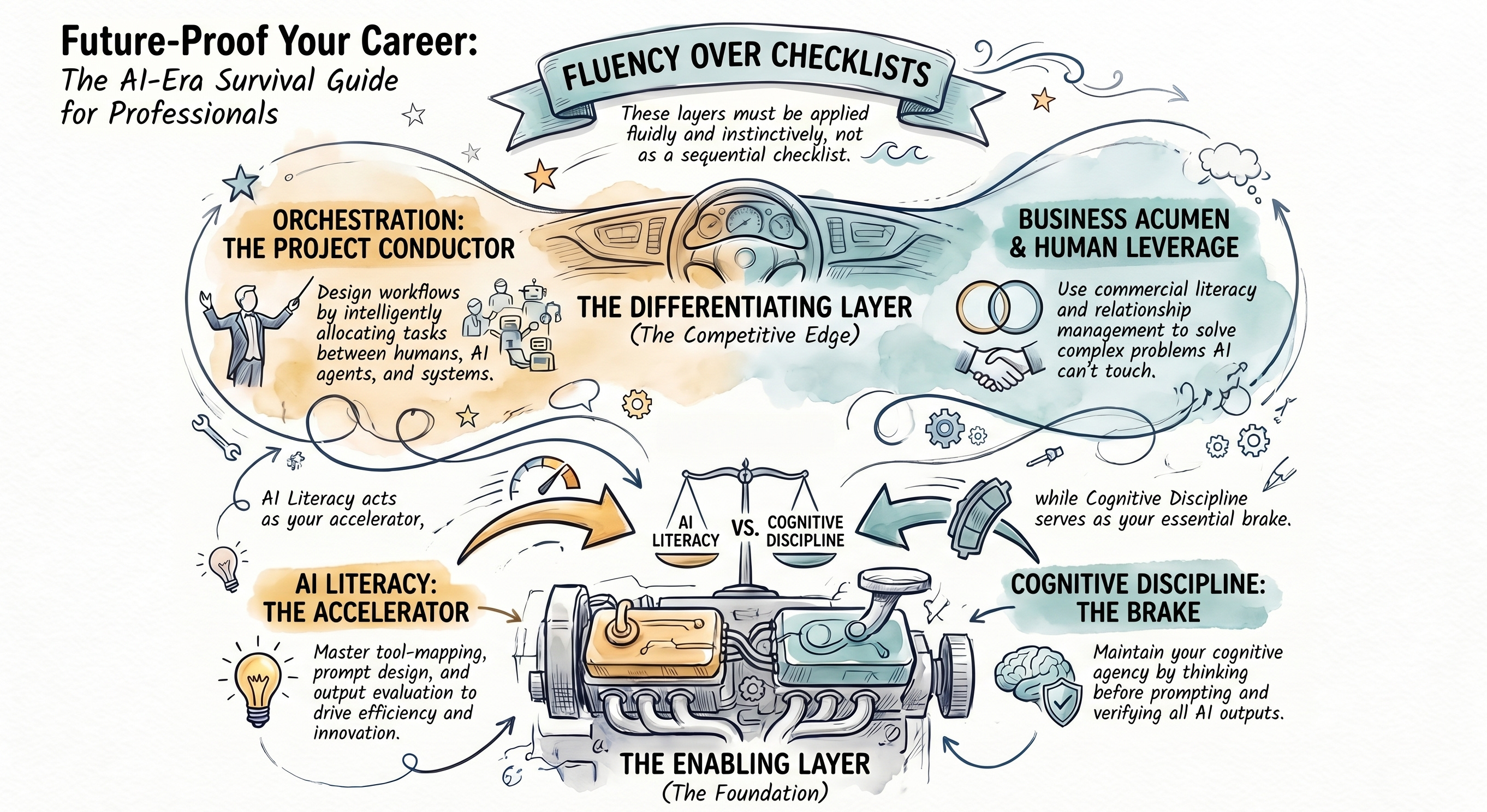
Waiting for your organization to future-proof you is, in a post-AI world, a career-defining mistake. Future-proofing the Procurement practitioner is an initiative that is on the individual, not the organization.
Most organizations will, of course, support your efforts in one form or another, but the pace of change, the sheer number of tools available and the nascent stage we’re at on the AI journey means change is happening faster than anyone can fully fathom - and certainly faster than many large, traditional, bureaucratic organizations (not to mention IT teams) can cope with. (And that’s for those organizations willing to do so - many are still grappling with the fear that AI will upend everything.)
So how, then, does an individual go about ‘future proofing’ themselves?
The first step is, of course, self-diagnosis: that is, how much of your role is at risk due to AI? In this post, I identified the eight factors that define whether a role or set of tasks will be automated, augmented or remain human. That’s the right starting point to understand where you personally are today. (Use the interactive tool linked within the article to conduct this assessment for your own role.)
The next step is to understand how to begin the future proofing journey, and there are three parts to this discussion:
The Enabling Layer
The Differentiating Layer
The Orientation Lens
I’ll cover parts 1 and 2 in this post. Part 3 is the lens through which the first two are pointed, and I’ll cover that in a future post.
Before we proceed, please note that I am making an important, underlying assumption: I am presuming that you have already developed the Procurement knowledge (core sourcing skills, category expertise, etc.) that forms the technical basis of your work. These skills are important but they’re foundational. They’re simply table stakes, not differentiators. As such, I will not be covering any of this in this post.
With that out of the way, let’s dive in.
A. The Enabling Layer
This is the first layer of capability and it’s comprised of two important skills - AI Literacy and Cognitive Discipline.
These are related ideas in that the former pushes you forward and capture the value that AI tools can provide, while the other ensures you don’t go too fast and lose your ability to think, comprehend and retain. In this way, AI literacy is the accelerator and Cognitive Discipline is the brake. You want to be able to deploy them both.
1. AI Literacy: The Accelerator
This is the foundational work of becoming AI-literate, that is, understanding the available tools and their impact. There are a wide range of tools already covering a wide range of applications, and it’s important to get smart, not about everything, but about what’s available and its potential.
The core skills to be developed here are:
Tool-mapping - look to understand the landscape. You don’t need to know every tool (and that isn’t even going to be possible)
Prompt design - learn to ask the right questions in order to be able to get quality output reliably and quickly
Output evaluation - learn to tell good output from plausible-looking garbage, which means not taking AI output for granted
Build vs. buy literacy - understand (practically) that, for many simple applications, you don’t need to buy, you can also build quick and efficient solutions yourself
Integration fluency - understand how different tools work together and/or connect into workflows.
A currency system - learn and embed the discipline to stay current and learn about new developments without drowning
It’s important to NOT limit your learning to work tools, but also bake AI into your daily personal use. Apply these tools to different personal use cases (trip planning, schedule development, vacation research, etc.) - which can provide for a safe space to learn about AI’s value and impact.
(I wrote about how to build AI literacy in the corporate context in this article.)
2. Cognitive Discipline: The Brake
A driver who follows the GPS without ever learning the city is going to have a problem navigating when the signal drops or the algorithm hiccups. Cognitive discipline is what keeps you from becoming that driver.
I wrote at length about the problem of cognitive debt (here) as well as the importance of not losing our cognitive agency when using AI (here).
Building Cognitive Discipline requires:
Thinking before prompting - always form your own view before asking AI to do anything; never start with AI
Challenge the output - never accept first drafts uncritically; consider each argument, click through to the sources and do your own reading as well; verify before you trust
Practice hard mode - deliberately do aspects of work without AI to maintain the muscle
Separate divergent from convergent thinking - use AI for the first point (to push you to think differently, identify gaps, etc.) but be careful with the latter (especially as AI has a tendency to always tell you your ideas are great!)
Practice metacognition - be cognizant of any tendency to offload your thinking; offloading execution is perfectly fine and safe to do
B. The Differentiating Layer
The Enabling Layer gets you in the game, but the Differentiating layer is what truly future proofs you. It comprises of three core skills:
1. Orchestration:
I talked about this idea at the organization level in my post last week on the six moats of the Procurement organization of the future. This is its application at the individual level.
Orchestration - in the context in which I am using it - is the core skill of any good Project or Engagement Manager. Think of it as the ability to design the work, allocate it intelligently across humans, agents, and systems, sequencing it correctly, and stepping in when it matters. This requires understanding the organization, the function(s), tools, people and processes and then tailoring the requisite work to drive towards desired outcomes.
The core abilities here include:
Systems thinking - understanding the problem end-to-end and then the path to the solution
Task decomposition - breaking the requisite outcomes sought into its sub-tasks and activities
Resource matching - determining which tool/human/agent is best for which sub-task
Sequencing and handoff - ensuring each aspect of the process is seamlessly executed as needed and by whom
Quality verification - ensuring the work is done to the requisite standards
Exception handling - stepping in to manage issues as and when they arise
2. Business Acumen:
This is the ability to think beyond your role and function to solve problems for the business. At its essence, it’s understanding your (internal) customer and their outcomes and goals sought to mediate towards the right and optimal solution.
There are host of subskills here, including:
Business & Financial literacy: including the corporation’s value chain and economics, how procurement’s and the category’s economics play into the P&L and create shareholder value, etc.
Commercial acumen - understanding deal structures, pricing models, contract economics, incentive design, etc.
Stakeholder/internal customer literacy - understanding what your internal customers actually optimize for, how their incentives work, what success looks like in their terms
Market and ecosystem literacy - understanding supply markets, supplier economics, where power sits in the value chain
3. Human Leverage:
This is the third and final core skill and is focused on developing the requisite human skills to drive towards valuable outcomes.
This builds on the concepts discussed above to encompass:
Relationship & Stakeholder Management - developing one-on-one relationships with different stakeholders and departments, managing competing interests, etc.
Influence and persuasion - moving people in a specific moment and situation, that is, being able to convince individuals to move towards specific outcomes in a way that aligns with the overall goal
Narrative development & communications - hearing what stakeholders actually mean versus what they say, crafting a narrative or story to shape the requisite outcomes and managing communications and understanding to achieve these goals
Creative problem-solving - ideating and developing unique solutions that solve problems and achieve key outcomes in the midst of resource constraints and competing agendas
Why Judgement Isn’t On The List
You’ll notice that I didn’t reference Judgment anywhere on the capabilities and skills above. This omission is entirely intentional.
That’s not because I don’t think judgment is an essential human skill. If you’ve read anything that speaks to Humans and AI, you’ve heard the argument that judgement is the differentiator, the one skill that will always remain human. I fully agree with that.
For me, though, judgement is a different kind of capability. It’s a meta-capability that sits above all of the other skills I’ve discussed - it’s the result of strong business acumen and human leverage skills.
As such, it’s important enough to merit its own post, and I’ll write about it soon.
Fluency - Not Sequence
The Enabling and Differentiating Layers discussed above need to be learned and absorbed such that we are intuitive and fluent in how we deploy them. They are not to be sequentially applied but in tandem, and fluidly, across a given situation.
For example, let’s say you’re leading a sourcing event under time pressure:
AI literacy ensures you ask the right questions and seek the right intelligence (internal and external) to dissect the issue at hand. Cognitive discipline allows you to question the AI-generated market analysis, which you can then tailor based on your own thinking and understanding of your stakeholders, your relationships and the corporate environment
Orchestration ensures you then take that strategy and sequence it appropriately: translating the insights gained into key tasks, incorporating stakeholder conversations and inputs, developing, for example, an RFP with agentic support, analyzing RFP submissions with the help of agents, and even questioning an AI-generated selection shortlist that looks suspicious, allowing you to then personally review and refine the analysis
You then weigh your options with all of the intelligence and agendas understood to date, conduct the (human) negotiations (possibly with AI support) and then finalize the go-forward recommendation, which is then communicated effectively to all concerned stakeholders across the enterprise (as well as outside of it).
My point is, the capabilities discussed are not individual items on a checklist that need to be run through, but instead should be understood and absorbed such that you develop fluency. In situations that matter, you won’t have time to consult checklists; you’ll either have what’s instinctive, or you won’t.
Your Operating Stance
I’ll get into the Differentiating Layer elements further in subsequent posts but in the interim, I’ll leave you with a few thoughts that underscore all of the above.
First off, it’s worth remembering that this is a journey, not a destination. Learning is never one and done. It’s ongoing, particularly in this space, because you can never be fully, perpetually future proofed. As the tools and capabilities and technologies evolve, so must you.
Second, understand and accept that failure is part of the journey. Believe it or not, AI is still in its early days and the technology still has issues, so mistakes and ‘failure to achieve outcomes’ are to be expected. That said, the technology will continue to get better. So, understand also that there will be issues and learn not to write off a specific tool just because it didn’t deliver as expected today. Experiment, learn, adopt and adapt. Keep moving.
Third, as you experiment, define your ‘safe’ spaces. This means identify how and where you can experiment without impacting ongoing or critical operations. Start with small impacts and initiatives and build on them from there. (Ideally, this will be done in conjunction with your employer - it is incumbent on them to create these safe spaces as well.)
Finally, this shouldn’t be a solo exercise. Sure, you can do it on your own but why take that path? We learn more from each other’s different takes and approaches. Co-opt your colleagues, peers and/or friends. Learn from each other. ‘Co-understand’ what good standards are and share learnings and best practices.
The Work Starts Now
The future-proofed practitioner won’t be someone waiting for permission or a corporate roadmap. They’re treating their own capability development as the most important project they’re running this year. Because in a post-AI world, it is.
Start with the self-diagnosis, then build the Enabling Layer so you can deploy AI without losing yourself. Then build the Differentiating Layer so you can do the work that AI can’t.
You have the model now. What’s left is the doing.
Over to you.