


In a world where AI takes on a growing share of Procurement’s analytical and transactional work, what remains is work that’s undeniably human.
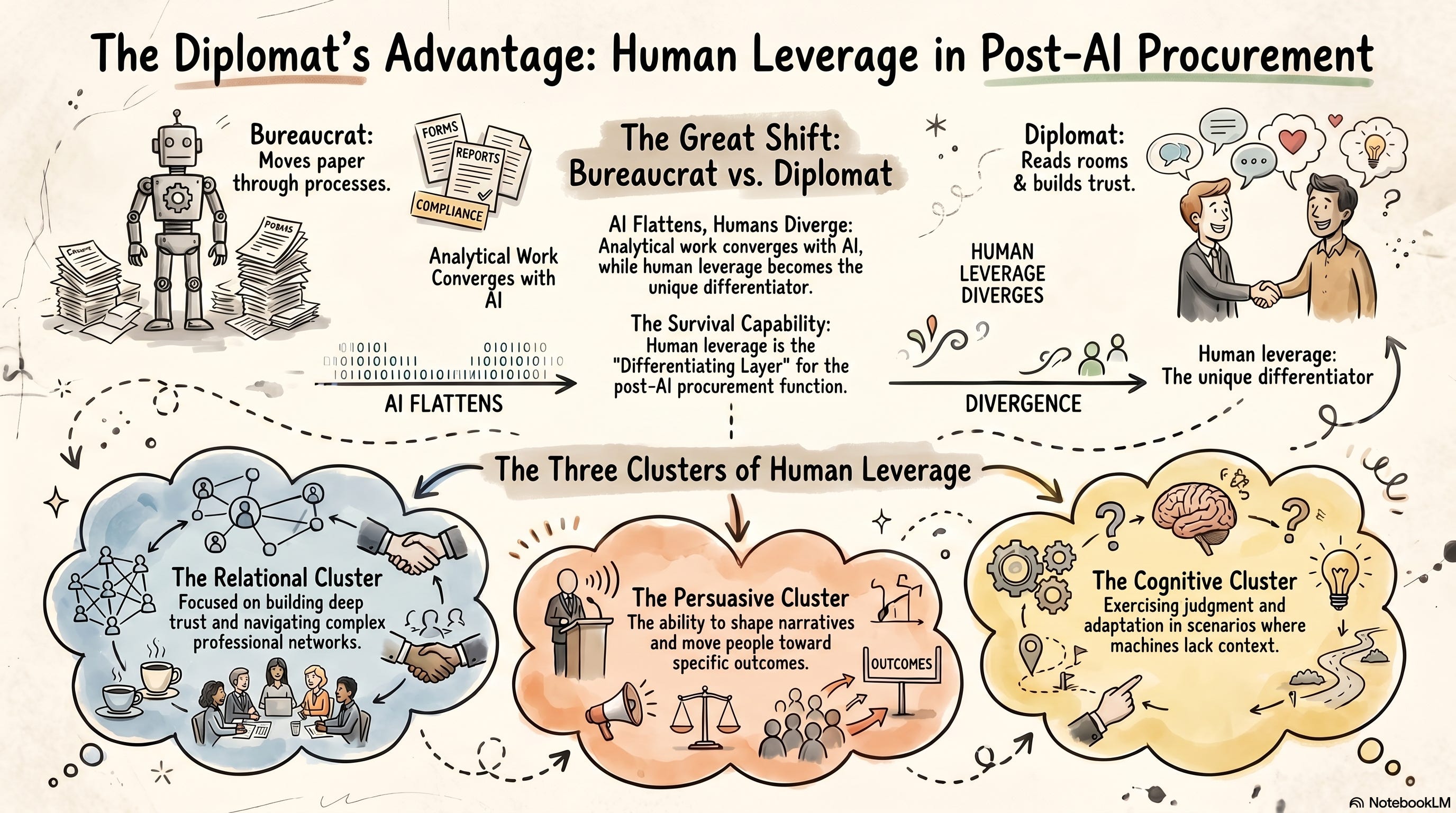
This type of work requires a completely different approach and perspective than what we’ve been traditionally used to. Practitioners who develop strong human leverage skills think and act like diplomats, not bureaucrats. A bureaucrat moves paper through a process while the diplomat reads rooms, builds trust, shapes narratives, and achieves outcomes through people.
In a post-AI world, the bureaucrat’s job is the one that gets automated; the diplomat’s job compounds.
Human leverage is, then, the third core skill of the Differentiating Layer - and it’s not just a skill. It is the survival capability for the post-AI Procurement function.
The skills that comprise it fall into three clusters:
The Relational Cluster: how we build trust and navigate networks
The Persuasive Cluster: how we move people toward outcomes
The Cognitive Cluster: how we think, adapt, and exercise judgment (where machines cannot)
Let’s dig into each cluster in turn.
Cluster 1: The Relational Cluster
Relational skills sit at the foundation of human leverage. Procurement, more than most functions, depends on outcomes achieved through other people - internal customers, cross-functional stakeholders, as well as the supplier ecosystem. AI can and will help analyze every aspect of every one of these relationships, but it cannot keep and develop them for you.
Three skills make up the Relational cluster:
1. Emotional Intelligence
Emotional intelligence is the foundation upon which all of the other relational skills sit. It is the ability to recognize and manage your own emotional responses, accurately read the emotions of others, and use that awareness to navigate situations productively. It encompasses self-awareness, self-regulation, empathy, and social awareness.
What This Means For Procurement: Procurement operates in friction-rich environments - failed deliveries, missed budgets, contentious negotiations, internal political pressures, supplier disputes and more. Practitioners who can stay regulated under stress, read what’s actually happening in a room, and adjust their behavior in real time have a clear advantage. AI can model sentiment from a transcript (after the fact), but it cannot sense, in the moment, that the CFO’s body language has shifted, or that a supplier’s silence is masking a deeper concern. The ability to do that is unquestionably human.
How to Cultivate:
Build a reflection practice - even ten minutes at the end of the day or week reviewing key interactions (”what did I feel, what did they feel, what did I miss?”)
Stress-test yourself deliberately - high-pressure presentations, difficult conversations, public speaking - and debrief honestly afterward
Invest in a 360-degree feedback exercise - most professionals significantly overestimate their self-awareness, and the gap between how you experience yourself and how others experience you is a development opportunity
Work with a mentor (or, if possible, an executive coach) for a structured period; this is one of the highest-leverage development investments at the senior level
Read widely outside business to build empathic range (including literary fiction, memoirs, and biographies)
2. Relationship Management
This is the skill of developing one-on-one relationships with different stakeholders across departments. It involves understanding individual interests, motivations, and hot buttons to build genuine trust that creates long-term optionality - the kind that serves you when you need it. Note the emphasis here: the focus is on depth and authenticity in relationships, not about being transactional and ‘banking favors’.
What This Means For Procurement: This is an especially essential skill for Procurement practitioners, where strong relationships are essential to achieving successful outcomes. This is particularly true for instances where Procurement has indirect influence rather than direct control and authority. The better the relationships, the higher the probability of successful outcome achievement. Relationship management must operate across three groups:
Internal customers: those the practitioner directly serves and for whom he or she is the category leader
Key stakeholders: those across the organization who impact and influence key outcomes and through whom the path to results can be smoothed out
Supplier ecosystem: the entire supply base, both current and potential
How to Cultivate:
Practice “deposit-first” mode - give value, share intelligence, make introductions long before you need anything in return
Establish a non-transactional cadence - regular 1:1s with key stakeholders that are not tied to a deal, an RFP, or an escalation
Maintain a private stakeholder log (what matters to each person, recent wins, ongoing challenges, business priorities, etc.) used carefully and with discretion
Volunteer for cross-functional initiatives that sit outside the procurement remit - the goal being to build relationships outside transactional contexts
On the supplier side: visit operations, attend supplier events, and run quarterly business reviews that go beyond performance scorecards into shared strategy
3. Stakeholder Management
This builds on strong relationship management skills to encompass managing across multiple stakeholders with competing interests. Where relationship management is about individual depth, stakeholder management is about network breadth. It involves identifying all key influencers and gatekeepers across your ecosystem who can impact your ability to realize your goals - and then leveraging the relationship equity needed to navigate this network.
It’s worth noting that this is where coalition building and organizational politics live. Knowing how to package wins for different sponsors, when to escalate, and how to build the political momentum required for cross-functional change is a distinct sub-skill within stakeholder management. It should be viewed as a craft that can be used for positive purpose and positive effect.
What This Means For Procurement: Whether or not Procurement “owns” the spend for a category, the practitioner must navigate a host of stakeholders to achieve outcomes. This type of stakeholder management becomes even more critical where the function has indirect influence rather than direct control. Knowing how to map out the full network of stakeholders, distinguish the formal org chart from the actual decision flow, and manage that network is, and always will be, an essential skill.
How to Cultivate:
Build a stakeholder map for major initiatives and update it as the work evolves
Make a habit of distinguishing the formal org chart from the actual decision flow; ask yourself: “Who gets the call before the decision is made?”
Run pre-meetings before key decisions - never let a major recommendation be heard for the first time in the room where it will be approved
Identify the “translators” in your organization i.e. the people who bridge functions and can carry your message in a language each constituency hears
Build coalitions before you need them, not when the fire starts; the time to recruit allies is when there is no battle to fight
Cluster 2: The Persuasive Cluster
If relational skills are about being known and trusted, persuasive skills are about moving people to outcomes. Procurement is, at its core, a function that achieves its best results through influence rather than authority.
The three skills in this cluster are how that influence is exercised - strategically over time, situationally in the moment, and across the table in formal negotiations.
4. Influence and Persuasion
This is the ability to move people in a specific moment and situation - being able to convince individuals to move toward specific outcomes in a way that aligns with overall objectives. It is a blend of art and science: it requires understanding individual motivations in context and the ability to map out how best to move that individual, in alignment with their motivations and the goal at hand.
What This Means For Procurement: Stakeholder influence is a key part of any role but critically so for the Procurement professional. In the age of AI (in particular), there is a need to move people toward decisions on the basis of not just the facts but competing priorities and agendas. While this skill is applicable regardless of category, it is often argued to be especially important for indirect category leaders, where demand management is a relatively more important driver than in direct categories - though direct category leaders face their own influence challenges with engineering, plant operations, and R&D.
How to Cultivate:
Practice tailoring the same message to four different audiences (e.g. the analytical CFO, the visionary CEO, the operational COO, the skeptical functional VP); the message stays constant, but the framing changes
Get explicit feedback on your executive presence - most practitioners overestimate theirs significantly
Run a “rehearsal of objections” before any high-stakes pitch: anticipate the three hardest pushbacks and know your response cold
Watch senior leaders work a room and decode what they’re actually doing; copy what works and discard what doesn’t
5. Narrative Development and Communications
Narrative is the art of hearing what stakeholders actually mean versus what they say, crafting a story that shapes the requisite outcomes, and managing communications to achieve those goals. These communications must be both written and verbal, and across multiple levels of the organization.
What This Means For Procurement: Strong communications are an essential tool for all management professionals, and equally so for Procurement practitioners. From influencing an individual one-on-one to making the case to the CFO for a material investment choice, the ability to craft a narrative and communicate those ideas separates effective practitioners from ineffective ones. The function’s perception inside an enterprise is shaped by the cumulative narrative its leaders tell over years - about its role, its value, and its trajectory.
How to Cultivate:
Invest in your writing - this is one of the most underrated leadership skills. Take a course, work with an editor, study the house styles of prominent publications (e.g. HBR, FT, and The Economist), etc.
Build the “30-second, 3-minute, and 30-minute” version of every major idea you carry; if you cannot tell it in 30 seconds, you do not yet understand it
Get coaching on the difference between informing and persuading in business writing; most procurement communication defaults to the former when it should be the latter
Read fiction seriously - people who only read business books tend to write far too formally
6. Negotiation
Negotiation is the live, real-time skill of reaching agreements that work for both sides - across the table, on the phone, or in the back-and-forth of a deal. AI will model scenarios, draft talking points, run BATNA simulations, and prep your data better than any analyst ever could. But the live negotiation itself remains stubbornly human: reading micro-signals, knowing when to push and when to walk, building rapport across the table, and adjusting in real time when a counterpart shifts.
What This Means For Procurement: Procurement is the negotiation function in most enterprises. As AI raises the analytical floor for everyone, what differentiates great negotiators from average ones will increasingly be the human craft of the negotiation itself. The practitioner who can use AI to prepare exhaustively and show up to the table with elite live skills will be the one who delivers disproportionate value.
How to Cultivate:
Treat every real negotiation as a learning opportunity - debrief honestly, alone or with a trusted colleague, on what worked and what did not
Seek out negotiations training that includes live practice with feedback, not just frameworks; the gap between knowing and doing is where most practitioners get stuck
Observe master negotiators at work whenever you can - sit in, watch the choreography, notice what they say and what they deliberately do not
Practice in low-stakes settings: salary discussions, vendor negotiations on personal purchases, etc.
Cluster 3: The Cognitive Cluster
The first two clusters cover how we engage with people. This cluster covers how we think, decide, and adapt, particularly under conditions that resist machine optimization. AI excels at solving well-defined problems within known solution spaces. The three cognitive skills below are about working in spaces that are not yet defined.
7. Creative Problem-Solving
This involves ideating and developing unique solutions that solve problems and achieve key outcomes - especially in environments faced with resource constraints and competing agendas. The goal is to find innovative ways to get to the right outcomes, balancing process alignment with organizational realities and constraints.
What This Means For Procurement: Given shrinking budgets, tight timelines, and competitive pressures, the practitioner’s ability to achieve results creatively (rather than simply following the process) will be critical to the function’s long-term relevance. In a post-AI world, internal customers and stakeholders alike will demand more of Procurement than just process execution and risk mitigation. While AI will optimize within known solution spaces, it will not reframe a problem from “how do we cut $X out of this category” to “what if we eliminated this category entirely?”. That kind of reframing is the human edge.
How to Cultivate:
Practice constraint-flipping: “we have no budget” becomes “what is the zero-budget version of this?” The reframe often unlocks the real answer
Design-thinking sprints work surprisingly well in Procurement contexts; structured ideation outperforms unstructured brainstorming
Build cross-industry exposure: how do operations, finance, and R&D solve analogous problems? Steal liberally
Build a peer or mastermind group outside your company - your in-house environment will only generate in-house ideas
8. Comfort with Ambiguity
This is the ability to function and flourish in contexts of incomplete information, changing landscapes, and economic uncertainty. When coupled with the need for speed in competitive environments, being able to make decisions with confidence despite a lack of information becomes a critical capability.
What This Means For Procurement: In times of crisis or in steady-state situations, there will never be the full complement of insight and analysis that would ideally be needed to make decisions. AI will reduce some of the information gap, but it cannot close it (and it introduces new ambiguities of its own e.g. model uncertainty, data quality, hallucination risk). The practitioner who is comfortable acting on 70% information will consistently outperform the one waiting for 95%.
How to Cultivate:
Deliberately practice deciding with incomplete information rather than waiting for “the 95%”; calibrate your confidence and review outcomes honestly
Take stretch assignments (new categories, new geographies, new functions) that force you to operate without the comfort of expertise
Keep a decision journal: record what you decided, what you knew at the time, and what you assumed. Review it months later to learn how your judgment actually performs
Practice scenario planning: hold multiple plausible futures in mind simultaneously rather than committing prematurely to one prediction
Spend time around founders and entrepreneurs; they live in ambiguity professionally and develop intuitions worth absorbing
9. Curiosity and Adaptive Intelligence
Curiosity drives practitioners to continuously learn, moving beyond superficial data to understand the underlying drivers of value and risk for the function and the enterprise; it is particularly important given today’s fast-moving technological trends, ensuring practitioners can adopt new tools effectively. Adaptive intelligence is the natural follow-on: the ability to adapt to changing market conditions, technologies, and corporate strategies. It is an essential component of resilience.
What This Means For Procurement: Curiosity and adaptive intelligence are essential competencies for the modern Procurement practitioner, especially given the transition to strategic value creation. Supply markets are extraordinarily dynamic right now: new technologies, new geopolitical risks, new supplier categories (especially AI services), and new commercial models. The practitioner who is not actively curious about adjacent fields will be obsolete in five years. These skills are essential to not just coexisting with AI as it evolves but thriving in genuinely dynamic environments.
How to Cultivate:
Read widely outside Procurement and outside business - geopolitics, behavioral economics, technology, history, etc.
Track adjacent fields hard right now: AI capabilities, sustainability regulation, geopolitical realignment, key spending shifts, and the changing supplier landscape they create
Teach or write - both force clarity and surface gaps in what you actually understand
Build a deliberate learning rhythm with explicit time blocks for reading, listening, and thinking
Practice the beginner’s mind in areas where you are an expert; the moment you stop questioning your own assumptions is the moment you become replaceable
Why These Skills Compound
A useful way to think about the post-AI Procurement function is that AI flattens analytical capability across the board. Every practitioner, every supplier, every counterparty will soon have access to roughly the same level of modeling, benchmarking, and data preparation.
But what will not converge is human leverage.
The practitioner who can build genuine trust with a CFO, read what a supplier is actually signaling across a table, craft a narrative that lands with the board, navigate a coalition through a politically charged transformation, and make a confident call with incomplete information is doing work that AI cannot do.
And this is often work that other practitioners cannot do either, as many are still focused on execution. The bureaucrat’s edge (knowing the process and executing the steps) will diminish while the diplomat’s edge (moving people, reading rooms, exercising judgment) will increase.
As such, human leverage is not the soft side of Procurement. In a post-AI world, it is the hard core. It is what separates practitioners who are made obsolete by their tools from practitioners who leverage these tools to make them indispensable.