


If you’ve been following along as I’ve laid out my model for future-proofing the Procurement practitioner, you will have noticed a glaring omission from the various layers that comprise the model itself.
Judgement.
This has, as I’ve stated before, been entirely intentional. Judgement isn’t a stand-alone skill that you can learn in the same way that you can study and develop financial literacy or even fundamental negotiations skills. You can’t go to school to learn judgement nor is it an “emergent” or “downstream” output that just flows automatically once you’ve developed the other skills in my model. It’s not a passive byproduct.
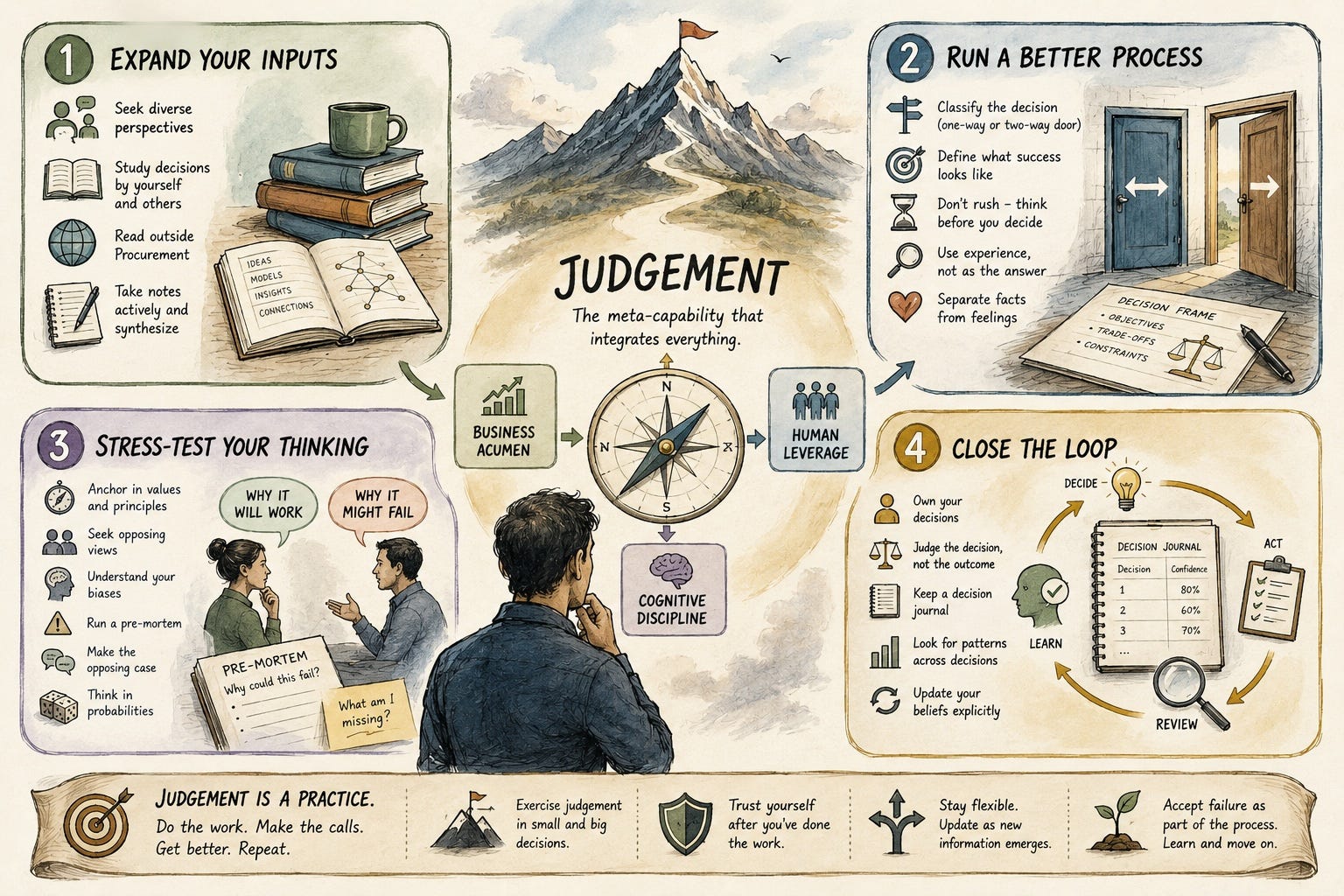
It is, in fact, a meta-capability that sits above all of the layers of the future-proofing model I’ve proposed. It’s a function of - the deliberate, practiced result of - all of the specific capabilities that make up each layer.
It is the act of integration: it consumes Business Acumen, Human Leverage and Cognitive Discipline (previously discussed here and here), and is refined through reps.
Why Judgement Matters More, Not Less
Back in 2018, the economists Ajay Agrawal, Joshua Gans and Avi Goldfarb researched and wrote about the value of judgement. Their core thesis: AI is, essentially, a prediction machine, and as the cost of prediction drops (which it has and will continue to do), its complements become more valuable. The three complements they identify are data, judgement, and action - with judgement defined in economists’ parlance as “the skill used to determine a payoff, utility, reward or profit”. It is the mental capacity to weigh facts, reason logically, and make sound decisions.
In the words of the researchers, human judgement becomes a complement (and gains value) as human prediction becomes a substitute (and loses value).
We need judgement to weigh the pros and cons and to value the payoffs and risks of specific decisions, with the focus on identifying the hidden costs of riskier actions.
In the Procurement context, what that means is that the practitioner who can make better calls wins: deciding when to override a sourcing algorithm’s lowest-bid recommendation because of relationship risk; choosing whether to push back on a CFO’s cost target or accept it and engineer around it; or making the call as to whether a supplier’s quality slip is a one-time blip or a leading indicator. In each of these situations, good judgement matters and makes a difference.
The Limits of Process (and Machines)
Historically, we’ve tried to grapple with this by using process as a means of replacing the very need for judgement. By codifying the work to be done and the path to the decision, we’ve tried to minimize, even eliminate the human in the decision-making process.
But this, of course, doesn’t work for complex, non-routine, non-standard decisions. Process cannot replace judgement (with all of it complexities) in these situations. Nor, for that matter, can the machines, even as we try to use AI to do the exact same thing we’ve tried to do with process. Short of an idealized AGI (which I don’t believe is realistic), AI will not be able to balance the contextual, the ethical, the political, the moral dimensions of difficult decisions.
It becomes important, then, to become deliberate in our quest to develop judgement. This is exacty where most practitioners get stuck.
Building Judgement Deliberately
Judgement is often viewed as this mysterious ability that is either inherent in an individual or results magically through experience. This is, to some extent, understandable as there are certainly non-codifiable, often indescribable, factors that judgement relies on.
Experience, of course, matters. Senior practitioners often have good judgement, even as they are unable to articulate why. There is research that finds that experts tend to pattern-match against thousands of prior situations without conscious deliberation. That is, judgement is partly tacit and developed through exposure, not through frameworks. So experience helps.
That said, building judgement should be viewed as a deliberate act - one that requires discipline and deliberate cognitive application.
There are four key steps to building judgement:
Expand your inputs
Run a better process
Stress-test your thinking
Close the loop
Let’s dig into each one of these in turn.
(Note: none of what follows substitutes for reps - but the reps only build judgment if you bring discipline to them.)
1. Expand Your Inputs
A. Seek multiple diverse inputs.
Good judgement starts with good inputs, and good inputs are rarely found in one place. Read across sources, functions, and perspectives.
If your information diet is limited to Procurement publications, your judgement will be limited to procurement-shaped thinking. Talk to suppliers, finance partners, operators, and customers - not just Procurement peers.
The goal isn’t to consume more information. It’s to consume different information, so that when you face a decision, you have a wider set of mental models to draw on.
B. Make a habit of studying decisions - by yourself and others.
Most practitioners experience decisions but don’t study them. Build the habit of pulling them apart.
When a senior leader makes a call, ask yourself: what did they weigh? What did they ignore? What would I have done differently? When you make a call yourself, look back at it the same way.
Study the public decisions of CEOs, investors, and historical figures - books, podcasts, and case studies are full of decision post-mortems if you go looking.
Treat every decision, yours or someone else’s, as a teaching artifact.
C. Read outside Procurement.
Functional reading sharpens functional skills, but judgement is sharpened by breadth. History, biography, decision science, behavioral economics, and even fiction give you mental models that procurement reading never will.
Reading about how military commanders made calls under the fog of war, or how investors think about asymmetric bets, or how scientists update beliefs in the face of new evidence - all of this builds the lateral thinking that good judgement depends on.
The best Procurement leaders I’ve worked with are almost always voracious readers, and rarely just of business books.
D. Take notes actively and synthesize, not just consume.
Reading isn’t learning - synthesis is. Pulling together different ideas and writing about them forces clarity in a way that reading alone never does.
Keep a notebook, digital or otherwise, where you write down the ideas that struck you, the frameworks you want to remember, and the connections you’re drawing across what you’re consuming.
The act of putting something in your own words is what turns it from information you saw into knowledge you own. Without this step, most of what you read evaporates.
2. Run A Better Process
A. Classify the decision before you process it.
Not every decision deserves the same level of process.
Jeff Bezos famously distinguishes between reversible and irreversible decisions: irreversible calls (one-way doors) deserve deliberation, while reversible ones (two-way doors) deserve speed. Oftentimes, we get this backwards, overthinking the reversible calls and underthinking the irreversible ones.
Before you spend cognitive energy on a decision, ask: is this a one-way door or a two-way door? Calibrate your process accordingly.
B. Define what success looks like before you decide.
You can’t evaluate a decision later if you didn’t say upfront what you were optimizing for. Get clear on the goal before you start weighing options.
Are you optimizing for cost, risk reduction, supplier relationship, internal stakeholder alignment, speed-to-market? In Procurement, multiple objectives are usually at play, and the trade-offs between them matter. Make those trade-offs explicit at the front of the process.
This single habit, more than any other, separates practitioners who learn from their decisions from those who just rationalize them.
C. Don’t make snap judgements - unless merited by the situation.
Most consequential decisions don’t need to be made in the moment, and most snap judgments are pattern-matching dressed up as decisiveness.
Give yourself the space to think. Sleep on it. Walk away and come back.
The instinct to decide fast often comes from discomfort with ambiguity, not from confidence in the answer.
(That said, some situations genuinely require speed. Know which is which - see 2A above - and don’t conflate decisiveness with thoughtfulness.)
D. Avoid the tendency to rely excessively on personal history and experiences.
Experience is valuable, but it’s also the source of your blind spots. The decision you’re facing today is not the decision you faced five years ago, even if it looks the same.
Markets shift, suppliers evolve, internal stakeholders change, and the lessons of past experience are only as good as their relevance to the present context.
Use experience as one input among many - not as the answer.
E. Separate facts from feelings.
Emotion isn’t the enemy of good judgement. Emotional signals often carry real information about risk, trust, and stakeholder dynamics that pure analysis misses.
But emotion shouldn’t be your conclusion. Notice what you’re feeling about a decision and ask what it’s telling you. Then put it alongside the facts, not in place of them, as another input for evaluation.
The practitioners with the best judgment are the ones who can hold both at once - alert to their gut, but disciplined enough not to let it drive.
3. Stress-Test Your Thinking
A. Have a values framework - and let it guide your judgement.
Decisions made without an anchor drift - know what you stand for, and know what the organization stands for; the principles you won’t compromise on and the trade-offs you refuse to make.
When the situation is ambiguous and the analysis is inconclusive, your values are what keep you steady.
This isn’t just about ethics in the narrow sense, but about having a stable frame of reference that lets you navigate complexity without getting lost in it.
B. Get opposing views.
Surround yourself with people who will tell you you’re wrong. Seek diversity of perspective, not just diversity of identity - people who think differently, work in different functions, come from different backgrounds, and have different incentives.
Understand the biases and motivations embedded in the views you’re receiving: who benefits if you decide one way versus the other? Who can you trust to give you a clean read?
The goal isn’t consensus - it’s pressure-testing. If everyone around you agrees with you, you’re not getting useful input.
C. Understand your own cognitive biases.
Every practitioner has characteristic ways their thinking goes wrong. Anchoring, confirmation bias, sunk-cost reasoning, recency effects, availability bias - the list is long, and they all apply to you.
Know your tendencies. The point isn’t to eliminate bias (you can’t), but to recognize when you’re most likely to be falling into it.
Self-awareness here is the difference between a practitioner who improves over time and one who repeats the same mistakes with more seniority.
D. Develop a pre-mortem.
Before you commit to a decision, run a pre-mortem: imagine it’s 12 months from now, and this decision has failed badly. Why? What went wrong? What did you miss?
This exercise surfaces risks that forward-looking analysis won’t always catch, because it forces you to imagine the failure rather than defend the choice.
If you can’t generate a plausible failure scenario, you probably haven’t thought hard enough.
E. Make the opposing case.
Beyond seeking opposing views from others, make yourself argue the opposing case. State the contrary position more strongly than its proponents would.
If you can’t make the other side’s argument well, you don’t understand your own argument well enough to commit to it.
This is often hard to do and most people resist it, which is exactly why it’s a high-leverage habit.
F. Practice probabilistic thinking.
Force yourself to put numbers on uncertainty. “I think this will work” is not the same statement as “I’m 70% confident this will work”.
Probabilistic thinking changes how you communicate, how you plan for downside scenarios, and how you learn from outcomes over time.
You don’t need to be precise; you need to be honest. A 70% bet that fails tells you something different than a 95% bet that fails - but only if you wrote the number down beforehand.
4. Close the Loop
A. Own your decisions.
Judgement doesn’t develop in people who deflect responsibility: own the calls you make - the good ones and the bad ones - openly with your team and with yourself.
The practitioners who hide behind committees, process, or “the data made me do it” never build real judgment because they never sit with the consequences of their own choices.
Accountability is the price of judgement.
B. Separate decision quality from outcome quality.
A good decision can have a bad outcome, and a bad decision can have a good outcome - this is one of the most important and least intuitive ideas in decision-making.
If you only learn from outcomes, you’ll learn the wrong lessons: you’ll punish good decisions that got unlucky and reward bad decisions that got lucky.
The discipline is to evaluate the decision based on what you knew and how you reasoned at the time, separate from how it happened to turn out.
C. Keep a decision journal.
Write down the rationale and your confidence level at the time of the decision. Revisit it regularly.
This is one of the most high-value habits you can build for developing calibrated judgment over time.
Without a record, memory rewrites your past calls to make you look smarter than you were. With a record, you see exactly where your thinking was sharp and where it wasn’t - and you get better.
D. Look for patterns across decisions.
Once you have a body of decisions to look back on, study the patterns. Where do you consistently overweight? Where do you underweight? What kinds of decisions do you handle well, and what kinds throw you?
Maybe you’re great at supplier selection but weak at internal political reads. Maybe you over-rely on relationships and under-rely on data, or vice versa.
Your characteristic failure modes are the most valuable thing you can learn about yourself as a decision-maker.
E. Update your beliefs explicitly.
After each reflection, ask: what do I now believe that I didn’t before? Then write it down. Most practitioners absorb lessons implicitly, which means they don’t really absorb them at all.
Explicit belief updates (”I used to think X, now I think Y, because of Z”) are how you compound judgment over time. Without this step, the reps don’t build anything durable.
What This Means For You
If there is a single takeaway from this post, it is that judgement is a deliberate act. It’s a process that you go through when making a decision - one that requires cognitive discipline, business acumen and human leverage skills.
At the same time, judgement is also partly tacit and non-codifiable, almost always built through reps and experience. Doing the work is an essential part of building judgement that makes a difference.
To this end, I’ll close with a few principles to remember when thinking about judgement and its development:
Look for opportunities to exercise judgement as much as possible - including the small decisions at work and in life, and not just the major, material ones at work
Trust yourself to make judgement calls - do the work (as described above) but don’t second guess yourself once the decision has been made
Stay flexible - be willing to update based on new and updated information. Conviction without flexibility is just stubbornness
Accept failure as part of the process - judge the decision, not the outcome; failure is just another data point. Accept it, learn from it, and move on.
One final thought:
Procurement spent the last twenty years trying to codify judgement into process. The next twenty will be about reclaiming it as a distinctly human capability. Process and machines can handle the routine (that’s what they’re for), but the hard calls - the ones that actually move the business - will always belong to the practitioner who’s done the work to earn them.
Be that practitioner. Build that capability - deliberately, repeatedly, with discipline and humility - until it becomes the most valuable thing you bring to the table.