


Over the last several months, I’ve defined and built out the Future-Proofing model for Procurement practitioners, spelling out each layer and capability within this development model. I then turned my attention to junior practitioner development in a post-AI world, emphasizing the need to find ways to ensure our juniors develop a more intrinsic understanding of the work they do. All of these posts focused squarely on the individual practitioner.
While this certainly informs the work of the Procurement leader, the progressive CPO must also think more broadly, focused not just on juniors but also the seasoned individual contributors as well as their leaders. The core question for the CPO to answer is:
Across my entire team, which capabilities matter now, how do I gauge these capabilities and where do I allocate my investments?
In other words, the CPO needs to have a capability agenda: **a way to read each person’s development, what to build and in what order.
This post lays out that agenda in three parts:
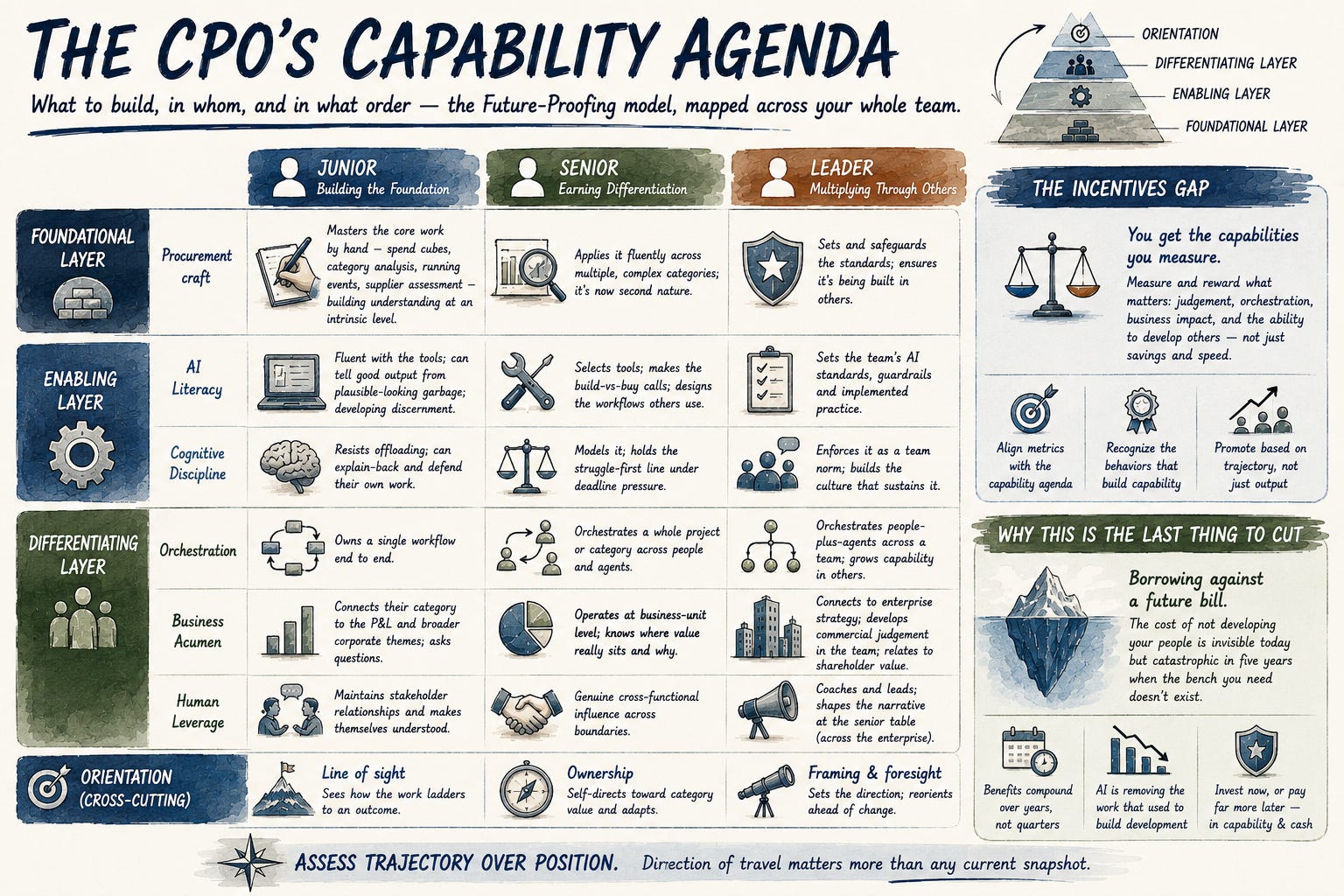
First, the capability architecture itself, which is the Future-Proofing model mapped across your entire team, by level
Second, the incentives gap i.e. the gap between what you say you want and what you actually reward
Third, the business case for all of this i.e. why, when budget crunches hit, talent development should be the last thing you cut, not the first.
Let’s start with the capability architecture.
Reading Your Team, Level by Level
The cleanest way to read your team is to look at it the way it’s actually structured - by level - and apply the Future-Proofing model to each one.
The interesting thing about the model is that, while it applies across the board and to all practitioners, the same capabilities will look different, and be assessed differently, depending on where the individual sits. For example, AI literacy in a junior is not the same thing as AI literacy in a leader. What you assess for - and therefore what you build - shifts as people rise.
To flesh this out for the CPO, I’ll use three tiers:
Junior - your early-career people, who are still learning their craft.
Senior - your experienced individual-contributor engine room, from mid-level analysts through senior category leads; folks who are proven past the junior level, carrying real work, but still doing it themselves rather than (primarily) leading others.
Leader - your people-leaders, responsible for developing those who do the work.
Each tier has a centre of gravity when it comes to their development - the one primary capability that defines it, which is where your assessment and investment should concentrate. The other capabilities of the model still matter at every level, but the centre of gravity is the thing to get right. (At the end, I’ll provide the matrix that lays out the full grid.)
Note that one lens runs across all three - Orientation - which I’ll provide my read on, at each level as we go, and then return to at the end, as it’s the most important thing to assess.
Junior - Building the Foundation
A junior’s centre of gravity rests on two aspects: the Foundational Layer and the Enabling Layer.
The Foundational Layer is understandable for those just starting out: learn the core technical skills that underpin the Procurement function. Understand why and how a spend cube is built and how to assess it in-depth; analyze a category and understand its dynamics and implications for the internal customer; organize, develop and run an event to meet specific end goals and objectives; assess supplier performance and health in order to maximize the defined end goals for that category within the organization.
In prior posts, I’ve referred to this as table stakes for everyone, and it is, but, for the junior, there is a level of understanding - both domain level and procedural - that must be mastered before all else. The point is to ensure they have an intrinsic (versus surface level) understanding of the everyday work of Procurement, regardless of how effectively or efficiently AI tools take over this work in future.
The second aspect is the Enabling Layer - and, within it, cognitive discipline above all.
This might be surprising to some: surely, the most obvious thing to assess a junior for is AI literacy i.e. can they use the tools? Of course, that matters, but, just like the Foundational Layer, that, too, is table stakes; they either have it or they can acquire it fast. An ambitious junior will have no issues getting up to speed and becoming AI-proficient. (In fact, they’re more likely to teach you, the CPO, a thing or two when it comes to AI!)
The thing that actually determines whether a junior progresses optimally is the opposite discipline: the brake, not the accelerator. Can they resist offloading their thinking to the machine? I’ve written about why this matters so acutely for juniors before: they are the group most at risk of outsourcing the very judgement they most need to build.
So cognitive discipline is important to assess - and yet it isn’t easy to see, because a junior over-relying on AI produces perfectly acceptable output. You have to look past the output to the thinking behind it.
So the test I’d apply here is one I’ve spoken about many times before: the explain-back. Hand them their own analysis and ask them to defend it - what it recommends, why, what it assumes, where it breaks down. A junior who can’t do that didn’t produce the work; they simply regurgitated what they were told by a machine. That gap is the single most important signal at this level.
Beyond Procurement knowledge and cognitive discipline, the Differentiating capabilities from the future-proofing model are all present as well, but they’re nascent in the junior. You have to assess them at task level: can they orchestrate a single workflow end to end, including the handoffs, rather than just a task within it? Do they understand how their specific category connects to the P&L? Do they appreciate how the broader corporate climate is influencing how and why we budget and set category goals the way we do? Can they hold a straightforward stakeholder relationship and make themselves understood?
The point here is to view these as indicators of potential, not proof of capability. Capability will take time to develop, but they need to at least show inclination and aptitude towards these differentiating levers.
Finally, orientation, in a junior, is about line of sight: can they see how their piece of work ladders up to a given outcome? The junior who asks “what is this actually for?” - rather than just completing the task in front of them - is showing you the beginnings of the thing that matters most. The one who executes flawlessly but never asks is a flag, not a star.
Build priority: Embed Procurement knowledge and lock in cognitive discipline first. Everything else compounds off it, and it is far harder to instill later once habits have set.
Senior - Earning Differentiation
This is a pivotal tier, as it’s the one that’s probably the easiest to assess least rigorously - because practitioners at this level are, by definition, competent; they get their work done. The trap, though, is mistaking “the work gets done” for “this person is developing”.
The senior practitioner’s centre of gravity is the transition into the Differentiating Layer. This is the level where you find out whether someone is becoming a leader or plateauing as a strong executor. Both look identical in terms of throughput but completely different in terms of potential and options eighteen months later.
What you’re assessing for is whether the Differentiating capabilities are actually showing up, and deepening:
Orchestration has widened from the single task to the whole project or category - designing the work, sequencing it across people and agents, and stepping in at the moments that matter. This is where project-management capability, genuine comfort working with agents, an outcomes orientation, and the ability to explain not just what got delivered but how it got there all come together.
Business acumen has moved up from “my category” to the business unit - understanding what their internal customers actually optimize for, the commercial structures at play (and even possible), and where the value really sits and how to get at it.
Human leverage has become genuine cross-functional influence - not just managing a relationship, but influencing people and shaping outcomes across boundaries.
The senior who’s differentiating is visibly operating at a wider scope than their job description strictly requires. The one who’s plateauing is executing their category flawlessly but showing no signs of reaching beyond it. Both are “good” but only one is a good bet for the future.
Of course, the Enabling capabilities don’t disappear here, but you’re no longer asking whether a senior has cognitive discipline - you’re asking whether they model it, whether they hold the struggle-first line even under deadline pressure when it would be faster to just let the machine do the work. And AI literacy has matured from using tools to selecting them - making the build-versus-buy calls and designing the workflows others will use.
Orientation at this level is ownership: do they orient their own work toward category and business value, adapting as conditions shift? The junior needs line of sight; the senior needs to self-direct, without having the outcome pointed out to them. A senior who still needs the outcome defined for them hasn’t made the transition, however good their work is.
Build priority: force the differentiating transition. Don’t let strong doers stall in the comfort of competent execution (unless that’s their defined career track, in which case, expectations should be clear on all sides). Give them the wider-scope work that either surfaces leadership capabilities or reveals its absence.
Leader - Multiplying Through Others
The line that separates this tier from the ‘Senior’ isn’t even more seniority. It’s that a leader’s value is now delivered through other people, not through their own output.
Which is why the leader level isn’t really about new capabilities at all. It’s about all five capabilities from the Future-Proofing model viewed through a central question: can they build these in others?
A leader might have superb personal orchestration abilities - but the thing you’re now assessing is whether they can develop it in their team. Can they coach judgement - not merely make good calls, but teach others to make them? Can they model and incent cognitive discipline in a way that sets the norm for everyone beneath them? Can they orchestrate not just work, but people-plus-agents across a whole team - which is a genuinely different skill from orchestrating their own projects?
This is the hardest transition in the entire architecture (for good reason), and the one organizations most often get wrong - because it is tempting to promote your best individual contributor into a leadership role and assume the multiplication simply follows. We should know by now that it doesn’t. Personal brilliance and the ability to build brilliance in others are different capabilities, and plenty of superb seniors make mediocre leaders precisely because no one assessed them for this multiplier skill before handing them the team.
(This is also why the manager’s role is the load-bearing wall of the whole rebuilt apprenticeship model - a point important enough that it’s the subject of an upcoming post.)
So at this level, read every capability twice: once for whether they still have it themselves - they should - and, more importantly, once for whether they can grow it in others. The second read is the one that really counts.
Orientation, in a leader, is framing and foresight. The junior sees how work connects to outcomes; the senior owns outcomes for their patch; the leader sets the outcome direction that others orient around - across categories - and senses where the function and its markets are heading well enough to reorient the team ahead of the change rather than after it. A leader whose team is perpetually responding to shifts rather than anticipating them has an Orientation gap, however strong the execution beneath them.
Build priority: assess and build for multiplier ability, not individual brilliance - and stop assuming the two are the same thing.
Above It All: Trajectory Over Position
Step back from the three levels, and take note of the lens that runs through all of them: Orientation. What you should see is that, at its core, orientation is a read on one’s trajectory rather than position. Every other capability tells you where someone is today, but orientation tells you where they’re going. And in an environment moving this fast, direction of travel matters more than any current snapshot. A strong-but-static senior is a worse long-term bet than a rougher one who is visibly climbing. Because the world is changing so fast, static practitioners are already falling behind - which has existential implications for not only the practitioners themselves but the function as well.
So the overarching message is simple: assess trajectory over position.
Weigh where each person is heading at least as heavily as where they sit today. This is the single most useful discipline a CPO can bring to reading their team - and, as we’ll see when we get to hiring and promotion, it’s what separates the talent decisions that hold up from the ones that don’t.
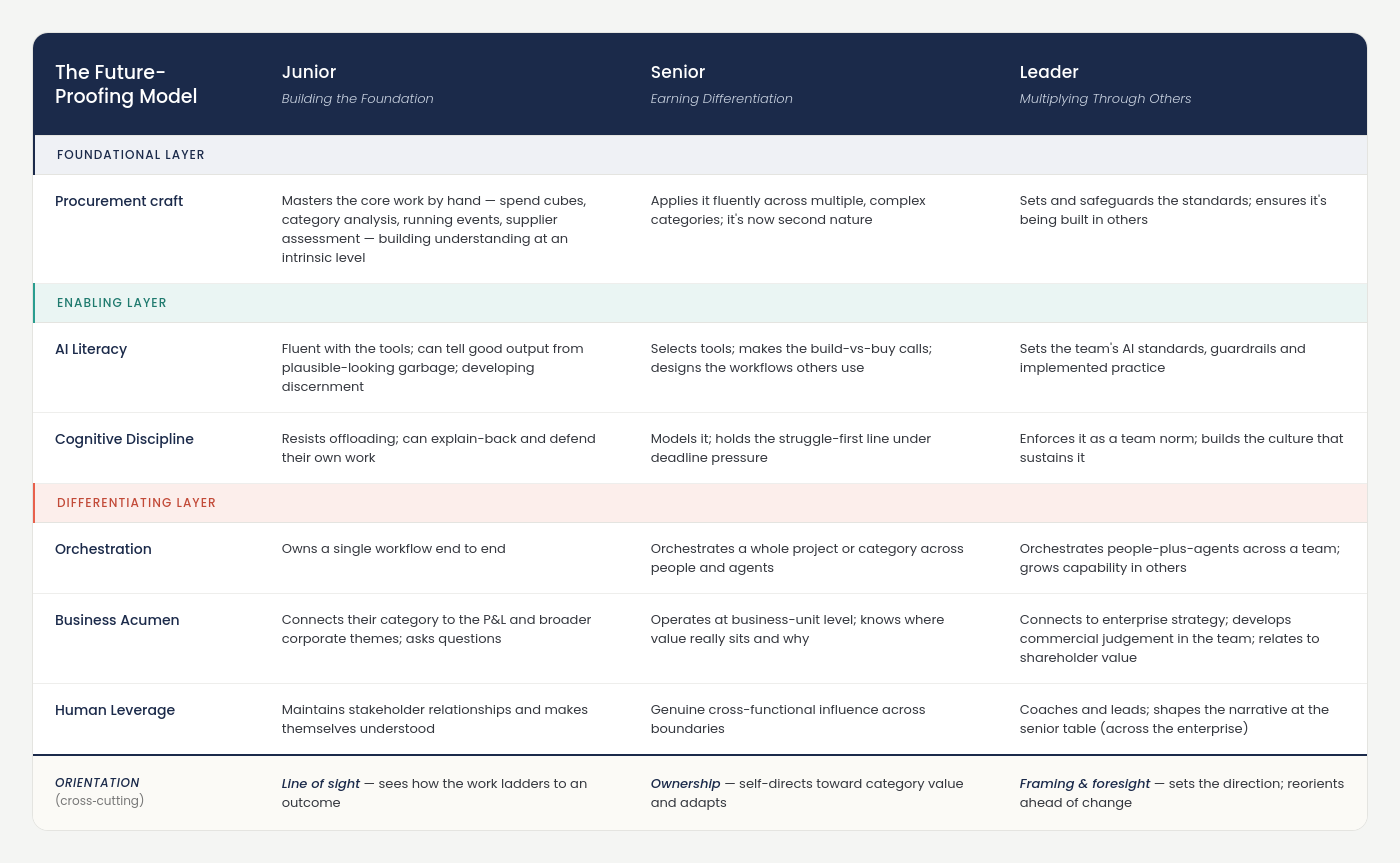
The Full Grid
Below is the full capability matrix in one, clean view - what good looks like by capability and by level:
You Get the Capabilities You Measure
Of course, even our best-laid plans can go awry and, in the context of the CPO’s capability agenda, there’s almost always one specific cause that undoes the entire architecture.
The agenda can tell your team what you’d like them to build, but how you incent, measure and promote them in accordance with this agenda will either ensure success or guarantee failure.
What you measure and reward will win every single time.
And this is exactly the problem. Most Procurement functions still measure and reward the same things: savings delivered, spend under management, cycle time, etc. That is, we’re rewarding execution - better, faster, cheaper. But you can’t ask a junior practitioner to slow down and focus on cognitive development yet still keep rewarding speed to output every single time. Neither can you expect leaders to expand their team’s potential and build their bench while incenting (mainly) their savings numbers. Those traditional metrics are fine as the base layer, but we need to also expand our focus to include traits such as judgement and the ability to develop others.
Point being, you can stand up the perfect development program, publish the perfect capability matrix, and then watch your people, understandably, ignore it all in favor of those metrics that the organization really values.
You get the capabilities you measure. Everything else is just slideware.
Fortunately, as the CPO, all of this is entirely within your control, but it does mean there’s more work to be done when it comes to your evaluation and reward systems, which need to be pointed in the same direction.
That means finding (and fighting to embed) ways that, however imperfect, measure and recognize the things that matter: a senior taking on the ambiguous, wider-scope brief; the leader whose people visibly levelled up; the junior who can defend their reasoning rather than just deliver fast output.
(I’ll come back to this point in a future post when we look at hiring and promotion.)
Why This Is the Last Thing to Cut
One last point, and I’ve discussed this in prior posts as well.
When budgets tighten - and rest assured, they will - training and development is always the first line item to get cut. It’s a discretionary line, the benefits are much further out and operations aren’t immediately impacted when it’s gone. Basically, it’s the easiest thing to do and, well, isn’t prioritizing hitting this year’s numbers the most important thing?
The problem, of course, is that you’re borrowing against a future bill.
Much like the iceberg I talked about a few weeks ago, many of the issues simmer below the surface. The cost of not developing your people is invisible this year but catastrophic in five - when you reach for a bench of seasoned judgement, only to find it not there. By then, it’s too late to reverse course without considerable cost.
AI is making this worse by automating away much of the work that built our development, and if we’re not then intentionally replacing that development due to budget cuts, we’re not just reducing our bench, we’re eliminating it entirely.
The business case, then, is simple: Talent Development cannot be the first thing to cut when times are hard. It should be close to last, because it is the main investment standing between you and a senior team that, five years from now, doesn’t exist.