


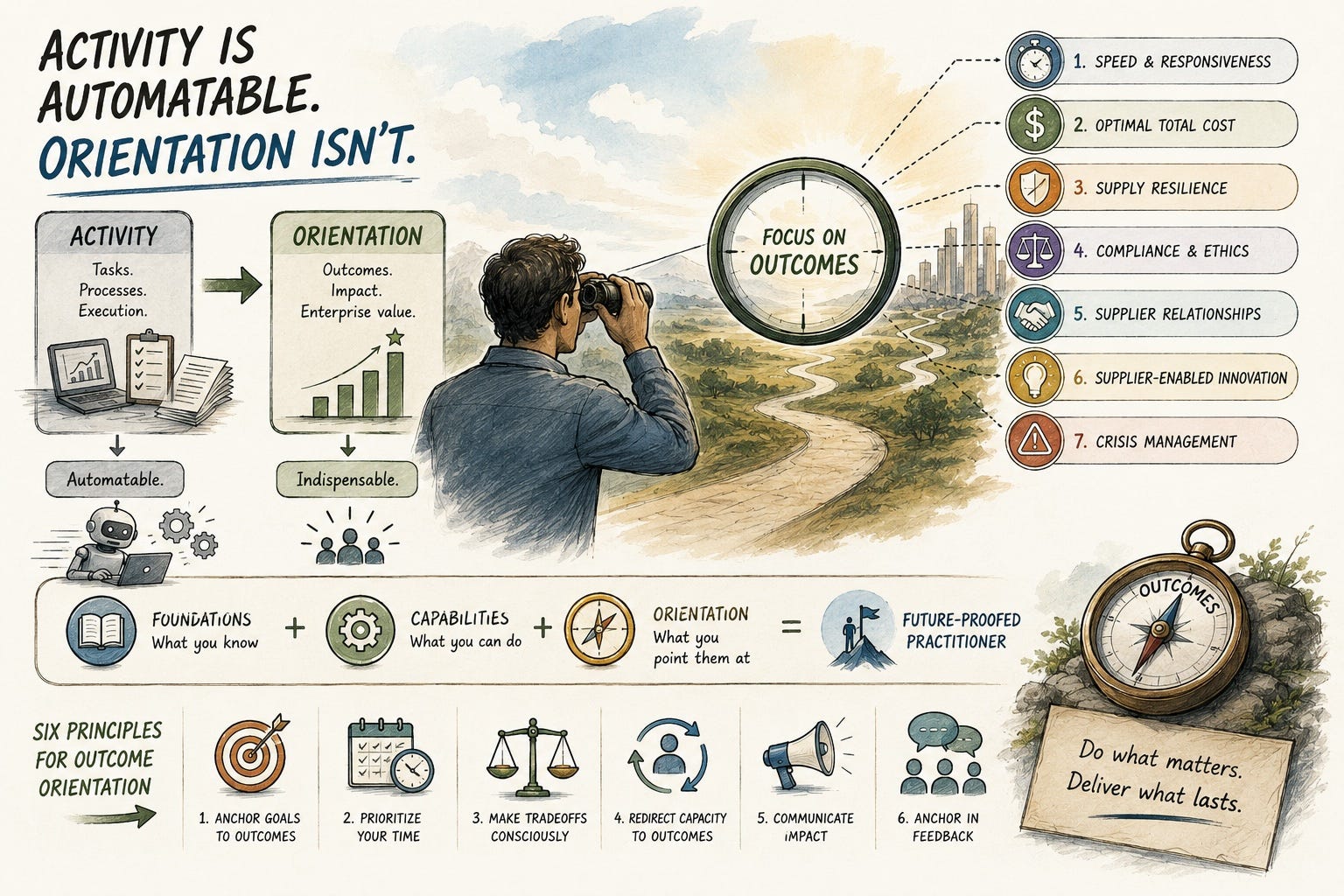
Two practitioners can have the same skills but still face opposite futures.
One spends their time executing - running sourcing events, refreshing contracts, turning around spend analyses - and then watches as AI absorbs each of these tasks in turn. The other points the same skills at what the enterprise actually needs - and becomes harder to replace every year.
The difference isn’t about capability - it’s about orientation.
Over the last several weeks, I’ve laid out my model for future-proofing the Procurement practitioner - the Foundations you build and the Capabilities you develop.
This final piece is about where you aim them.
Orientation, Defined
The Orientation lens, in this context, is the art and science of applying the skills and capabilities we’ve learned towards Procurement-focused goals that move the enterprise. It is about ensuring that the work we do is relevant and meaningful - not just for the function itself, but the organization as a whole.
Orientation is, therefore, the lens through which we apply what we’ve learned - a lens that ensures Procurement remains positively positioned within the organization. In the context of our future-proofing model, think of it this way:
Foundations are what you know, Capabilities are what you can do, Orientation is what you point them at.
And what do we point them at? In my view, our orientation lens should be focused on outcomes. When we understand and focus our work around outcomes, we ensure that our total focus is on delivering value, not just for Procurement and the stakeholder in question, but for the enterprise as a whole.
I wrote about the seven most critical Procurement outcomes in detail here but to recap, they are:
Speed and Responsiveness of the Procurement Process: When a business unit needs something purchased, how quickly and painlessly can they get it?
Achieving Optimal Total Cost of Ownership: Are we optimizing the full economic cost of a buying decision, including implementation, maintenance, switching costs, quality, etc.?
Maintaining Supply Resilience and Mitigating Risk: Can the business count on having what it needs, when it needs it, without disruption?
Ensuring Compliance and Ethical Assurance: Do stakeholders know and believe that what they’re buying, and who they’re buying it from, won’t expose the organization to legal, regulatory, or reputational harm?
Ensuring Optimal Supplier Relationships: Are we managing supplier relationships such that the organization earns unique and preferential access?
Driving Supplier-Enabled Innovation: Is Procurement unlocking real value through suppliers and ensuring those suppliers see the organization as a customer worth innovating for?
Crisis Management: Is Procurement involved front and center in ensuring the organization survives crises with its financials, operations, relationships, and reputation as intact as possible?
Of course, these outcomes are not new; they have always mattered. What’s changed is that orienting around them is not only just good practice - it’s existential.
Why Activity Stopped Being Enough
The idea of orientation is particularly relevant in a post-AI world.
For years, the proxy for value (and the practitioner’s personal moat) was activity. That is, you were valued precisely because you were the one who could run the RFP, model the should-cost, and manage the process. But as we’ve discussed before, AI will absorb most of this activity-level work - and not just the transactional stuff (the “grunt” work), but the cognitive/decision support work (the analysis) as well.
What remains, then, cannot simply be a re-assembling of residual activities and tasks, but a fundamental rethink of who the Procurement practitioner is and what he or she does. What survives will be the progressive value driver who is focused on organizational goals, and ensuring Procurement leverages its core remit to achieve those goals.
The practitioners who will survive, then, will be the ones who define their value through their relentless focus on achieving relevant outcomes - versus their prowess at accomplishing specific tasks. The activity-defined practitioners will become automatable, but outcome-oriented ones will become indispensable.
So how do we become outcome-oriented?
Six Principles for Outcome Orientation
Orientation isn’t a step-by-step process that can be neatly applied. It is, at its core, a mental mindset that points everything at ‘results’ not ‘process’.
Installing this mental mindset requires internalizing a series of principles that ensure that the outcome focus is front and center:
1. Anchor every multi-year goal to at least one of the seven outcomes.
The simplest test of whether you’re oriented around outcomes is to look at your own goals.
If they describe activity - “run twelve sourcing events,” “complete the contract refresh,” “onboard the new spend-analytics tool” - then you’re measuring motion, not value. Rewrite them so each one ladders up to a named outcome: not “run sourcing events” but “improve total cost of ownership in the key categories where it’s most leveraged”.
If you don’t control how your goals are framed, push to renegotiate them. What your scorecard measures is what you and your team will actually orient around, so get outcomes onto it.
2. Actively prioritize your time around the critical outcomes.
Outcome orientation set once a year and forgotten is just a planning artifact.
The discipline is in the cadence. Each month and each week, look at where your hours actually go and ask whether they tracked to the outcomes you said mattered. Usually, the honest answer is no - calendars often fill up with the urgent and the procedural, and the outcomes that need sustained attention get whatever time is left.
Treating outcome focus as a recurring allocation decision, rather than an annual aspiration, is what keeps orientation real between planning cycles.
3. Make your tradeoffs consciously.
The seven outcomes are in constant tension. Speed pulls against resilience; cost pulls against innovation; compliance pulls against responsiveness. A practitioner who claims to be advancing all seven equally is usually advancing none of them deliberately.
The genuinely ‘oriented’ practitioner doesn’t just track the seven. They make conscious calls about which to optimize for, when, and at whose expense, and they can defend those calls when challenged.
This is also where AI changes the work. AI is going to make these tensions visible in ways they never were before - simulating cost-versus-resilience scenarios, flagging compliance-versus-speed conflicts in real time. As the work itself gets automated, the scarce and durable human act becomes owning the call.
4. As AI absorbs activity, redirect the freed capacity toward outcomes.
When AI accelerates sourcing, contract review and the rest, the path of least resistance is to simply do more of the same, faster. But that’s exactly the trap. Doing twice as many sourcing events isn’t future-proofing - it’s automating your way deeper into ‘activity’.
The disciplined move is to take the capacity AI gives back and reinvest it into the outcomes that chronically get starved: supply resilience, supplier-enabled innovation, the quality of key relationships. These are the outcomes that are hardest to automate and carry the highest human premium, precisely because they resist being reduced to a process.
To be clear, again, AI doesn’t change what matters - the seven outcomes are the same as they always were. It changes how much of your capacity you can point at them.
Consciously make the decision about where that reclaimed capacity goes.
5. Communicate your impact.
Work that moves outcomes but is never seen to have moved them tends, over time, to be valued as activity.
Make a habit of communicating impact in the language of the seven outcomes rather than the language of tasks completed i.e. not “we closed forty contracts this quarter” but “we cut supply risk in two critical categories and unlocked a supplier innovation that the business unit is now building on”.
I know many practitioners bristle at this idea, considering it to be self-promotion, but it isn’t. It’s how the organization learns to associate Procurement with value rather than throughput, and it’s a key part of how you keep a seat at the tables where consequential decisions get made.
6. Anchor your read on outcome impact in feedback - not self-perception.
The difference between the impact you think you delivered and the impact your stakeholders said you delivered is often where a lot of well-intentioned orientation fails. It’s easy to convince yourself you’re delivering on resilience or relationship quality; it’s harder, and far more useful, to hear it from the people on the other side of those outcomes.
So anchor your assessment in the voice of the customer and the voice of the supplier. If your stakeholders don’t experience you as fast and enabling, you aren’t - regardless of your internal cycle-time dashboard. If your strategic suppliers don’t treat you as a customer worth innovating for, you haven’t earned that outcome yet.
External feedback is the only honest scoreboard for work this qualitative.
The six principles above are not a pick-and-choose menu. They compound, building on each other and ensuring that Procurement not only focuses on value delivery but is seen to be doing so.
And while they describe the destination we’re after, we still need a way to tell us how far we are from it. Enter the diagnostic checklist.
A Diagnostic Checklist
If the principles are the mental mindset, or where we want to get to, we need to also understand where we stand today.
To do so, it’s worth working through a structured set of questions:
The terrain you’re operating in
What is the “cultural” incentive of the organization? What tone does the C-Suite - through to the CPO - set about where impact is most valued?
Which outcomes is my function structurally incapable of moving on today, and what would it take to change that?
What I’m planning, and where my time goes
How many of my goals and objectives are genuinely oriented toward moving key outcomes, rather than describing activity?
How many are multi-year? Am I working a portfolio of short-, medium-, and long-term changes, or only chasing short-term movement?
How much of my time is actually allocated to each outcome - and does that match what I claim matters?
The calls I’m making
What is the balance across the seven outcomes? Am I inordinately focused on Cost?
Where am I making tradeoffs across outcomes implicitly that should be made explicitly?
Which outcomes does AI augmentation most expand my reach on, and am I shifting effort to capitalize, or just doing the old activity faster?
How I know any of it is real
Am I communicating impact in the language of outcomes, or the language of tasks completed?
Am I proactively collecting outcome-impact feedback from stakeholders, both internal and external?
If those stakeholders were asked which of the seven outcomes I’m known for, which would it be - and is that the balance I want?
It’s worth going through this checklist periodically. My suggestion would be three times a year - at the start of the planning cycle, mid-year as a performance check and finally at year end evaluations. This ensures we are not only calibrating correctly as we begin the year but then course-correcting and extracting the right lessons and learnings as we go through each annual cycle.
The Future-Proofed Practitioner
The future-proofing model comes down to three questions.
Foundations ask what you know. Capabilities ask what you can do. Orientation asks what you point them at.
And in a post-AI function, that third question is the one that decides, in a practical, delivered sense, who stays essential.
The fact is that AI will keep getting better at the what and the how: it will run the analysis, surface the options, even recommend the call. But what it won’t do is decide which of the seven outcomes the enterprise needs most right now, and then aim the function’s scarce human attention there.
That decision - that orientation - is the real work and it’s not a skill that AI can take from the practitioner. It’s what makes the practitioner all the more valuable.
The future-proofed practitioner, then, isn’t the one who does the most. It’s the one who focuses - and delivers - on what matters.