


Over the last several months, I’ve laid out what it takes to develop Procurement talent in a post-AI world - from the Future-proofing model and the various learning layers that comprise it, to the junior apprenticeship crisis and the underlying developmental chain that needs to be consciously developed to resolve it.
I’ve also talked about the range of stakeholders involved in making sure this talent is developed optimally - from the CPO who sets the pace and the ground rules, to the individual practitioners themselves (senior and junior) who must do the heavy lifting of learning and growth.
Look closely enough, though, and you’ll see that there’s one stakeholder (other than the practitioner) upon whom most of the onus is placed: the manager.
Almost every program, every learning layer, and every mechanism I’ve proposed requires the manager’s time and attention. It is the manager who oversees the implementation of these talent programs, who models the thinking, enforces the cognitive discipline, coaches the discernment, and provides the space for the development of judgement.
Of course, it’s easy to just say that’s their job, that managers must step up and take on the responsibility of developing their people. I’ve said it myself, repeatedly. After all, it’s the reason they’re called managers: they manage.
And yes, of course, they should take on this responsibility, but for them to be successful in doing so, we need to also answer an important question: can the manager’s role, as it’s currently built, actually carry the weight we’re piling onto it?
My honest answer is “no”, at least not as the role currently stands, not in most organizations, and, therefore, not without a major role redesign.
That is what I’ll focus on in this post.
The Squeeze
The manager sits in a vice that’s been steadily tightening over the years - one that predates the emergence and growth of AI in our collective consciousness.
From above, managers have watched (and often helped) organizations continuously flatten. Their leaders have stripped out layers and widened spans of control. In many organizations, the number of direct reports has jumped to double digits over the last decade. And yet, even as they’re overseeing even more employees and receiving even less support than they might want or expect, many managers are doing larger chunks of the work themselves.
From below, those direct reports need more counsel and guidance, not less. With businesses facing ever more uncertain environments, those employees expect their managers to be beacons of certainty, or at the very least composure and direction. To add to this, the manager is now also being asked to develop judgement in their people deliberately - the very thing that, as I’ve discussed before, used to happen on its own, when the procedural grind did a lot of the teaching for us.
The results are exactly as you might expect: overload and burnout.
Managers tend to report burnout at higher rates than any other level in the organization, and there’s enough (at least anecdotal) evidence that says managers are simply overwhelmed. This, as you might expect, has knock-on effects in terms of team morale and engagement.
The net result: the single most important role that drives the development of your people is also the most stretched - a troubling idea for any CPO serious about talent development.
The Coaching Windfall That Hasn’t Arrived
Of course, with AI, we expected the opposite to happen.
The story we’re told is that AI will automate the administrative grind and hand our people - our managers especially - a windfall of time; time they can then pour into thinking strategically, engaging with critical stakeholders, and, yes, coaching and developing their people. The machines would take the drudgery and the humans would finally get to do human work.
But that isn’t how it’s playing out - for a number of reasons.
First, the manager’s role hasn’t simplified, its become more complex. In addition to the pressures cited above, they’re now expected to orchestrate a blended workforce of humans and AI agents and manage new workflows with different handoffs and quality parameters to consider - creating opportunities, yes, but also new failure modes that didn’t exist just a couple of years ago.
Second, the bar for what Procurement must deliver is rising at an ever increasing rate - for a host of reasons, ranging from the value the function is expected to realize for the organization (a result of its demonstrated successes over the years) to the need to justify its cost and impact beyond that of the machines. As a result, internal customers expect more, the C-suite wants more, and suppliers expect more. All of this is the manager’s responsibility to deliver.
Third, and this is a new one for our era, the manager now has to manage for AI workslop as and where it appears. As we’ve discussed before, AI has the ability to produce high quality work, but if we’re not careful, it can also produce output that looks polished but is actually hollow: plausible, confident, and wrong in ways that only reveal themselves once you’ve conducted considerable inspection. There is emerging evidence that many workers now receive this kind of output regularly, each instance of which takes time to identify and fix. The responsibility for that verification lands, again, on the manager.
(If we’re honest, we should also note that a meaningful share of AI workslop comes from the managers themselves. The very person we’re relying on to set the standard for cognitive discipline - to model what disciplined AI use looks like - is, in many cases, doing just the opposite. If a manager is just forwarding unchecked machine output, everyone below them learns this to be the acceptable norm.)
All of these pressures add up, and instead of the windfall of coaching time, the manager’s plate is now even more full.
“Coach More” Is The Wrong Prescription
So we see the problem and we accept that it needs to be fixed.
But telling the manager to simply “coach more” and “make the time” is not going to work. As well meaning our intent might be, it’s useless advice, because the problem is a structural one.
Faced with a hybrid human-agent workforce, far too many direct reports, increasing output volumes and heightened outcome expectations, doing “more of the same” isn’t the solution; it’s like telling someone who’s drowning that they need to just ‘swim better and faster’.
The manager’s job, as it stands, is no longer manageable, not for the new era we’re now in, and more training (while helpful) isn’t going to be the fix. We need to rethink the role.
So the core question to ask is: how do we rebuild the manager’s role so that coaching and developing people becomes the prime work - not the thing that’s squeezed in the margins after everything else is done?
Two Conditions
Before we get into the redesign, let’s be clear on two things.
First, the point of rebuilding the role - the underlying principle, if you will - is to make the manager less of a doer and answerer and more of a guide; someone who provides patient, questioning coaching that actually builds judgement. Keep that in mind as we dive into the redesign elements. I’ll come back to why it matters later.
Second, not everyone is built to be a people manager and this is important to take into account in manager selection. People management shouldn’t be the inevitable ladder of progress in every organization and some professionals don’t want to manage others at all. We need to identify who these people are and decide how they fit into our organization. There is, in my view, absolutely a role for senior individuals like these - experts in their fields who bring specific skillsets and value to the organization. They just shouldn’t be managers.
Redesigning the Role
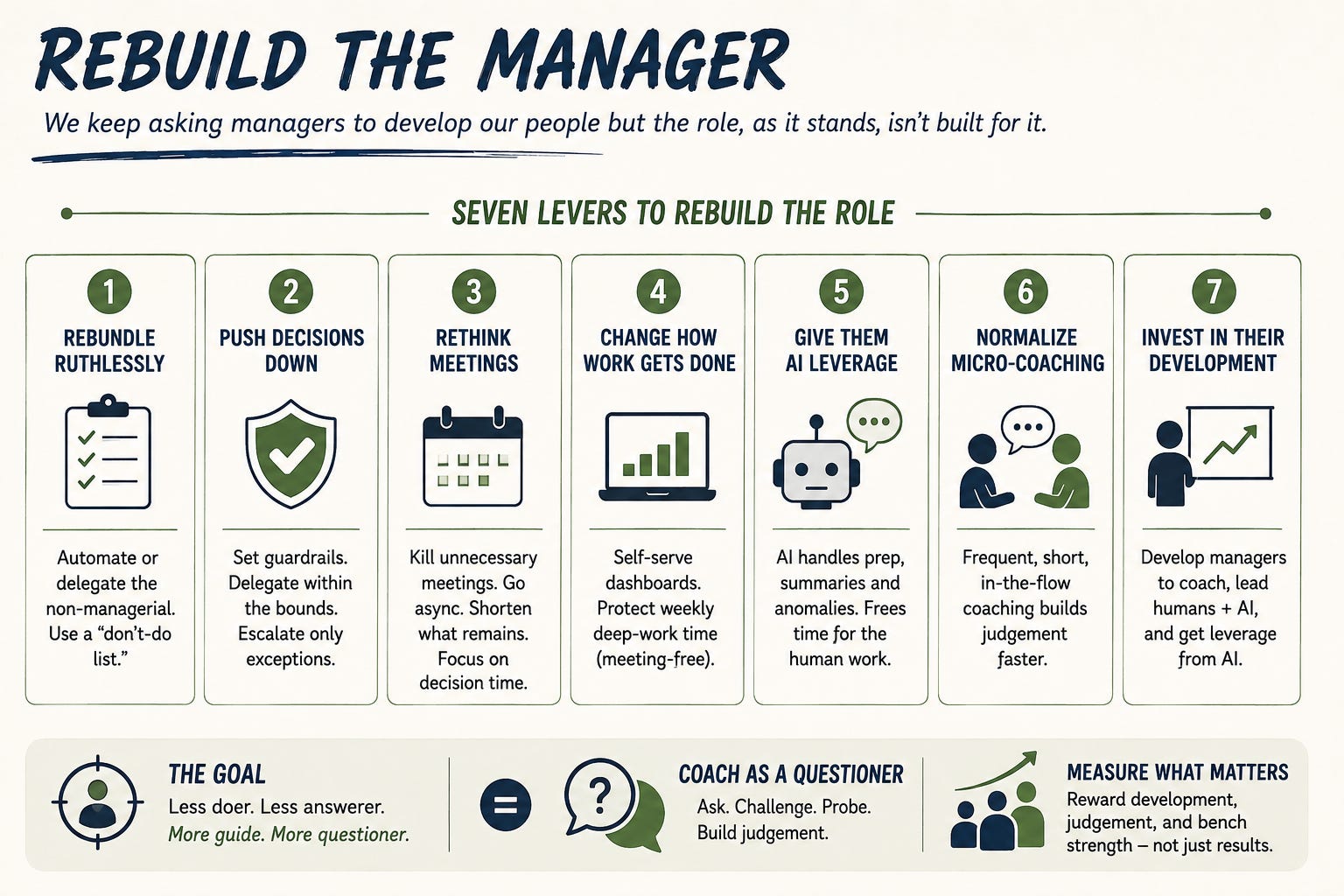
There are seven levers for the CPO to pull - most of these are not things that a manager can pull for themselves, so the CPO has to take the lead:
Rebundle the role ruthlessly. Start by looking honestly at where your manager’s hours actually go, and automate or delegate everything that isn’t genuinely managerial - the status updates, report compilations, data consolidation. Hand as much of this work to the machines as you can. As important, be explicit about what the manager should no longer do. A “don’t-do list” is as important an element of the job description as the duties you actually want them to do. Without this latter list, any freed-up time simply refills with work they shouldn’t be doing - and nothing actually changes.
Push decisions down, with clear guardrails. A great deal of manager time is consumed in being the approval point for decisions that never should have reach them in the first place. Set clear parameters - financial thresholds, escalation triggers, pre-agreed playbooks - and delegate everything within those bounds to the people below. Decisions inside those guardrails shouldn’t come to the manager, only the genuine exceptions. (This might require, if you’re honest, a broader rethink of your decision-making culture.) This gives the manager time back, and it also forces judgement onto the very people they’re trying to develop.
Rethink meeting culture. This rule is easy to identify but difficult to implement: kill meetings that don’t need to be meetings. Review standing meetings and ruthlessly assess which ones are absolutely needed. Move status updates, basic reporting and routine reviews to asynchronous channels - a dashboard someone reads on their own time, not a meeting that requires a read out in-person or virtually. For those meetings that are necessary, establish the one required goal of that meeting and shorten it to the minimum length of time needed to get to resolution. Send pre-reads (where applicable) ahead of time, so that meeting time itself is spent on debate and decisions, versus recaps.
Change how work gets done. Make dashboards and analytics self-serve, so no one has to convene to review numbers they could have read over email or via an app. Protect a defined portion of every week - a day, or a half-day at least - as meeting-free time for the deep work of developing people. As the CPO, you need to model and mandate this. This will be a challenge (many organizations just don’t work this way), but it’s a commitment that will pay off.
Give them their own AI leverage. This one is obvious: the same tools eating the manager’s time can give some of it back, if used in the right way. AI can draft summaries, surface patterns, prep one-on-ones and flag anomalies - which frees the manager to do the human work on top of it. The goal is to automate around the manager, leaving them with the time to do the work they should be doing. (And don’t forget to factor cognitive discipline into the mix.)
Normalize micro-coaching. The image of coaching as organized, scheduled, hour-long sit-downs is part of the problem. Sometimes that is what’s needed but more often, it isn’t. The most effective coaching is quick and frequent - for example, a five-minute exchange in the flow of the actual work, tied to the live problem in front of the person; or a well-placed question just as a report goes out; or it could be as simple as a two-minute debrief after a supplier call. Frequent, tiny, in-context touchpoints build judgement far more effectively than monthly reviews, plus they fit inside real calendars in practical, workable ways.
Invest in the manager’s own development. We pour enormous energy into developing juniors and almost none into developing the people meant to develop them. We just expect our managers to develop on their own (or worse, think they’re past the need for development). That’s just wrong. Managers need explicit development plans of their own: how the role itself is changing, how to coach judgement rather than dispense answers, how to lead blended human-and-agent teams, and how to get genuine leverage from AI in their own work rather than drowning in it. The manager is the multiplier - and investing in them multiplies their realized value.
Coach as a Questioner - and Measure It
The levers above represent the key steps every CPO needs to take to rethink the manager’s role.
But even if we’ve done the hard work to restructure that role, even if we’ve automated what’s necessary and protected the manager’s time, the fact remains that the redesign can still fail, for two specific reasons.
First, how a manager coaches matters more than how much time they have to do it.
Consider the most natural thing in the world for a busy manager to do: a direct report comes to them with a problem and the manager, who’s seen this a hundred times, gives them the answer. Problem solved. It’s fast and it feels like good work, but it’s actually an incredibly corrosive habit.
Because every time the manager supplies the answer, they buying speed today but paying for it in dependency tomorrow. No judgement is built on the part of the employee, who learns over time that the fastest path is to just bring it to the boss. In time, the manager becomes the bottleneck as judgement across the team atrophies.
This issue has been around since the practice of management began- but it resonates even more strongly today in a post-AI world. If we accept the idea that handing people answers erodes their judgement, then we should trust that instinct just as much when AI does the same thing. The ‘manager-as-answer-machine’ is simply the human version of the discernment trap I described earlier in this series. AI just makes it more urgent.
Which is why the manager’s core developmental posture, in an age of AI, is the same one I’ve argued the tools themselves should take: be a questioner, not an answerer; a Socratic coach, not an oracle. When a direct report raises an issue, ask “what have you considered? What’s your strongest argument for an action? If this call is wrong, how reversible is it?” The manager that does this builds judgement in their people.
In addition, managers should also administer the explain-back test: “Walk me through how you got here - what did you assume, and where could this be wrong?” Direct reports who cannot defend their reasoning behind an AI-assisted piece of work are guilty of cognitive offloading, and explain-backs spot this in the course of the normal coaching process.
The second key reason a redesign can fail is to do with measures and incentives.
I’ve made the argument before that you get the capabilities you measure: talent development is stunted when performance reviews measure the wrong things. If a manager is measured purely on their team’s savings number and delivery throughput, coaching is always going to lose, because when the quarter gets tight - and it always does - the manager will, entirely rationally, drop the developmental work that isn’t part and parcel of their review to protect the numbers that do.
So the manager’s scorecard has to widen. Alongside the traditional delivery metrics, you have to find ways - however imperfect - to measure and reward the people development: whether the team’s judgement is visibly growing, whether their reports can defend their own reasoning, whether they’re building the bench.
Net-net: redesign the role to focus on coaching, insist on the Socratic method rather than answer-dispensing, and then measure it.
The Catch
None of this is easy. I recognize that. Everything I’ve described is genuinely hard.
The demands on the manager are real and rising, and the risk of burning them out is real. If you take this post simply as “here are more things for the manager to do,” you’ll make the problem worse.
But that is exactly the point of - and the need for - the redesign, and the reason the rebundling has to be disciplined rather than aspirational.
This is not “coach more, on top of everything else.” It is coach instead - a genuine swap, in which the execution and administrative work is removed, automated, delegated and pushed down, allowing the newly freed up space to be deliberately filled with the developmental work that is the manager’s actual job. To do otherwise, and to do it sloppily, means that coaching becomes additive, and we’re right back where we started.
Done properly, though, this is probably the single highest-leverage move a CPO can make. Because the manager is indeed the load-bearing wall of the talent development model we’ve spent months rebuilding. Every framework, every developmental model runs through the manager.
Strengthen the manager, and the whole structure holds. Neglect them, and it won’t matter how good the blueprint was. No one will be left with the time to build it.