


Over the last couple of posts, I’ve drilled into the CPO’s talent agenda, looking at where the development focus in a post-AI world should be, by level, within the organization, and then analyzing how we should rebuild the role of the manager, which happens to be the load-bearing wall when it comes to developing this talent.
That said, all of this only matters if you have the right talent to develop in the first place. Leaders can only build value-creating Procurement teams if they have people worth developing.
The challenge today, though, is that the measures and metrics we’ve relied on to hire, assess and promote talent are under serious question. Some are less effective than they used to be, while others are no longer fit-for-purpose.
In other words, the instruments we’ve relied on for decades to recruit, evaluate and promote our people have stopped working. And unless we get that right, we’re going to have a problem building Procurement teams that can fulfill their potential in this new world.
So how, then, do you know that you’re building the right talent pool for a post-AI world?
That is the question I’ll explore in today’s post.
The Signals Are Gone
Think about how we hire, evaluate and promote:
We review cover letters and resumes en masse and cull them down to the select few worth interviewing, post which we conduct remote interviews to gauge candidate fit and quality, finally culminating in an in-person interview to make the final selection.
Once hired, we look at the individual’s work outputs and impact (usually their savings delivered, efficiencies captured, etc.) to gauge their performance, using these measures (along with perhaps a couple of other metrics) to assess how they’re doing.
We then aggregate these measures and performance history over time to determine their progression within the organization.
But there’s a problem: all of the old proxies that we’ve become used to are broken. Because, in a post-AI world, everyone can present as competent - and technology is the reason why.
Yes, of course, technology has been a boon in the talent management process. AI tools allow us to rapidly assess resumes at the press of a button; remote interviewing has materially reduced the costs of the interview process; goal-tracking software, feedback automation, workforce analytics allow us to infer ongoing performance and productivity; while skills and competency-inference tools help us to assess an individual’s development and readiness for promotion.
But, intentionally or otherwise, technology has also allowed the process to be (seriously) gamed.
To start with, AI has resulted in a near-total contamination of the hiring process. The majority of job applicants (up to 80% according to SHRM) are now using AI to generate cover letters, resumes, and to conduct interview preparation. Every single one of these outputs looks polished and reads great. On top of that, there are even emerging tools that provide real-time interview assistance, providing interviewees with live answer overlays to questions as they’re being asked, unbeknownst to the interviewer. The net of it all, as discussed in an HBR article that surveyed 6,380 screening sessions: companies are basically hiring for those who are best at navigating the recruitment process, not the best at the job itself.
Even when we look at ongoing employee performance, there are genuine question marks. People are using Gen AI to proliferate AI-slop, and it’s pervading the workplace: work product that looks polished but is actually low to moderate quality - and there’s a real question as to how much of this quality drop-off is being picked up (in time). We then have the potential for systems sitting on top of this work that generate and interpret aggregations and summaries and analytics that managers make decisions on. But if we have questions about the data at source i.e. the actual work product itself, then we have to ask whether these performance summaries will convey any real meaning, or whether we’re simply relying on interpretive signals based on work that has been hollowed out at the source. In other words, our traditional approach of assessing throughput and productivity may not measure quite what we think it should in a post-AI world.
This has natural follow-on implications as we assess who we should promote. We have to question whether we’re doing so on the right bases, whether these individuals are truly fit for the new Procurement world we’re in, and whether they will be capable of flourishing in an outcomes-driven world that demands the ability to deliver value beyond (simply) the traditional metrics of savings and efficiency.
TL;DR: what got us here almost certainly won’t get us there, because, again, in a post-AI world, everyone can now present as competent.
What To Focus On
So what is the CPO to do?
Their focus, as we’ve discussed over the last few months, should be squarely on assessing their people across the Future-Proofing model’s three constituent parts:
Enabling Layer: Is the individual AI-literate? How comfortable are they with tech and AI tools in general, and how well have they integrated these tools into their daily disciplines? Do they consume AI critically or passively?
Differentiating Layer: What is their inclination towards orchestration? What is their aptitude when it comes to business acumen? How strong are their human leverage capabilities?
Orientation Lens: Is the individual focused on driving towards outcomes? Are they focused on getting to results - defined broadly - versus ‘sticking to process’? Can they explain their work, their goals and their impact in terms of the organization’s overarching objectives?
(Once again, as I stated when I laid out the model, practical Procurement knowledge - the working understanding of the nuts and bolts of the Procurement function - is a hygiene factor rather than a differentiator, except in the case of junior hires, for whom these capabilities must, of course, be developed, which is why it isn’t referenced directly in the model.)
The key is to understand not only their proficiency and ‘current polish’ at each layer but also their trajectory i.e. whether they are trending in the right direction when it comes to these capabilities.
But these questions cannot be answered using the old assessment tools - paper records and ‘traditional’ work outputs - and then correlating accordingly. AI, as I’ve mentioned earlier, has severed that correlation.
Leaders must now assess these traits directly, in ways that many are not accustomed to doing. In other words, what the post-AI world also calls for is a rethink of how we assess hiring, performance and promotion.
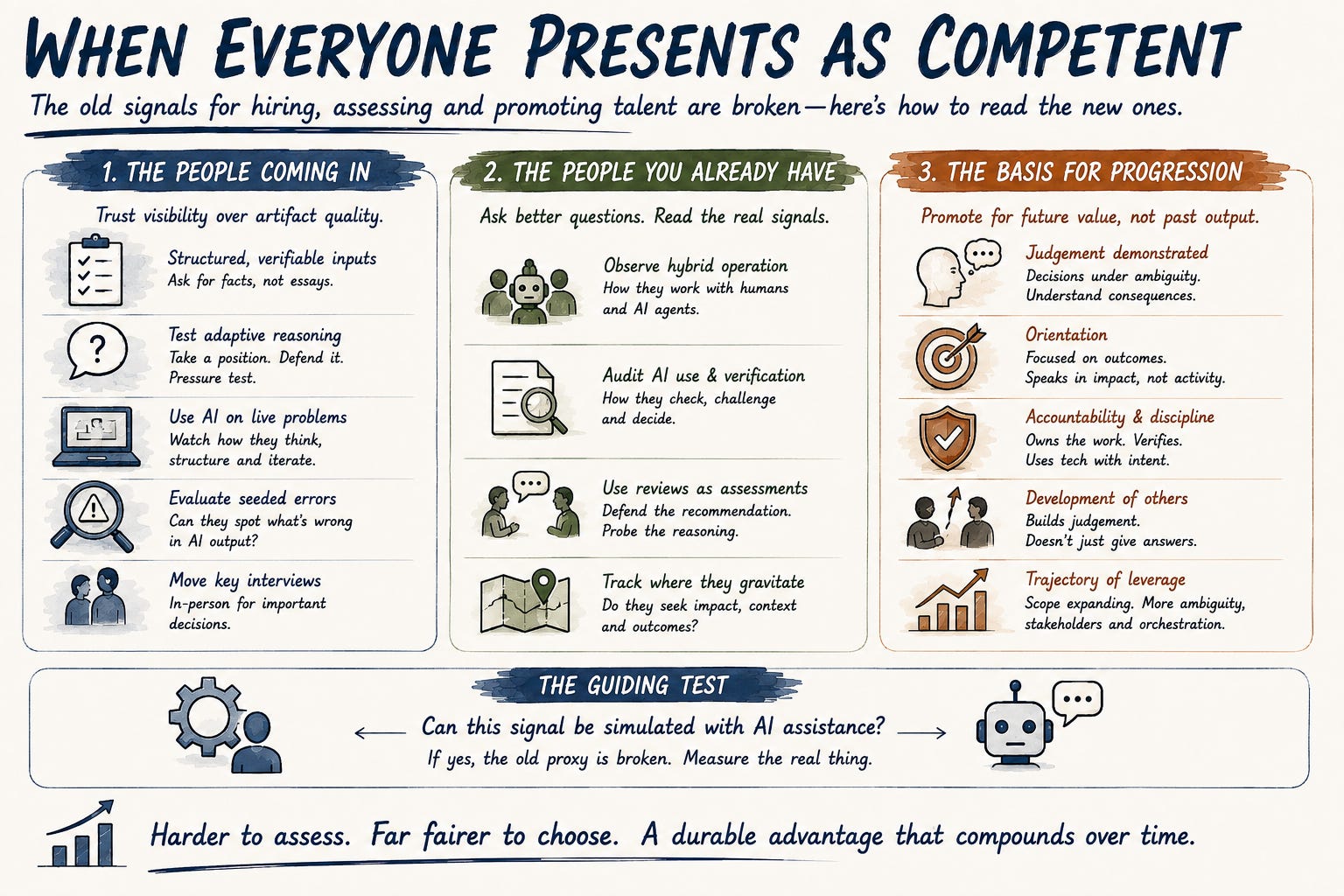
Essentially, the governing test we need to apply at all stages is: Can this signal be simulated with AI assistance? If so, then that’s the broken bit that needs to be fixed.
Let’s dive into this from the three specific contexts: the people coming in, the people we already have and those we want to promote.
Context One: The People Coming In
The key during the recruitment process is to trust visibility over artifact quality. That is, evaluate what people are able to do and discuss versus (just) what they say they produced.
This translates into a host of tactics:
Ask for structured, verifiable inputs versus open narratives: There is an argument to replace free-form resumes with structured surveys that ask about specific, checkable facts e.g. categories managed, spend under control, team sizes overseen, etc. These are facts that are easier to check and validate.
Test adaptive reasoning: Give the candidate a scenario and ask them to take a position on it. See how they defend their argument. Pressure test during the discussion, taking alternative tacks and see how well they respond and, at the very least, reason their way through.
Leverage AI to solve live problems: Instead of banning the use of tools, incorporate them into the interview process. Give them a realistic category problem and ask them to work through it live. The point is to gauge what questions they ask, how they break down the problem, structure their approach, and how they iterate their way to the answer (the exact nature of which doesn’t matter as much as their questions and their process).
Evaluate seeded errors: Give the candidate an AI-generated analysis that contains subtle flaws - perhaps a supplier assessment based on overgeneralized or wrong assumptions, or a savings model with a buried error. Assess how they analyze the output, whether they can find what’s wrong and what they suggest should be done.
Move key interviews to in-person: For all key decisions, move away from the remote interview, regardless of level. With the current and emerging state of AI tools, there is too much room for gaming the system and, given the importance of human leverage skills, in-person is the most effective way to assess personal capabilities.
The bottom line - stop weighting anything that can be AI-assisted unless it’s intentionally co-opted into the process. Otherwise, you’re just processing noise.
Context Two: The People You Already Have
The issue with external recruitment is that, in most cases, we are signal-poor i.e. we don’t have the evidentiary basis to assess an individual’s capabilities and so we need to engage and understand them via the tactics above.
Internally though, we are signal-rich: we have access to all the data we need. We just need to learn how to read it - by asking better questions:
Observe how they operate in a hybrid environment: Watch how they actually work day to day - how well they integrate technology into their workflows, and how fluidly they navigate between humans and agents to get work done. Assign work that requires both and observe where they lean. Comfort with the hybrid approach must become a baseline signal of readiness, and it is only visible through observation, not self-reporting.
Audit how they actually use AI - especially at the point of failure: Review their working process, not just their output. How and what do they verify before sharing an analysis? Where do they make decisions to override the AI output? Can they explain their reasoning, or why they rejected an alternative? Most revealing of all: when the AI output is confidently wrong, do they catch it? Ironically, the practitioners who take a little longer to produce might often be the ones adding the most value.
Use reviews as assessment instruments, not simply status updates: Restructure review conversations so that defending the recommendation is the point. Question consistently and probe the reasoning behind every recommendation. Can they defend their position under sustained questioning, or do they repeatedly forward polished outputs that they can’t interrogate? This should be a standing discipline, not a periodic test.
Track where they gravitate within the Future-Proofing model: Give people discretion in how they approach their work, and watch where they naturally move. Do they gravitate toward orchestration, stakeholder engagement and business context - or do they retreat to execution work? Can they think outside the ‘process’ to get to results? Can they hold their own in contextual and strategic discussions with principal stakeholders? Discretion reveals inclination, which reveals where their natural strengths lie.
Note the questions above reiterate the importance of the rebuilt manager role we discussed in the last post. They are the ones closest to the ‘signals’ and hence our primary assessment engine when evaluating talent within the organization.
Context Three: The Basis for Progression
One thing that should be clear based on the discussion above as well as prior posts is that promotion based on the metrics of old (savings delivered, efficiencies captured) will not suffice. Given how AI is taking over so much of the work that delivered ‘value’ historically, as well as how the nature of the practitioner role is evolving, we need to assess performance based on criteria that will ensure success in the future, not in the past.
These criteria encompass:
Judgement demonstrated, not output produced. Has the individual shown the ability to make decisions under ambiguity? Do they understand and rationalize the consequences of those decisions? Can they reconstruct their reasoning?
Orientation. Are they focused on outcomes versus activities? Can they speak to their work in terms of impact and changes delivered versus tasks accomplished? Do the stakeholders they serve credit them with the outcomes achieved?
Accountability and verification discipline. Do they take accountability for everything they produce? Are they able to determine when to deploy technology, when not to, and how to strike the right balance? Are they willing to slow down to get to the right results?
Development of others. Do they build judgement in the people around them, or do they simply dispense answers? How are they helping to build judgement versus simply ‘getting the work done’?
Trajectory of leverage. Are they trending in the right direction - towards the layers and capabilities within the Future-proofing model? Is the scope of what they can own expanding? Are they able to take on more ambiguity, more stakeholders, more orchestration?
Harder, But Fairer
The tactics detailed above are hard, in that they take work and investment to implement. But they’re essential.
They are the far fairer way to assess capabilities because they measure them directly, in action, versus on paper. They force validation via real time engagement and adaptive reasoning.
These tactics and metrics also provide an added benefit: those who are fully capable but present less well now have a valid shot at being seen and moving forward. These are the folks who have perhaps gone through career changes, who have track records that are less glamorous or “brand-forward”, who have always done the work but not been able to ‘showcase’ themselves effectively.
Real results over paper pedigrees. Probably the most valuable dividend from this approach.
The Compounding Advantage
All of this is learnable and quickly implementable. The tactics and measures can be embedded into existing hiring and evaluation cycles relatively quickly, without the need for new technologies. It just requires commitment and effort.
And, it is an approach that compounds over time. The CPO that implements this thoughtfully will build a durable, meaningful advantage - bringing in, retaining and promoting people who can deliver real human value in an era where the machines will play an ever larger (and more compelling) role.
The results should, and will, speak for themselves.