


Over the last few weeks, I’ve laid out my model for future-proofing the Procurement practitioner, which is made up of three layers:
The Enabling Layer — comprising AI Literacy and Cognitive Discipline
The Differentiating Layer — comprising Orchestration, Business Acumen and Human Leverage
The Orientation Lens — comprising the outcomes towards which we orient our efforts
I’ve detailed the key capabilities within each layer and also provided practical suggestions as to how to best build those capabilities.
(It’s worth reiterating that foundational Procurement skills are not on this list and that’s entirely intentional. My assumption is that you have already developed that Procurement knowledge - core sourcing skills, category expertise, etc. - that forms the technical and foundational basis of your work. These are table stakes, not differentiators.)
To wrap up our discussion of the Future-Proofing model, there’s one final question we need to address - and it’s a harder one than it might at first look:
How do you build and keep these capabilities over time?
AI Is Changing How We’re Learning
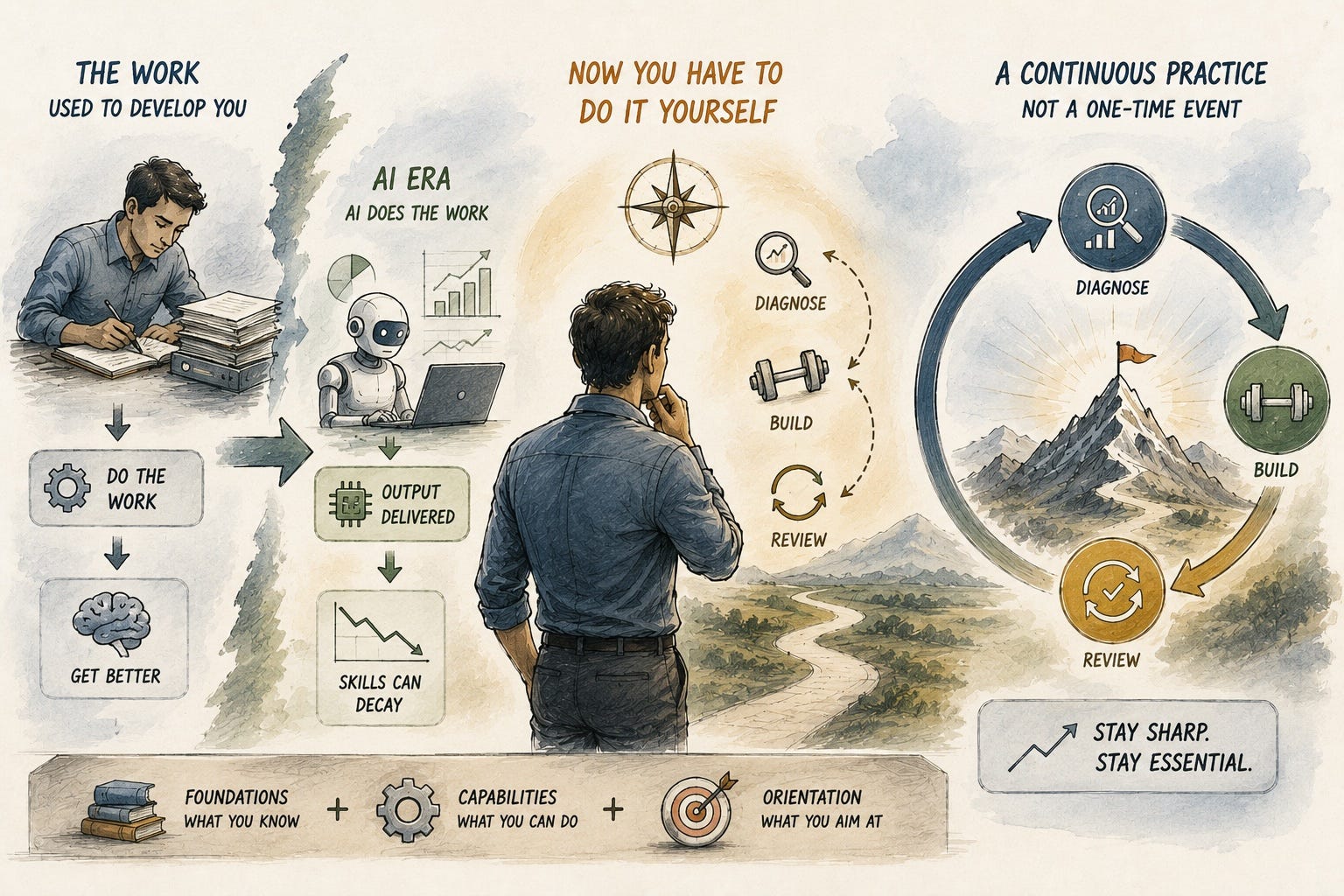
In the world before AI (certainly Gen AI), simply doing the work developed you automatically. You understood and managed spend, and then ran sourcing events, and got better at all the requisite skills required to do that work. In other words, the skills you needed to succeed as a practitioner were baked into the work itself. The more you did it, the better you got.
That’s no longer the case. AI is now absorbing exactly those reps that built the muscle. Today, you can pick any core procurement task or capability and there’s a piece of technology ready to take it over and do it 24/7.
So for the first time, the work will no longer develop you by default - and certainly not when it comes to the more progressive skills laid out in the future-proofing model above. You, as the practitioner, have to deliberately manufacture the development that the job used to hand you for free, especially in terms of these higher order skills.
There’s one more issue, and this is what makes the situation urgent rather than just interesting: your skills can decay even as you feel more productive than ever.
Why? Because, from an activity standpoint, nothing in your weekly calendar will tell you you’re not delivering. The deliverables will still ship and the events will still close - but that’s because AI keeps the output flowing even as the requisite capabilities and judgement underneath it erode. That might be tenable, for now. But at some point, it won’t be.
Which is why capability development - in the right areas - cannot be left to chance. It has to become a practice.
So how do we build that practice? Three actions: diagnose, build, review.
Manufacturing Your Development
1. Diagnose your trajectory - not just your level
Most self-assessments ask “Where am I?” The more useful question in an age of AI is “Which way am I moving?” The risk isn’t being an 8 out of 10 on cognitive discipline today; it’s sliding from an 8 to a 5 without noticing because AI took the work.
So map yourself across the seven capabilities of the model on two axes.
The first is Proficiency - but assess it by evidence, not feel, because feel is exactly what AI corrupts. Don’t ask how confident you are in your business acumen or your human leverage; ask whether you can point to a specific, recent moment where you visibly exercised it - and what came of it. When did your read of the business actually reframe a category decision? When did you move a resistant stakeholder? When did you catch an AI output that was plausible but wrong? If you can’t name an instance, that’s your answer, however strong you feel.
The second axis is Trajectory - which direction that proficiency is heading. And the cleanest way to gauge this is to assess whether your role still hands you real opportunities to exercise this capability, or has AI absorbed them? “I used to do this constantly, but lately the tool handles it” is not a neutral observation - it’s indicative of a downward slope.
Basically, that’s only two questions per capability: show me a recent instance, and are the reps still coming? - so assessing where you stand on all seven capabilities is a five-minute task, not a fourteen-point audit. If you do this honestly, it gives you four positions (see image below):
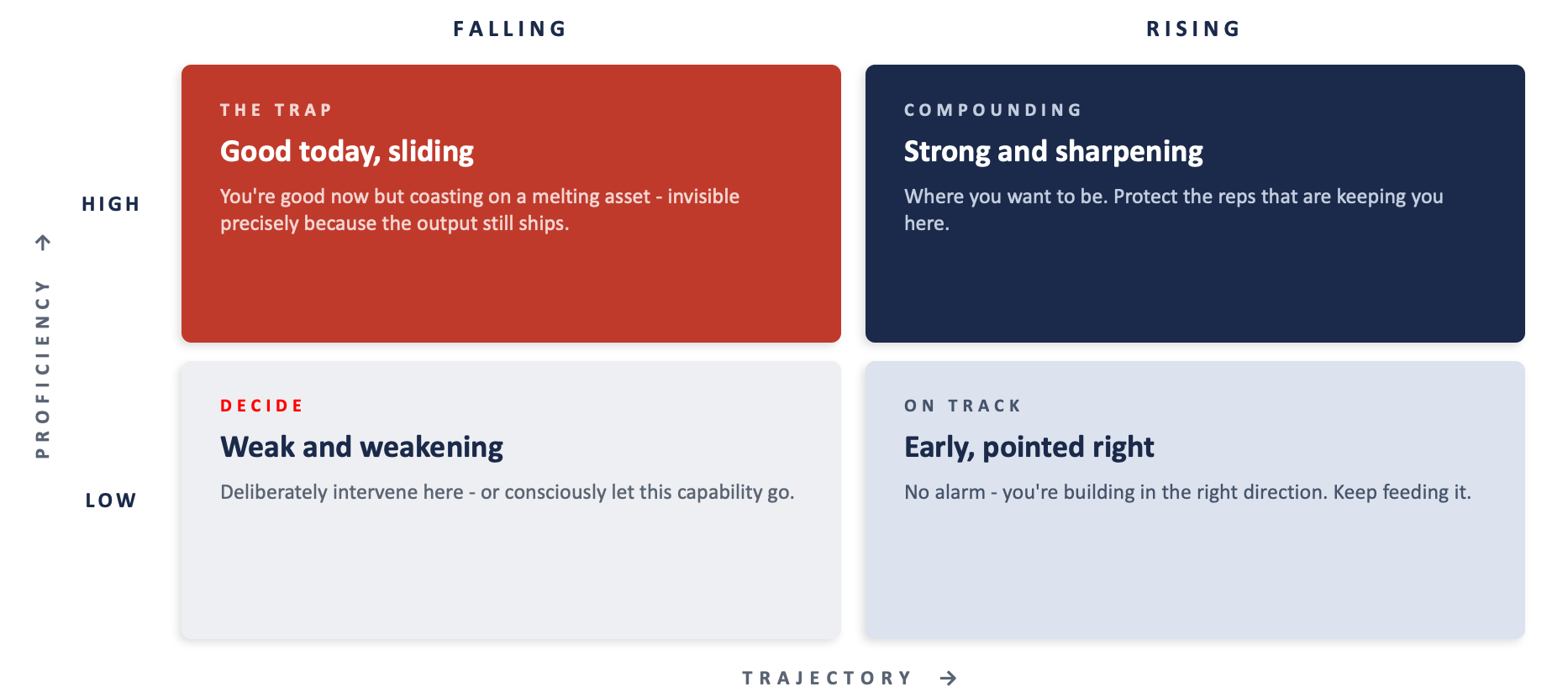
High proficiency, Rising Trajectory: You’re strong here and still getting sharper; protect the work that’s keeping you there
High proficiency, Falling Trajectory: The dangerous box: you’re good today but coasting on a melting asset
Low proficiency, Rising Trajectory: No cause for alarm; you’re early but on the right trajectory, so keep feeding it
Low proficiency, Falling Trajectory: The capability is weak and getting weaker; this is where you either intervene deliberately or consciously let it go.
The value of this map is that it tells you where to spend your development time, because, critically, you shouldn’t be spending it evenly across all seven.
2. Build the practice - defend hardest what AI erodes fastest
The capabilities in the model don’t all decay equally: AI erodes the muscles tied to the work it does for you. The thinking work - for example, cognitive discipline, and downstream of it, judgement - is under active erosion every single day you use the tools unconsciously. The capabilities AI doesn’t do for you - your relationships, your exposure to the business, etc. - erode the same way they always have, through your own neglect.
So we defend hardest what AI erodes fastest and focus on the most prominent skill gaps. In rough order of priority:
Keep a decision journal. This is one of the single highest-leverage habits you can have, because it hits three capabilities at once - judgment, cognitive discipline, and, if you log how you read the room, human leverage. Record the consequential calls you make, your reasoning, and what you expected. Then go back and close the loop on whether you were right. This is how judgment is maintained when AI is making the easy calls for you.
Embed deliberate friction. Be skeptical about what you’re getting back - from AI, from the process, from the way things have always been done. Before you accept an AI-generated answer on a call that matters, write the one-line counter-case: what would make this wrong? That single sentence is cognitive discipline in practice.
Re-architect one workflow each quarter. Orchestration doesn’t erode so much as it ossifies - you settle into a default human-plus-AI process flow. Maintenance here means deliberately redesigning a workflow you’d otherwise run on autopilot: who does what, in what sequence, where you step in at the seams.
State the outcome before the activity. We naturally drift, over time, back toward activity and process - it’s baked into many work environments. So on any given project, force yourself to name the outcome you’re orienting toward before you touch the activity. Are you focused on a meaningful outcome? Are you contributing to what matters? This ensures orientation stays alive instead of falling back into busywork.
Maintain an exposure diet. Business acumen and AI literacy grow through exposure - to the business, to supply markets, to what’s actually being impacted by AI and related tools. This is an ongoing, deliberate intake over time.
The key with the above is not to create a parallel development calendar to the work you’re already doing. Instead, bolt these onto the rhythm your Procurement work already has - the sourcing cycle, supplier reviews, QBRs, budget season. The work is already happening, so add in the necessary reflection attached to them. In other words: same work but with added intentionality.
3. Review - and course correct
A practice you never check is a resolution, not a regimen. So once a quarter, return to the diagnosis, not to just repeat it, but to understand if your efforts have been worth it.
The first diagnosis you run tells you where to spend your development time. The subsequent reviews every quarter ask a direct question: did it work? That capability you’ve spent the past quarter building or defending, is it actually growing and holding, or did it slip back? If it slipped despite your attention, then rethink your practice.
Another reason this regular review cadence matters is that the map moves under you. AI improves and evolves every quarter, which means capabilities that once sat safely in the “rising” column can slide toward erosion without you doing anything wrong. The fact is that the technology evolved and the ground simply shifted; something the tool couldn’t touch ninety days ago, it may absorb now. So re-scan: what does AI now do that it didn’t last quarter, and which of my capabilities did that just put at risk? Then you adjust where you spend your time, and reset for the next quarter.
That moving target is exactly why this can’t be a one-time audit, and why staying sharp is an ongoing commitment, not a box you tick once.
The Real Shift
For most of your career, staying good was a byproduct of showing up - the work did the developing for you. That era is over.
From here on, staying sharp has to be a deliberate act: something you actively focus on and develop, or else it becomes something you lose.
The practitioners who pull ahead in a post-AI world won’t be the ones who simply use AI best. They’ll be the ones who keep developing the right complement of skills while they use it - the ones who refuse to let fluency with the tools hollow out their judgement.
Of course, this entire playbook presumes a foundation. You can only maintain judgment you’ve already built, you can only journal decisions you’re already trusted to make. That works for the experienced practitioner.
But our juniors have none of that: they have no foundation to maintain or build on, while, at the same time, AI is busy removing the execution work that used to build it.
Which raises a genuinely difficult question: how does anyone come up the curve now?
That’s going to be our next set of topics, starting next week: the apprenticeship crisis.