


Over the last few weeks, I’ve talked about what remains human in Procurement at the individual role and subtask level, introducing the Human Edge Matrix, which allows practitioners to assess how much of what they do remains human, what is augmented, and what can be fully automated.
I also put forth my argument that what actually remains human - independent of capability - really isn’t even procurement’s decision to make. It’s shaped by what its internal customers and suppliers value and trust. As part of this argument, I laid out the seven outcomes that stakeholders actually care about and how to assess what remains human in the context of those outcomes.
All of this gives us a view of what stays human.
But it also raises the next obvious question: if we know what stays human, what do we actually build around it?
In other words, once we’ve identified the work that remains ours, we can’t just cobble together the remnants into our prior architectures. We need to rethink what the enterprise genuinely values - ideally, into something that cannot be eroded by the next wave of AI tools or absorbed by an adjacent function because ‘Procurement isn’t delivering commensurate value’.
To me, this is where the conversation needs to go next, especially for CPOs. Because if you’re sitting at your desk today, trying to build a Procurement function that will still matter in five years, you need a clear answer to the question: what am I building toward?
This post is my attempt at that answer.
A Different Way To Think About The Function
So what does the architecture of the Procurement organization look like in a Post-AI world?
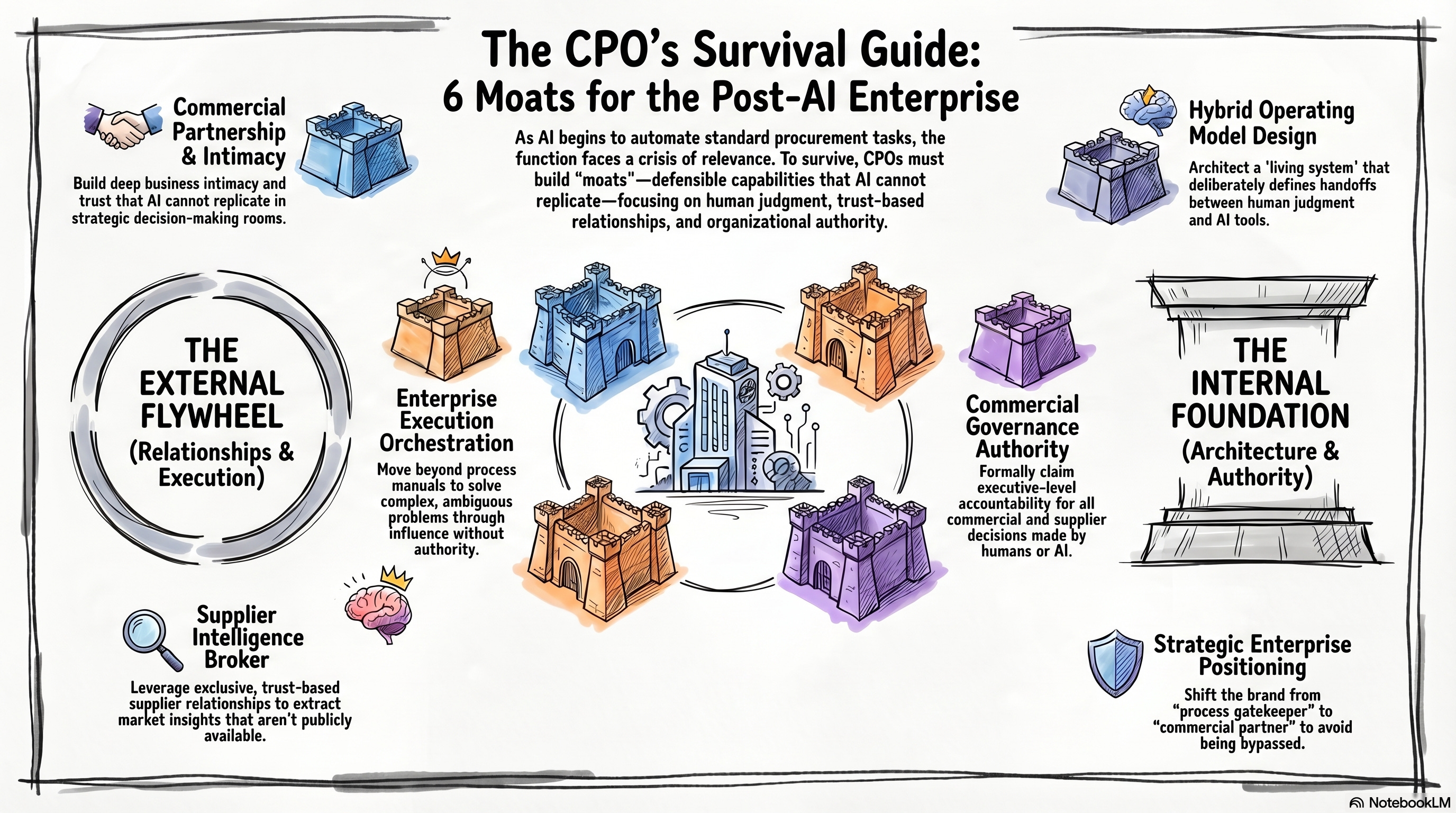
While it’s tempting to think of this in the form of boxes on org charts or specific skills that need to be retained or developed, I think it’s more appropriate to visualize this architecture in the form of organizational moats. That is, capabilities that Procurement needs to build deliberately if it wants to remain relevant, valued, and credible in a post-AI world.
Note that I’m using the term ‘moats’ in the loose sense - borrowing from the competitive strategy world, where it refers to a structural source of defensibility (something that’s hard to replicate and that compounds over time). Michael Porter alluded to this through his Five Forces work, Warren Buffett popularized the idea in his shareholder letters, and Hamilton Helmer formalized it through his seven “powers” framework.
I’m not trying to shoehorn Procurement into any of those perspectives but, instead, I’ve taken inspiration from their models, especially the idea that defensibility should constitute both a benefit and a barrier, and applied it to what I believe a post-AI procurement function needs.
A quick note before I get into the moats: this is not a list of skills. Skills live inside individuals and I’ll tackle those in upcoming posts. For example, judgement is a differentiating skill but it’s embedded in all six of the moats I’ll describe. It’s not a moat in and of itself.
Similarly, the ability to develop the next generation of talent is also not a standalone moat, in my view. It’s the maintenance layer that keeps it all intact over time. Important but not distinct items on this list.
The moats I’ll discuss are the organizational capabilities that CPOs need to be deliberately building: defensible terrain that comprises the architecture of the function, not the people inside it.
The Six Moats That Matter
There are six moats I’ve identified:
Two customer-facing moats (commercial partnership and execution orchestration)
One internal-facing moat (hybrid operating model design)
One supplier-facing moat (supplier intelligence broker)
One structural moat (commercial accountability and governance authority) and
One about perception (enterprise positioning).
These cover, in my mind, the major surfaces where procurement creates and defends value.
Some of these moats exist in mature form in some functions today, though most don’t. All of them, I’d argue, are the things a CPO should be investing in now if they want their function to matter in a decade.
Let’s dive into each one.
1. Commercial Partnership
The first moat is procurement’s ability to act as a genuine commercial partner to the businesses it serves - not a process gatekeeper, not an order taker and not the function that shows up late to tell someone their preferred supplier isn’t on the approved list.
I mean a genuine commercial partner - someone who understands the business well enough to help shape what it’s trying to achieve, knows the category well enough to translate between commercial reality and operational need, and has earned the right to be in the room when real decisions get made.
There are three components to this that have to be built together:
Business intimacy - the ability to hold a substantive conversation with the ‘consumer’ of the category about strategy, market dynamics, competitive pressures, and operating model choices, without needing a translator
Category depth - genuine expertise in the supply markets, cost drivers, and supplier landscape relevant to that internal customer’s work, so procurement can contribute ideas rather than just react to requests
Stakeholder relationships - the accumulated trust and rapport that makes internal customers want to involve procurement early rather than late (or worse, not at all)
Why this is a moat: The combination of these three things is rare, takes years to build, and is nearly impossible for AI to replicate - because it depends on context, relationships, and tacit knowledge that only comes from being in the conversations. An AI tool can surface market data but it can’t sit in a room and read the organizational or political dynamics of a leadership team debating whether to restructure a category. Once Procurement has earned partnership status, though, that status is sticky - once accumulated, it cannot be rapidly built by internal ‘competitors’.
What CPOs should be building: A deliberate model for developing commercial partners, not just category managers. That means rethinking hiring (possibly business generalists with curiosity, not just sourcing specialists), broadening training paths (focused on business acumen and stakeholder management), redesigning development opportunities (rotations into the business, not just within procurement), and creating explicit time and permission for the relationship work (including embedding these outcomes into individual metrics).
2. Execution Orchestration
The second moat is procurement’s ability to actually make things happen - to take a commercial problem and mobilize the people, process, suppliers, and systems needed to deliver the outcome.
And yes, I know the procuretech crowd uses “orchestration” in a narrower sense these days, usually around orchestrating AI agents across a workflow. That’s not what I mean. I mean orchestrating the enterprise: turning strategy into delivered value across stakeholders, suppliers, internal teams, and whatever AI-assisted workstreams sit in the middle. (A more sophisticated form of project management, if you will.)
This capability spans two ends of the spectrum:
Bespoke work - taking on a complex, ambiguous commercial problem that no playbook covers and figuring out how to deliver
Routine work - ensuring that standard buys happen without friction so the business never has to think about them
Both matter, and they reinforce each other. The trust earned from frictionless routine work is what buys the credibility to take on the complex, strategic problems (though not on its own and not without Moat #1 above).
Why this is a moat: Orchestration at this level depends on influence without authority, which is one of the hardest organizational skills to build and one AI has virtually no ability to replicate. It also compounds. A function known for making things happen gets invited into more things, which creates more opportunities to demonstrate the capability, which deepens the reputation further. Procurement’s very own flywheel.
What CPOs should be building: Explicit development of this type of orchestration muscle - which means giving people increasingly complex delivery challenges with real accountability, resisting the temptation to reduce orchestration to a process manual, and coaching them through the political and influence dimensions. Orchestration in this sense relates to judgment, intelligence, flexibility and an outcomes orientation - not a process orientation. You need a particular caliber of individual to be able to do this.
3. Hybrid Operating Model Design
The third moat is the internal architecture of how procurement work actually gets done (and the closest I’ll get to the idea of boxes on org charts in this conversation).
This involves the deliberate design of the Procurement operating model so that it’s clear which decisions route to humans, which route to AI, where the handoffs sit, how exceptions get escalated, how the AI tools themselves get governed, and how the function’s own workflow is structured so that humans stay sharp rather than getting progressively deskilled (or distracted by low value activities).
I appreciate that this can sound like an overlap with the first two moats but it’s actually quite different in nature. Commercial partnership is about how procurement engages the enterprise. Orchestration is about how it delivers outcomes. The operating model is about how procurement organizes itself to sustain both over time in a hybrid human-AI environment.
It’s effectively the plumbing, which most functions haven’t deliberately built as yet. The default approach to AI in procurement today is additive: bolt an AI tool onto an existing process, hope for productivity gains, and move on. That approach creates hidden liabilities:
It optimizes locally without asking whether the overall flow still makes sense
It embeds AI decisions in places where accountability may still be unclear
It deskills the humans who used to do the work
A well-designed operating model does the opposite. It asks explicitly: where does human judgment add value here, and how do we protect the conditions that let it develop? Where does AI genuinely help, and how do we govern it? These are design questions, not technology questions - and answering them well is a capability in its own right.
Why this is a moat: Most procurement functions aren’t even framing these questions yet, let alone answering them deliberately. The ones that do will have a structural advantage in sustaining all the other moats because their humans will stay sharp and their work will stay coherent. As such, this is a meta-moat: one that holds the system together and allows the other moats to flourish.
(It’s also worth emphasizing that operating model design in a hybrid human-AI environment is an emerging discipline with very few practitioners. Building the internal capability to do it well is itself a cornered resource, because the people who can actually design these systems are few and far between, and will likely remain rare for years.)
What CPOs should be building: An explicit operating model design function - probably a small team or a named role - responsible for thinking about the human-AI-process architecture as a living system, not just implementing whatever the latest vendor sold them. This is among the least developed of the six moats in most procurement functions today, and the one where deliberate investment pays off fastest.
4. Supplier Intelligence Broker
The fourth moat is building on Procurement’s privileged position in the supplier ecosystem - specifically, the ability to extract genuine strategic intelligence from suppliers and translate it into value for the enterprise. This is one of the most underused sources of defensibility in the function today and, in my view, one of the most durable.
Here’s the core idea:
Suppliers - especially in strategic categories - know things the enterprise doesn’t. They see the market differently. They have perspectives on competitors, on technology trends, on regulatory shifts, on what other customers are doing. A procurement function with deep, trust-based supplier relationships can become an intelligence broker between that external knowledge and the internal decision-makers who need it.
But - and this is the catch - it only works if the relationships are genuinely trust-based. Which means procurement has to earn the right to that intelligence through years of reciprocity, discretion, and actually treating suppliers as partners rather than counterparties to be squeezed.
But most procurement functions don’t operate this way. The ones that do have built something extraordinarily hard to replicate, because the trust that enables the intelligence flow was accumulated over time and cannot be bought, copied, or AI-generated.
Why this is a moat: It’s a cornered resource in the strictest sense. The relationships are unique, the trust is non-transferable, and the intelligence flow depends on a position that only Procurement is structurally positioned to hold. AI tools can aggregate public supplier data; they can’t replicate a twenty-year relationship with a supplier’s CEO who is willing to share something they haven’t told anyone else. And the value to the enterprise - genuinely differentiated insight into the supply markets that matter most - is exactly the kind of thing internal customers will pay a premium for in attention, engagement, and budget.
What CPOs should be building: A deliberate architecture for supplier intelligence. That means identifying the categories where intelligence matters most, investing in the relationships that unlock it, creating internal mechanisms to translate supplier insight into decision-ready intelligence for business unit leaders, and - most critically - protecting the trust that makes the whole thing work by resisting the temptation to exploit suppliers for short-term cost gains. This moat is the easiest to destroy and the hardest to rebuild.
5. Commercial Accountability And Governance Authority
The fifth moat is different in character from the others. It’s not a capability procurement builds alone but a structural position procurement claims, formalized at the executive level, that establishes the function as the organization’s accountable owner for commercial and supplier decisions.
The question this moat answers is as follows: In a world where AI is increasingly recommending suppliers, flagging risks, scoring bids, and triggering contract actions, who is accountable when those calls turn out to be wrong?
The answer shapes where authority, budget, and relevance concentrate in the post-AI enterprise. And there are really only three possible homes for this accountability:
The business units that use the suppliers - which creates a clear conflict of interest, since the people making operational decisions shouldn’t be the same people overseeing them
A new enterprise function - like governance or technology risk, which gradually absorbs procurement’s commercial oversight role
Procurement itself - as the function with the cross-enterprise view, the supplier relationships, and the commercial context to bear it credibly
The third option is the one that preserves Procurement’s structural relevance. But it doesn’t happen by default; it has to be claimed, negotiated, and formalized - typically in partnership with the CFO and General Counsel, and ratified at the executive level. Once claimed, it becomes one of the most defensible moats on this list, because no other function is structurally positioned to take it over.
Why this is a moat: It’s a claim on organizational territory that, once established, is genuinely hard to dislodge. It also has an interesting property the other moats don’t: the threat isn’t primarily from AI itself, but from other functions - risk, legal, technology - that might otherwise absorb this accountability by default. Procurement that doesn’t claim this role loses it, and losing it erodes the rationale for procurement as a central function at all (which as I explained above, comes at a cost).
What CPOs should be building: The arguments, the relationships, and the internal capability to bear this accountability credibly.
Step one is a conversation with the CEO and CFO about where commercial accountability for decisions relating to the supply base - human and AI-enabled alike - should sit (and why procurement is the right home).
Step two is the internal capability - governance frameworks, decision audit trails, escalation protocols - that lets procurement actually discharge the responsibility once it’s been claimed
Without step two, claiming step one is reckless. Without step one, building step two is pointless.
This is the moat most dependent on executive alignment, and the hardest to build through sheer functional competence alone. Unlike the other five, you can’t start building this one tomorrow morning unless you already have the executive relationships to do so.
6. Enterprise Positioning
The sixth moat is the one Procurement has historically been worst at - and the one that most urgently needs to change.
It’s the deliberate work of shaping how Procurement is seen, engaged, and valued by the rest of the enterprise, including the service model that delivers on the positioning and the ongoing communication that sustains it.
Call it “branding” if you like, though I appreciate that that word triggers all the wrong associations in a Procurement audience. This isn’t about marketing fluff, logos, or internal newsletters. It’s about the gap between what procurement actually does and how the enterprise perceives what procurement does - a gap that, in most organizations today, is enormous and damaging.
If the enterprise sees procurement as a process gatekeeper, a cost cop, or a source of friction, then in a world where AI makes much of the process and friction disappear, the enterprise will stop routing work through procurement at all. The function gets disintermediated - for reasons not at all related to capability. Perception and reality have to move together, and right now they’re badly misaligned in most organizations.
Closing that gap is itself a capability, and it has to be built deliberately because it won’t happen on its own.
What does good positioning actually look like?
A clear, honest articulation of what procurement offers that no one else in the enterprise can
A service model designed around outcomes rather than process - for example, an account executive approach, where named procurement leads own the relationship with specific business units and are measured on commercial outcomes rather than activity metrics
Sustained, proactive communication that keeps the function’s value visible rather than assuming it’ll speak for itself
Most procurement functions do none of these well. The ones that do, stand out immediately.
Why this is a moat: Positioning, once established, compounds the same way brand does in consumer markets. A Procurement function that’s understood as a commercial partner gets invited into more strategic conversations, which produces more opportunities to demonstrate value, which reinforces the positioning. A function that’s understood as process overhead gets routed around, which reduces its visibility, which accelerates its decline. The flywheel runs in both directions, and the direction you end up in depends on whether you invested in the positioning work when it mattered.
What CPOs should be building: A deliberate positioning strategy, treated with the seriousness a marketing function would treat its brand. That means defining what procurement stands for, designing the service model that delivers on that promise, and creating the ongoing rhythm of communication and engagement that keeps it alive in the enterprise’s mind.
(Of course, it also means honestly assessing the gap, as uncomfortable as it may be - between current perception and desired perception, and building a plan to close it.)
One brief acknowledgment on this moat: it’s possible that in ten years, positioning won’t need to be a distinct capability, because Procurement will have rebuilt itself enough that the function’s value is self-evident. I don’t actually think we’ll get there that quickly - but even if we did, it would be a good outcome. For now, though, the gap is real, and pretending it isn’t would let CPOs off the hook for work that desperately needs to happen.
Where This Leaves Us
Six moats, then. Two customer-facing, one internal-facing, one supplier-facing, one structural, and one about perception and reputation. Each of them hard to build. Each of them defensible once built. Each of them compounding over time.
Two final points:
First, it’s worth noting that these six moats are not independent of each other:
While Commercial partnership and Execution Orchestration can exist without the Hybrid Operating Model Design moat, they won’t sustain in a post-AI environment unless the redesign happens
Commercial partnership and Supplier Intelligence Broker reinforce each other, as the insights from suppliers are often what make procurement valuable to internal customers in the first place.
Commercial Accountability & Governance Authority becomes credible only when the Commercial Partnership, Execution Orchestration and Hybrid Operating Model Design moats are in place to credibly justify it.
Enterprise Positioning will be hollow without the substance of all of the other moats before it.
A CPO thinking about where to start cannot, therefore, treat these as six separate investment decisions; they form a system, and the sequencing matters.
Second, if you’re a CPO reading this, ask yourself this: how many of these six do I have in any meaningful form today?
My own answer, based on the functions I’ve worked with across my years at A.T. Kearney and The Smart Cube, is that most have fragments of one or two, almost none have all six, and the most neglected moats aren’t always the ones you’d expect.
I want to come back to this topic in a future post, specifically on the topic of where a CPO serious about post-AI relevance should actually start.
For now, though, the framework itself is the starting point.
The CPOs who invest in these six moats now will run the procurement functions of 2030. The ones who don’t will be running something smaller, more marginal or possibly nothing at all.