


In my last post, I talked about six factors that are driving change across the Procurement function and why, as a result, most practitioners aren’t ready for the future that is unfolding.
For the most part, these factors are the result of developments or pressures from outside of Procurement that are subsequently having an impact inside the function.
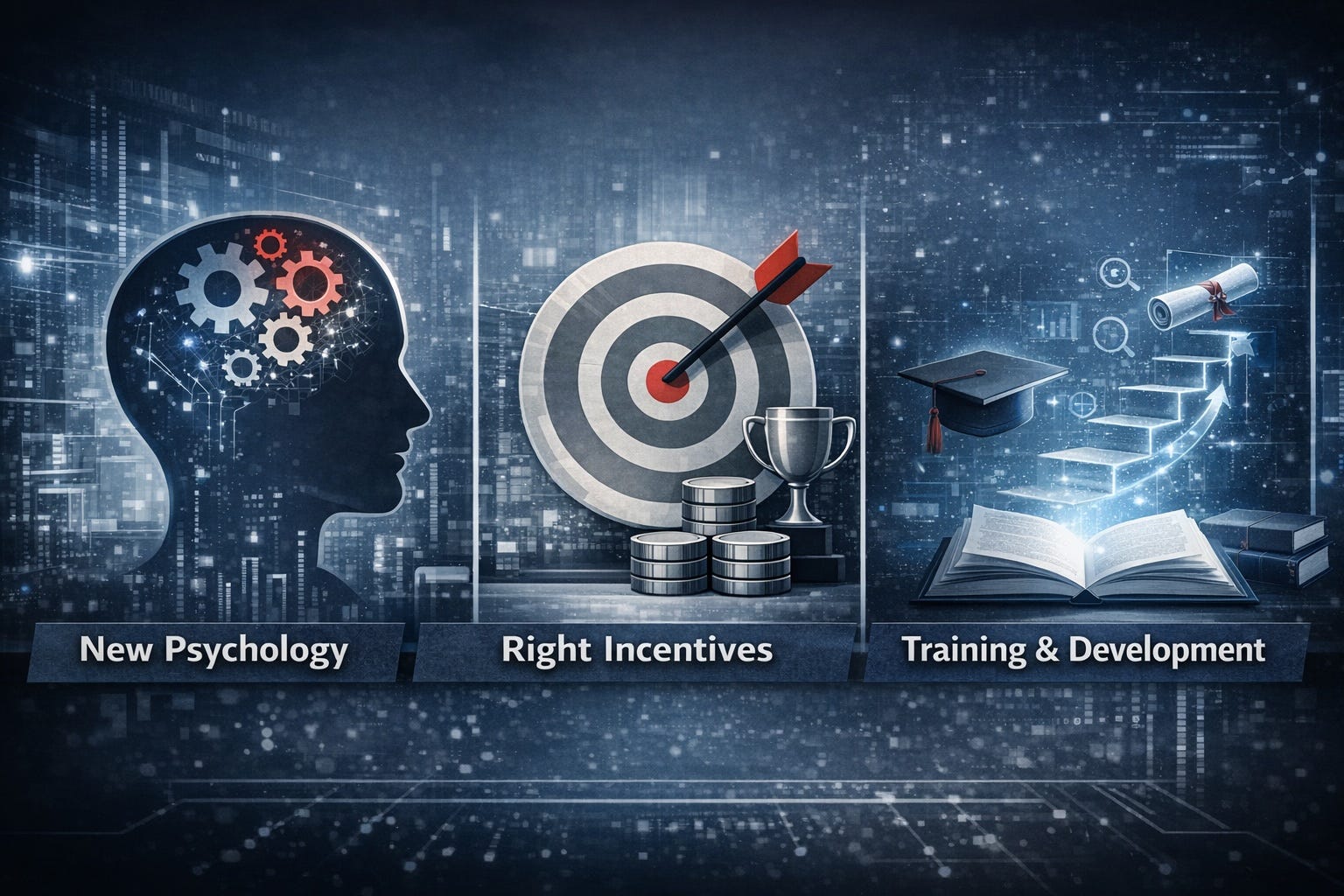
In this post, I want to dive into three very specific considerations that Procurement will need to grapple with as it looks to reposition and reinvent itself for a Post-AI world:
New Psychology
Right Incentives
Relevant Investments
Rethinking these considerations isn’t a ‘Procurement only’ problem - it will require support from individuals and groups outside of the function as well. But the impetus for change must begin, as it always should, with us.
Let’s dive into each of these in turn:
1. Towards a New Psychology
When I was with The Smart Cube, there’s a statement I‘d make in discussions with Procurement leaders and practitioners that would always elicit an immediate, visceral reaction - almost always at one extreme or another:
“Procurement’s goal should be to become the biggest value creator in the enterprise.”
As soon as I’d say those words, half the audience would look up, eyebrows raised and energized by the idea, while the other half would, subtly (and sometimes not so subtly), shake their heads, put off by it.
To me, that divergence in reactions encapsulates one of the core issues that impedes the function even today, even after the years of progress the function has made (and it’s got nothing to do with whether you believe my statement - meant as a ‘North Star’ - to be achievable or even realistic):
Do we believe in ourselves and what our mission could be? And do those around us share in this belief?
In many organizations, Procurement is still constrained by this psychology: how the function sees itself as well as how others in the organization view the function.
Of course, history has a part to play here. Procurement has come a long, long way from its ‘back office’ administrator era. We have better tools, more methodologies and a far better caliber of talent across the function.
But that progress is still unevenly distributed, both across and even within companies. Some Procurement teams have advanced, espousing ambitious goals, while others are still in ‘order taker’ mode. At the same time, many Procurement teams are still wrestling with others in the organization (from the C-suite to peers in other departments) who still hold on to the baggage of the “old” Procurement.
Beyond this baggage, there’s also the (rapidly growing) distance between where the Tech is taking the function versus what practitioners have been trained to do. Most Procurement professionals today are built for an era that is rapidly becoming “unfit-for-purpose”, one very much focused on:
Knowing the process
Working the data
Being the ‘expert’
Procuretech - and specifically, AI-First/AI-Enabled Procuretech, is changing that paradigm. As we’ve discussed in prior posts, the model is evolving to one where the prime skills will revolve around:
Optimal orchestration
Sound judgement and,
Delivering better outcomes.
In short, Procurement is moving from being valued for what it knows to being valued for the decisions it enables.
Thing is, we’ve not caught up to this shift, and even where we have in terms of mental acceptance of the idea, we’re certainly not there in terms of wholesale, practical, skills-based readiness.
So to me this is THE foundational issue. We’ve spent decades working to break out of the old psychology and, now, here’s this AI thing, further challenging our identity. That’s as much an emotional and cultural issue as it is a technical one.
2. Towards Better Incentives
If you want the right outcomes, incent the right behaviors.
That’s may be an age-old mantra, but it’s one we all agree on. So much so that we’ve seen significant progress putting it to work in Procurement over the years.
We’ve seen metrics galore: across the function as well as within every sub-function. We’ve seen them in cascading scorecards that encompass both hard and soft metrics. We’ve even seen two-way metrics that cross organization thresholds to include suppliers as well. (If you’re interested, I co-wrote an article for MIT’s Sloan Management review on this topic years ago.)
You would think that with all of this metric sophistication, we’d be in a far better place. Well, we are - and we aren’t. There are a couple of pretty major problems:
First off, most of our metrics today are focused on process and activity. Things like the number of RFQs run, or cycle time or pure savings booked. All useful metrics, for sure, but AI is making these metrics meaningless, because machines will administer a good chunk of the work that many of these metrics inform, to the point that they cease to become “human” metrics.
Instead, we need to focus less on activity efficiency and more on enterprise effectiveness i.e. outcomes (or as close to it as we can get). Outcomes like savings, for sure, but also our ability to:
Improve time-to-market
Avoid risk and increase resilience
Create optionality to manage for unpredictable business outcomes (versus just maximizing realized savings in the moment)
In other words, less of just “we delivered 3% savings” and more of “we enabled a product launch six months earlier by rethinking the supplier ecosystem”.
This mean rethinking our metrics, including expanding our definitions to encompass what constitutes better outcomes and then better measure our ability to help internal customers achieve them.
The second, and to me far more important, issue is that despite the plethora of available metrics, only a limited few are perceived to matter - and, most of the time, just one: hard savings, and more specifically, hard savings that hits my P&L this Fiscal Year.
But this so often leads to conflicting incentives. Not just because of the short-term-ism that it manifests in behavior, but also because better outcomes don’t always manifest themselves in the form of dollars and cents (near-term or otherwise). We’re paying Procurement to be a steward of enterprise value but then we’re not measuring them (not truly) as such.
We need a better and more widely accepted definitions of value - and, yes, that will take more than just Procurement to get sorted. We need the C-suite to buy in as well. That means better ‘customer’ champions, defined quick wins to prove our case, stronger, more coherent communications about our impact, (real) leadership buy-in, and so much more. We cannot go on to ‘self-actualize’ the function unless we do.
Bottom line: Metrics matter. No question about that, but we cannot go on, especially in this Post-AI world that we’re moving into, optimizing for the obsolete.
3. Towards The Right Investments
Ask any leader and they’ll tell you that “people are our greatest asset”. How we operationalize that statement in a Post-AI world, is worth some deeper thought.
Historically, the vast majority of training and development expense has focused on “hard skills” - policy, process, tools, and compliance. And even the soft skills we trained for focused on narrow angles that made sense for a different time:
Negotiations focused mainly on playing suppliers off against each other and extracting concessions
Stakeholder management that was more political navigation than proactive multi-party orchestration under uncertainty
Communications that was more focused on status and updates than narrative construction and management
Relationship management viewed primarily from a supplier harmony lens than a more holistic portfolio-based perspective
All useful and necessary, no doubt, but sufficient? Optimal?
In an age where the machines will do a good chunk of the work, where so much of our involvement distills down to “dialog with the agent”, and where our engagement moves from engaging with our laptop most of the time to engaging with humans (for tasks beyond fire-fighting), where do we turn our developmental focus?
We need training & development that is focused on two explicit categories:
Business Judgement Capabilities such as value chain economics, P&L literacy and the ability to make strategic trade-offs. In other words, we need to be able to better assess the business situation at hand and then configure and cultivate the best path to the optimal decision
Human Leverage Capabilities that go beyond simple concepts such as AI literacy and technical proficiency (both necessary but just part of the overall equation) to also consider relationship management, narrative development, creative problem-solving, the ability to be comfortable and operate with ambiguity, etc.
The underlying point is that we need to cultivate skills that reposition the practitioner as orchestrators and architects. And that’s about more than getting them ready to just execute.
The one other - perhaps even more important - point I’ll make here is that, even with the best tools and intentions, one fundamental issue still remains: when times are tough, training is always the first budget to get cut.
I understand why (in practical terms anyway). Training is flexible and modular, more often than not, seen as a nice-to-have. There’s no immediate system failure when training is paused, no visible outage when human development slows. So it becomes an easy head to serve up when budgets tighten.
But in a Post-AI world, this logic is deeply flawed. Cutting investment in capability building is, in truth, an unstated risk decision, increasing the likelihood of poorer judgment, weaker orchestration, and slower adaptation - exactly when the role of the human matters most.
We need to change this mindset. We keep saying that people are our most important asset and yet we don’t act like it.
If Procurement wants to remain relevant in a world where machines handle execution (and more), it cannot treat the development of judgment, business acumen, and human leverage, as optional.
Cutting investments in capability building in a Post-AI world is nothing less than strategic negligence.
In Summary
The transition to a Post-AI world doesn’t begin with technology. It begins with belief - belief about what Procurement’s mission really is, belief about how it creates value, and belief about whether developing human judgment is a cost or a strategic necessity.
AI will continue to do its thing - compressing execution, automating processes, and surfacing insights, whether we’re ready or not.
What will remain, though, is the distinctly human ability to frame the right problems, make trade-offs under uncertainty, and orchestrate outcomes across complex enterprises.
Procurement’s ability to flourish in this post-AI world means it must choose to see itself differently, align its incentives to that ambition, and, finally, invest accordingly.
Otherwise, instead of leading with value in a Post-AI world, we’ll still be answering questions about the function’s relevance.