


In my conversations with CPOs, practitioners and founders over the last couple of years, there’s been a broad consensus around one idea: many of today’s Procurement professionals aren’t prepared for what’s coming.
That is, a sizable portion of today’s Procurement professionals do not have the skills needed to flourish in a Post-AI world. (I fleshed out my perspective on what a “post-AI” world is in my last post.) This is borne out not just in the informal chatter online but also by research:
Deloitte’s 2025 Global CPO Survey calls this out directly, noting that while a ‘digital‑adept and digital‑capable workforce’ is now a critical differentiator and that next generation skills are needed, more than a third of CPOs cite a ‘talent gap’ as a top barrier to value delivery.
In a McKinsey discussion on AI in procurement, 43% of CPOs identified strategic thinking as the most critical future competency for category managers, which underscores the clear move (or at least the desire to move) away from transactional skills toward higher‑order capabilities.
How prevalent is this issue? My own (admittedly non-scientific) estimate, yielded from hundreds of discussions over the last couple of years, suggests that the issue is far more serious than even the numbers above might suggest. The figures I hear are as high as 80%, and never below 60%.
In other words, somewhere between 60-80% of practitioners are not equipped with the skills needed to flourish in a Post-AI world.
Why is this the case?
The fact is that most Procurement roles were designed for a pre-AI world. These roles valued compliance, control and standardization as the means to drive efficiency and impact. Organizations and structures were built to reflect this ethos and investments were made in tools and technologies that enabled this agenda.
Then, partly as a result of the function’s success (and you could say its failures), expectations began to change. Spurred on by ever more competitive markets and internal pressures, internal customers and the C-suite began raising their demands of the function. Procurement responded with growing sophistication, led by progressive leaders and a higher caliber talent pool. Combined with the last decade and a half of Procuretech development, we saw the promise, and delivered reality (albeit unevenly) of a different, more value-added Procurement.
AI has now accelerated and magnified all of this.
The net impact is that the expectations of Procurement are shifting faster than the skills, incentives, and operating models can cope. We now are beginning to see a structural mismatch between what the role has trained people to do and what it is being expected to deliver.
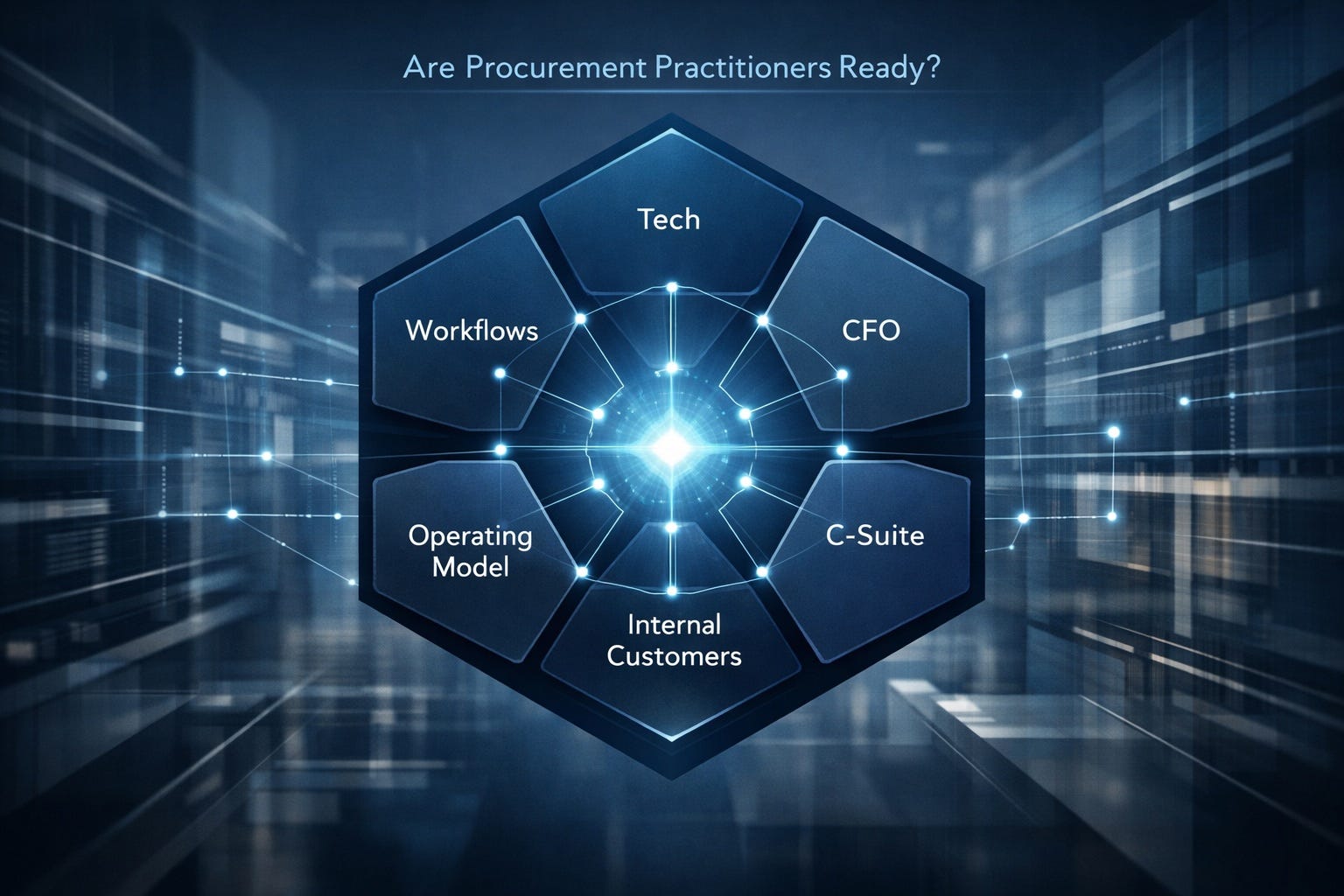
Six factors underpin this shift of expectations:
Tech
Workflows
Operating Model
CFO
C-Suite
Internal Customers
Let’s look at each of these in turn.
1. The Tech is Absorbing More Than We Expected
Over the years, with the rise of Procuretech (and most tech in general), most of us assumed these tools would “take the transactional work” but not the “interesting stuff” i.e. all the decision support and cognitive work that humans do.
But, in reality, AI is moving up the value chain much faster than expected.
With the advent of today’s crop of tools (powered by AI), we’re seeing the tech take away work we’ve come to expect as our exclusive domain; not just the transactional stuff but so much more than that. A few examples:
Supplier discovery becoming an ‘auto-generated’ feature
Market benchmarks created in minutes
Cost breakdowns inferred from sparse, public data
Contract risks flagged before Legal even gets its turn
Scenario modeling (“what if we dual source?”) done instantly
All of this is decision support work - traditionally a “high value” activity that was part of the developmental trajectory of Junior Analyst to Manager to Category Lead. But with AI absorbing this work, many practitioners are losing not only their learning path but also their value narrative and their differentiation.
Think about it: if you traditionally optimized for producing analysis, you now need to move beyond. Producing the analysis isn’t good enough - machines will do that and you will need to optimize for interpreting, challenging, and owning decisions.
2. Workflows Are Changing Faster Than Skills
If your job is to administer a process, you’re at risk, because AI isn’t just automating tasks, it’s reordering - changing - the way work is done.
Traditionally, we saw workflows that were reasonably sequential:
Intake → Requirements → RFx → Evaluation → Negotiation → Contract
But AI-enabled workflows are different:
Problem framing → Constraint definition → Outcome modeling → Exception handling → Stakeholder alignment
They force us to focus on the bigger picture: What are we trying to achieve? What are alternate paths there? How can I get creative and get to the solution quickly and efficiently and optimally?
In other words, there’s less demand for process administration and a greater demand for judgement, especially on critical projects and at critical moments. The days of “we have a process so let us follow it” are numbered.
So the value premium will be knowing which outcomes matter, where human intervention is necessary, and then being able to figure out when not to follow the process and get to the right outcome.
In the past, we rewarded for procedural rigor, not discretionary judgment. That’s going to change.
If your job is simply administration, coordination, and communication within a process, your job will go.
3. The Operating Model Is Flattening
AI is compressing layers and removing hierarchies.
We’re going to see fewer “Analyst to Manager to Director” handoffs and more direct ownership of outcomes by individuals - because a sizable chunk of the work done in “administering the process” and “analyzing and synthesizing the data” is going the way of the machine.
This means flatter models where visibility increases and output matters more than activity. There will be fewer opportunities (and far lesser tolerance) for excuses. Procurement professionals will be asked:
“Why did you choose this path?”
“What trade-offs did you identify and accept?”
“Which risks did you consciously take or avoid?”
These are questions that go deeper than they might at first sound and the more critical the category (the ones where we want our cliched ‘seat at the table’, the more pronounced they’ll be.
In the past, it was easier to hide behind structure, hierarchy and process, which shielded individuals from accountability and deeper explanation. AI is going to remove this.
4. CFO Pressure will Increase
Given that most CPO’s tend to report to the CFO (and even where they don’t, are very directly influenced by them), the priorities of the CFO are paramount to the existence, focus and future of the function.
If your CFO (truly) believes in Procurement, the world is your oyster. But if he or she doesn’t, then Procurement’s role will be relegated, for the most part, to the transactional. The advent of AI tools has only exacerbated this.
Because CFOs don’t see AI as just a “nice to have”, they see it as a capacity unlock - though perhaps not entirely in the way that the progressive practitioner might want or expect.
CFOs are, rightly, asking questions such as “If intake is automated, why do we need as many buyers?” or “If sourcing cycles are faster, why isn’t throughput higher?” or just simply “Why do we need as many people in Procurement?”
And to be fair, the answers given the current pace of technology are “We don’t”, “It should”, and “we don’t”.
AI is creating an expectation, initially implicit but becoming much more explicit: Headcount should not scale linearly with workload anymore. In fact, we are likely past the point of peak employment in the function.
In other words, if we have any hope of staying relevant, AI demands that practitioners clearly articulate business impact every step of the way.
So we have two options: Either we accept this and the functions turns into a distributed, self-serve, transactional driver of spend, or we upskill and focus on becoming value creators.
If the hope is to stay relevant, there’s only one answer.
5. C-Suite Expectations Have Shifted
In 2024, the main question from the C-suite was “Are we using AI?”. Moving into 2025 and now 2026, the question has shifting to asking “Where is AI changing outcomes?”
In Procurement’s case, this translates into tangible outcomes:
Cost reduction (of course)
Faster time-to-market
Measurable working capital impacts
Supply risk anticipation and timely mitigation
Margin protection under inflation
Innovation through suppliers
The point is that we’re moving beyond AI theater, beyond the simple reporting to the Street about all the cool initiatives we’ve implemented, to ‘here’s what the new tech has actually delivered and changed’. Procurement professionals, for their part, are increasingly being expected to:
Identify where AI should be applied
Define clear success metrics
Explain why its use case matters commercially
This means a shift from executing initiatives to shaping them - a skill that will be the domain of not just a few senior folks but that of the entire (smaller but more capable) function.
6. Internal Customers No Longer Tolerate “Generic Procurement”
Some practitioners bristle at the idea that they have “customers”. They say, instead, that “we have partners, we are equals”. This is an argument around semantics and misses the point. Procurement exists to serve the business, which has asked it to manage a specific set of spend to better meet the goals of the overall business.
In other words, Procurement has customers. And those customers are demanding a much higher caliber of performance - especially as so much of a corporation’s work is “AI-ified”. Their key question is:
“If you cannot deliver clear and specific value to my BU or department, then I don’t need you.”
Think about it. If AI can run an RFQ using simple chat prompts, conduct the analytics, benchmark pricing and even flag Contract-to-RFQ risk, then it’s right for the business to question the value of a Procurement model that cannot meet it’s specific requirements.
This means a shift from historical emphases on ‘standardization and scale’ to ‘contextual, custom relevance’.
The real value drivers, then, are category intimacy and business understanding as well as the ability proactively spot opportunities to create custom value.
Ask yourself, how many of your team are ready for this future?
In Summary
The above, in my view, are the prime reasons why Procurement is changing and why the function, as a whole, is not quite ready for the shift.
(In my next post, I’ll speak to some of the internal structural and historical factors within Procurement worth considering as we work to engineer the shift for ourselves.)
The net of all this is that, if we’re not prepped and ready, then all of the concerns we have about “the machines coming to take our jobs” and “Procurement becoming irrelevant and being phased out of existence” will come to fruition.
And this won’t be because of a lack of intelligence or work ethic on the part of the individual practitioner. It’s got nothing to do with that. It will be because AI is eliminating the version of the function that we have historically optimized for.
And, in my mind, if we let that happen, then it will be a problem not only for the function and its Practitioners, but for the corporation as a whole.
We will lose the human element. We will lose the ability to truly manage through ambiguity. We will lose accountability.
In the end, we will lose as a corporation.