


The “Post-AI” world.
I’ve used this term a lot and often get asked what I really mean - not just what it is, but when it will arrive, and what the world will look like when it does.
In this post, I’ll parse through exactly what I mean - and also why we need to move beyond the conventional interpretations of the term.
AI is Already at Work
There’s plenty of debate about what AI is, it’s “true value” and what it means for the work we do. There are even conversations about whether AI is “real” and if, in time, it’ll end up being just another simple tool, like so many other tech solutions out there.
I’ll start by saying that the bus has left the station. AI is real and it’s already delivering value.
Individuals are using it at work to do their research, think through strategies, and approach new business interactions in thoughtful ways. (And that’s not even touching personal use cases outside of the workplace.)
Companies are using AI as well to automate transactional processes, implement agents to take on specific tasks (reasonably) autonomously, and accelerate time (and path) to outcome. (Obviously, there’s much more work to be done here, but the trend is positive.)
So, sure, we can debate the nuances of AI all we like, but the fact is that its value is here, at the very least, in its early stages.
AGI is a Red Herring
Another discussion that you hear a lot in conventional media as well as the social media sphere is about Artificial General Intelligence or AGI - an all knowing technology that will do everything we humans can do but better.
Personally, I think all this talk of AGI is a red herring. No one (really) knows if it’s even possible or, if it is, when it might become a reality. So, for all practical purposes, until we know substantially more, it doesn’t matter for what we do.
(Personally, I don’t believe we’ll get to a perfect replication of the brain in machine form, at least without severe deficiencies and/or material adverse consequences. Our brains are just that complex. You can fight me on this later.)
In other words, AGI as ‘full autonomy’, ‘zero humans’, etc., is just a talk track. Let’s not waste cycles on remote eventualities. It just delays preparation for what already matters.
Instead, let’s focus on tech we can actually work with. The AI of the here and now.
Post-AI is Not a Future State
When I say “Post-AI”, I don’t mean when “AI is finished and perfect”.
I mean when “AI stops being optional”. It ceases to become a differentiator, it becomes an assumption. It’s when AI is embedded, imperfect, unevenly deployed, constantly improving and already reshaping expectations. It is NOT a future state waiting for the perfect tech, sometime in the future.
It is, in actual fact, now. It’s our current reality in which AI is already embedded, one way or another. Imperfect, yes, but still immensely valuable.
In this reality, we’re already seeing the signs in Procurement - a trendline moving away from a process and task focus to one where Procurement roles are being reshaped around outcomes, orchestration, and human judgment.
In this world, advantage accrues from better roles, better decisions, and better interactions - not (just) from adopting more AI.
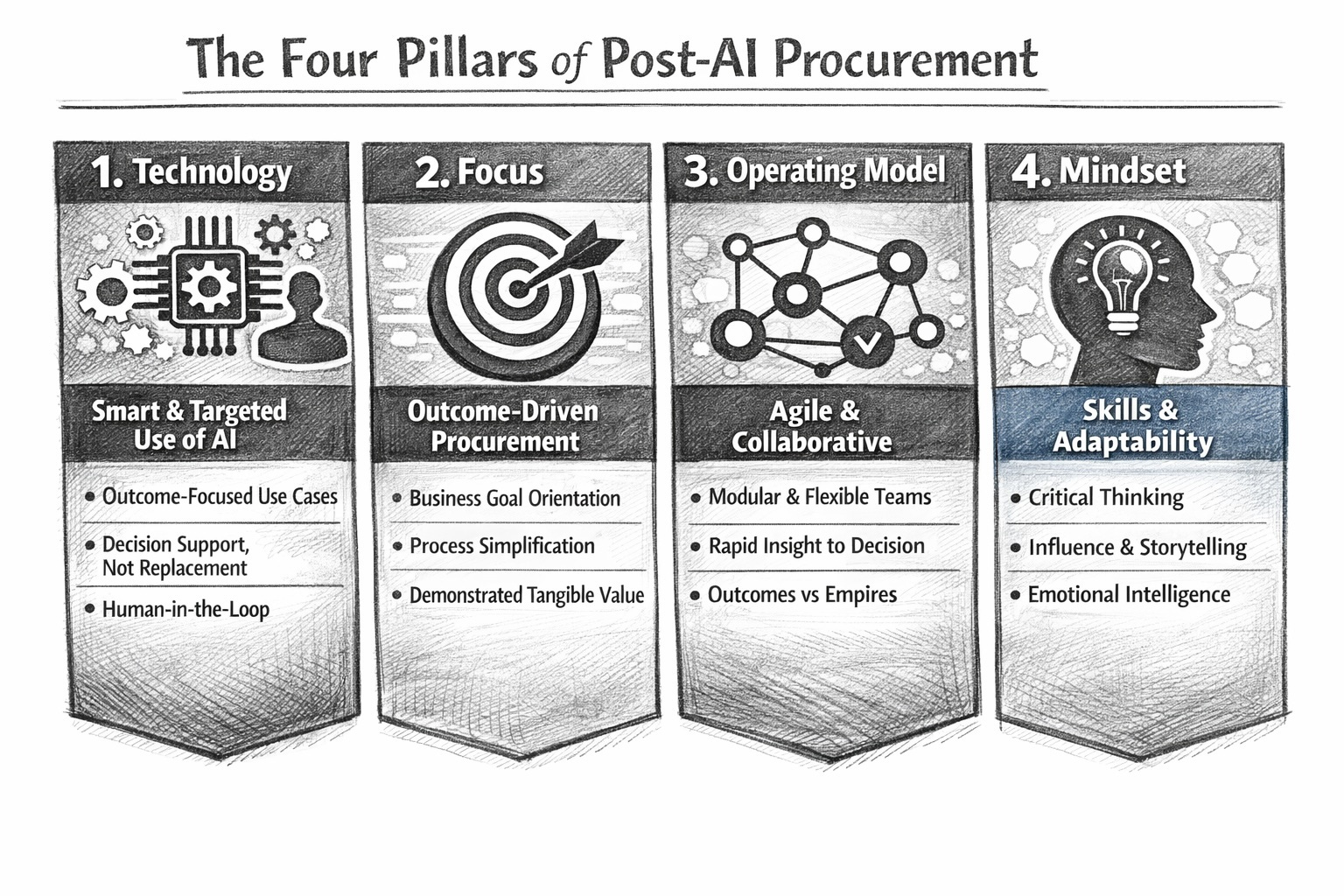
The Four Pillars of Post-AI Procurement
So my point is that the post-AI world is now.
And to make sense of it requires us to understand it’s multiple facets. Not just “AI as Tech” but rather, its four foundational pillars: Technology, Focus, Operating Model and Mindset/Human Capability. These pillars are the lenses that help us frame this world we’re now dealing with.
Let’s look at each one in turn.
Pillar 1: Technology
Yes, the tech is an essential ingredient. But in a post-AI Procurement world, the tech doesn’t need to be perfect, nor does it need to be everywhere. It just needs to be intentionally and precisely deployed.
Don’t worry about how advanced it is, just focus on using it thoughtfully:
Consider narrow sourcing use cases that accelerate outcomes
Recognize its value as a tool for decision support (vs decision replacement)
Treat the need for the “Human-in-the-loop” as a feature, not a bug
Pillar 2: Focus
Shift Procurement’s focus from its pre-AI emphasis (compliance, consistency and process fidelity) to business outcomes and internal customer satisfaction. This is, of course, harder than it sounds, because it’s weighted down by myriad factors, which we’ll get into in future posts.
The point is to focus on delivering the right results for the business. Stakeholders don’t care how Procurement gets there, they just want to know:
Did you help me hit my goals?
Did you reduce friction i.e. did you make the process as easy as it could be?
Did you improve the final decision aka ‘did having you in the room matter’?
Pillar 3: Operating Model
We need to rethink our operating models (how we deliver) from “empires” to “orchestration”.
AI breaks the logic of large centralized teams, hierarchies and the hoarding of capabilities. Instead it demands that we move towards a modular mix of small cores of accountabilities, optimal expertise (both internal and external), carefully considered Make vs Buy decisions, and the liberal (but thoughtful) use of Agents.
Practically, this means:
More rapid movement from requirement to insight to decision
Less ownership and, maybe more accurately, administration of the tools
More ownership of outcomes (which requires much clearer accountabilities) and,
Fewer fiefdoms (because Procurement’s scale comes from orchestration not from headcount).
Pillar 4: Mindset and Human Capability
In the post-AI world, outcomes are all that matter.
Which means judgment, trust, and business fluency will matter more than ‘working through the system’. Which means technical differentiation will matter far less than human differentiation.
Post-AI Procurement professionals will value judgment under uncertainty, stakeholder influence, commercial intuition (aka business sense), narrative and storytelling as well as sound reasoning.
Soft skills, more than anything else, will become differentiators as Practitioners thrive by generating options, helping stakeholders choose better paths, manage for the right trade-offs and own the outcomes (and their consequences).
Post AI is Already Here
So, to me, we’re entering the Post-AI world, if not already very much in it.
The tools and technologies to help us are already out there. They may carry different labels - AI-First, AI-Native, AI enabled - and they may be imperfect, but they’re already changing expectations. What matters now is how we thoughtfully adopt them.
And, as I’ve outlined here, this will be about so much more than the tech itself.
It will be about our ability to rethink the very pillars that define the work of the Procurement Practitioner - delivering better judgment, clearer accountability, and a redefinition of what it truly means to add value.
AI will keep improving either way. Whether Procurement adapts its roles, models and mindsets fast enough to stay relevant is the real question.