


This site grew out of a question that I’ve been grappling with for at least the last five years:
How should the role of the Procurement practitioner transform over the next decade?
The impetus for the question came from the massive changes we’ve been seeing in the Procurement space over the last two decades - the explosion of both end-to-end as well as best of breed technologies that were changing the way work was being done, as well as the increasing sophistication of the function (from the caliber of its practitioners to the more sophisticated management approaches being deployed).
There was no question in my mind that, as a result of all of these changes and more, the function was going to have to move further up the value curve lest it be deemed irrelevant.
Then along came Gen AI.
Gen AI (and more broadly, AI in general) has, quite simply, accelerated this trend, making Procurement’s existential question even more, well, existential.
In my view, AI is coming for Procurement work faster than Procurement is preparing for it. Most are still figuring out how to best integrate this new tech into their workflows, and how to maximize the ROI from their investments. There’s discussion and experimentation with alternative operating models, hybrid staffing approaches, and more. Despite the massive hype and the perceived speed of change, it’s still early days, and we still have time to figure out the right path forward.
But even as all of this experimentation and value extraction has been occurring, one topic that almost no one has been talking about has been what all this change would mean for the practitioners themselves and, more specifically, what they need to do to not only survive but flourish in this new world. That is, what happens to the human?
Sure, there’s been plenty of lip service about the value of the human and how qualities such as judgement and empathy will be essential, but probe one level below and there’s little real insight.
Which is why I started Proquria - to answer these questions.
Thirty plus weeks later, I’ve run through all of the key questions I wanted to answer. This post provides a recap of the ground covered over the last eight months, followed by a discussion of what’s next.
The Argument In Brief
The premise is simple:
AI is absorbing the work that built Procurement careers and trained our very best people - work that not only fortified our domain knowledge but also gave us the procedural grounding that developed the intrinsic understanding we needed to have to serve our stakeholders.
With the machines now coming for this work very directly - not just in terms of the transactional but also tasks that are higher up the value chain such as cognitive and decision-support work - the nature of the function, in terms of size, caliber and focus, must be re-engineered very deliberately. And we’re going to have to do this work ourselves. No one’s going to do it for us.
If we don’t, Procurement faces an existential risk:
If the work we do is no better than the machines, then why not just let the machines do all of the work?
How The Argument Unfolded
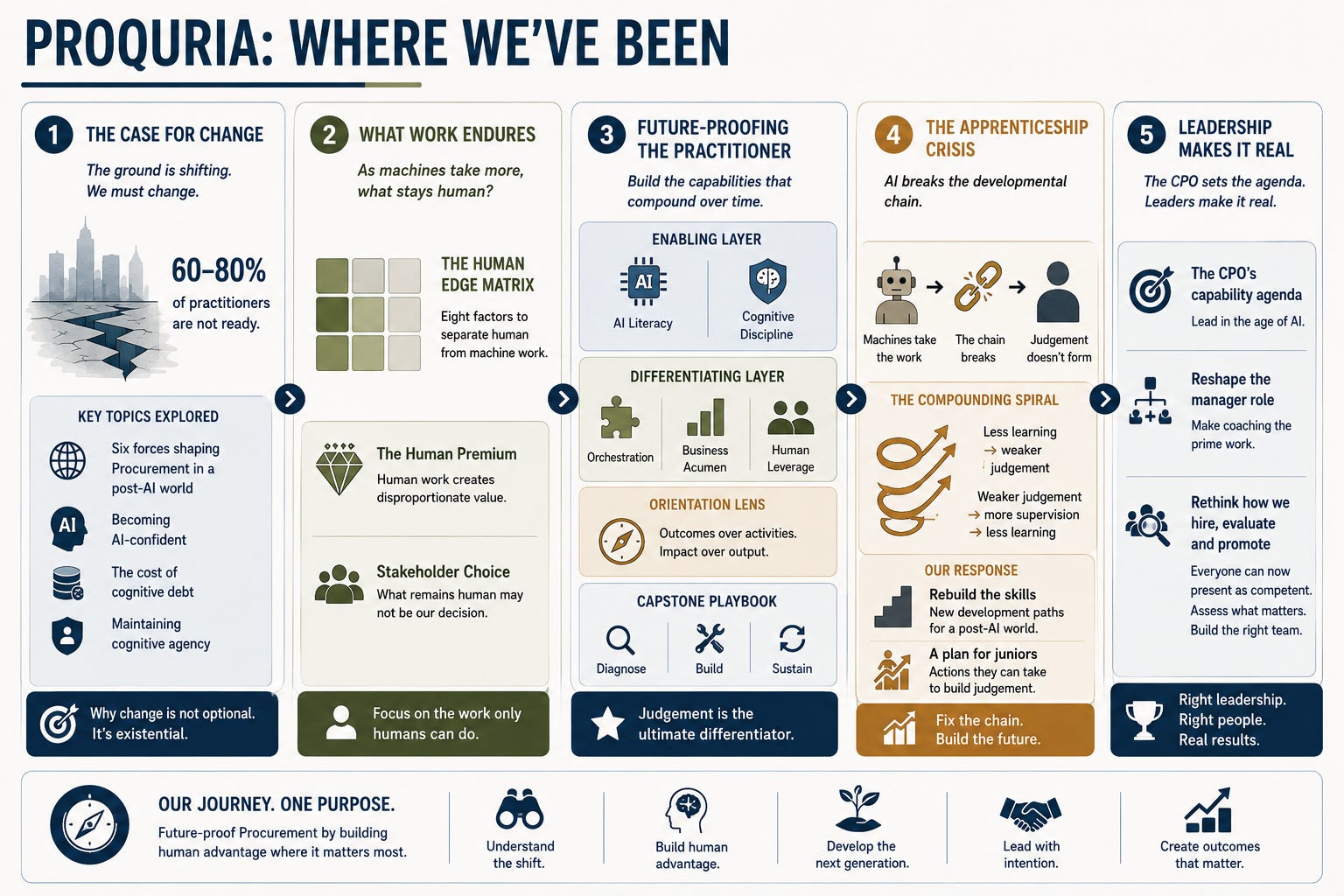
I began the discussion by making the case for change. I argued that the ground under the function was shifting far more rapidly than any of us ever expected and that these shifting sands were introducing an existential risk. We needed to reshape the role of the function, which wasn’t about just the tech, but about operating models, incentives, mindset and, most importantly, the practitioners themselves, as my own (informal) research suggested that 60-80% of practitioners were not ready for this change. Along the way, I dove into topics such as the six forces shaping Procurement in a post-AI world, how we can become AI-confident as well as the cost of cognitive debt and what we need to do to maintain cognitive agency in this new environment.
I then dove into what work endures i.e. what work stays human as the machines take everything else. I presented the Human Edge Matrix, an eight factor framework that helps determine how much of our work will go the way of the machine and what will not. I discussed the human premium in detail - and the fact that the type of work that remains human may not even be Procurement’s decision to make, but that of its stakeholders.
I then laid out my model for future-proofing the Practitioner in detail, with its Enabling Layer (AI Literacy and Cognitive Discipline), Differentiating Layer (Orchestration, Business Acumen and Human Leverage) and Orientation Lens. I also provided a capstone playbook to diagnose, build and sustain this development, along with a deep dive into what we really mean when we talk about judgement as being the differentiator.
While the Future-proofing model is helpful for the senior practitioner, the whole idea of the machines taking away the work that has been foundational to our development begs another question: what do we do about our juniors, who rely on that type of work for their own development? I argued that AI was creating an apprenticeship crisis because it was breaking the developmental chain and creating the discernment trap. We were asking juniors to take on the supervisory work while removing the very mechanisms that built the judgement to perform that work in the first place. I put forward my perspective of the compounding spiral we need to focus on as well as my proposal for the rebuild of these skills in a post-AI world and a plan of action for the juniors themselves.
I capped the entire series off with a deep dive into what leadership needs to do. The CPO must be primed to capitalize on not only taking advantage of the promise of AI but also of making sure his or her team is able to deliver on that promise in a meaningful, value added way. I set out the CPO’s capability agenda in this new world, why and how we need to reshape the role of the manager to fully take advantage of it, and then how we need to rethink the way we hire, evaluate and promote those within our organizations - especially since everyone can now present as competent - to create the future-proofed Procurement team.
Where I Drew The Line
So in terms of the questions I originally set out to answer, which were focused squarely on the practitioners themselves, I’ve answered just about everything I’ve wanted to.
At the same time, though, I recognize that many of the function questions have not been addressed here i.e. what does the Procurement function itself become? What does the operating model look like, what is its precise architecture and its incentives in this new age?
I did touch on some of these issues - I dove into the six moats that underpin the future-proofed function as well as the issue of how we define and deal with more ambiguous metrics and incentives such that they can’t be gamed (though at the level of people rather than the function) - but they have not been my prime focus.
That said, there are plenty of good folks studying these issues, who are giving this the fuller treatment it deserves. I’ll highlight some of their work as we go forward but my own intent has been very much (and very deliberately) on the people inside the function.
What Comes Next
Two things specifically.
First, this series will become a book. The working title is “Future-Proofing The Procurement Practitioner” and it will be released in early 2027. The book will build on the body of content on this site (which will remain freely available) and provide more layers of depth to the topics discussed here, including my perspectives from my time building The Smart Cube and at Kearney, tools and templates, case studies as well as real-world narratives and sidebars. If you’d like to know the moment the book is available, just subscribe to Proquria at the link below.
Second, Proquria as a blog will certainly continue. I’ll be posting regularly on a host of related topics and keeping an eye on the key developments and critical questions Procurement is facing as it pertains to the talent issue. I’d love to get your feedback on the body of work here and where it works, where it doesn’t and how I could improve it further.
Over To You
So, at least at this level, my perspective on the talent thesis is all here: the case for change, the practitioner’s playbook, the junior apprentice’s development plan, the manager’s role rebuild and the CPO’s leadership agenda.
The one last point I’d add is that, if you’re a practitioner, it’s incumbent on you to take charge, take the initiative and get yourself going. This is the opportunity ahead of us.
Nobody is coming to get us sorted. It’s down to us.
Let’s get going.