


Procurement practitioners today are living in what seems like a strange split-screen reality.
On one side, every CPO agenda has “GenAI” stamped on it in bold ink:
EY’s 2025 Global CPO survey found that 80% of CPOs plan to deploy GenAI in some capacity over the next three years (with more than a third having deployed GenAI in a meaningful way).
Deloitte’s 2025 Global CPO Survey found that ‘Digital Masters’ (the top quartile performers) are allocating a quarter of their budgets to procurement technology (nearly double 2023 levels) and achieving a 3.2x ROI on their GenAI investments.
The promise (both real and hyped) is there for all to see (and desire) and the exhortations to chase after this ‘promised land’ are ubiquitous.
On the other side, the practitioner’s day job continues to have real teeth: contracts still need negotiating, stakeholders still want their answers yesterday, suppliers still need to be managed actively, while risks continue to show up uninvited. All of these need to be handled now. They require us to leverage all that we know to keep doing “good work”.
But hovering over both these realities is the idea that the baseline for what constitutes “good work” is shifting. The Hackett Group has put an even sharper edge on this:
64% of procurement leaders expect AI and GenAI to transform their roles within five years.
(Note that that’s research from early 2025, before the last year of model releases and product launches that have accelerated the conversation even further.)
And while we can get caught up in discussions about timing, it’s clear to me that the ground is moving. Change is coming.
So the real question isn’t whether AI will matter but, rather, what posture are you taking while AI is becoming the new ‘normal’?
In other words, how are you becoming “AI-ready”?
In this post, I’ll do three things:
Explain why ‘learning to code’ is the wrong bar for most practitioners
Provide you with a quick self-assessment, and
Describe the mindset shifts that move you up the curve.
Why I Stopped Believing “Learn to Code” Was The Answer
For a while, I believed that to be “AI-ready” you needed at least a working understanding of coding. I don’t believe that anymore.
It’s not that I think technical depth is worthless - it absolutely isn’t. It’s just that, for most procurement practitioners, “becoming technically proficient” becomes a treadmill with no finish line. The technology is constantly outpacing us - the models improve, the tools change, the interfaces shift, the jargon mutates, and so on and so on. You can spend months chasing proficiency and still feel behind.
In the meantime, you still have a day job to focus on - a day job that does not and will not pause for the transformation.
Add to this the fact that the “Tech” is also getting easier to use (”the best UI is a text box that you talk or type into”), and it all begs the question:
How do you prep for a new world in a way that advances your understanding and does so in a way that furthers your ability to do your real work more efficiently and effectively?
Or to put it more simply:
How do you become AI-Confident in a way that is meaningful and contextually relevant?
The answer, to me, isn’t technical but behavioral:
the willingness to experiment (without expecting perfection)
the ability to ask better questions
the discipline to verify outputs and not take them for granted, and
the ability to turn experimentation into repeatable ways of working
In other words: judgment, intention, practice.
The Three States I Keep Seeing in Procurement
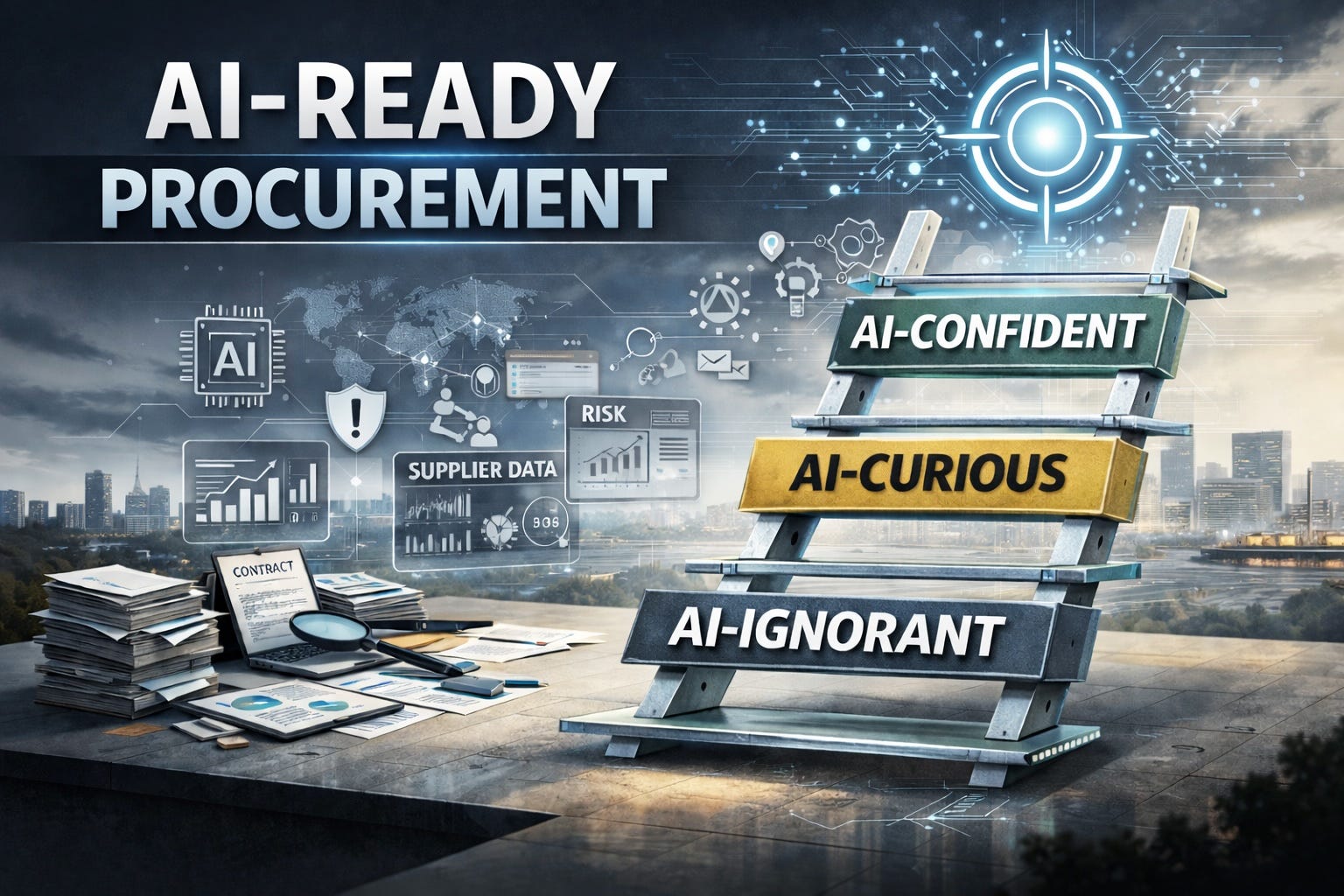
This is why I keep coming back to a simple framing. I tend to see three broad types of practitioners: AI-ignorant, AI-curious, and AI-confident.
Let’s dig into each of these types more practically, via a quick self-assessment.
Self-Assessment: Where Are You Right Now?
1) AI-Ignorant (AKA “I’m Too Busy”)
You might be here if:
You rarely use AI tools unless absolutely pushed to do so
You think “AI confidence” equals coding or being a technical expert
You assume the value will become obvious later…”I’ll figure it out then”
You’re waiting for training, governance, or a corporate rollout to make it “official”
You avoid experimenting because you don’t want to look foolish or wrong (”I’ve heard it hallucinates”)
You’re just plain worried
The thing is, a lot of what we call “AI ignorance” is really just passive avoidance - and it’s not sustainable, because the world isn’t going to wait for you to ‘feel’ ready. Sure, the tools aren’t perfect but they are delivering value in different ways today, and they’re going to keep on improving.
So over time, avoidance doesn’t just keep you unchanged, it erodes your credibility because expectations around speed, clarity, and insight will keep rising even if your mindset and approach and workflow don’t. And that’s going to be far worse.
2) AI-Curious (AKA The Default Setting)
You might be here if:
You follow the headlines and opinions (especially the loud ones)
You’ve tried the big-name tools a few times
You experiment for a day or two, then go quiet for weeks
You don’t yet have a clear sense of where AI helps your work most
Your exploration is driven by novelty, not outcomes
This is AI-curious, where most people are - and it’s a reasonable place to be, all things considered.
But there is a hidden problem: curiosity without structure doesn’t compound. It remains as a king of ‘sporadic entertainment’, something you “check out” rather than something that you use to change you.
3) AI-Confident (AKA It Isn’t What You Think)
You might be here if:
You use it with intent, not just when you remember
You translate experiments into repeatable workflows
You can point to a few parts of your work where AI reliably helps
You keep judgment in the loop: you sanity-check, triangulate, and challenge outputs
You focus on outcomes: faster insight, better options, clearer stakeholder communication, sharper risk visibility
AI-confidence doesn’t mean you can build models, it means you’re focused on constant learning. It means you know where you’d try AI, how you’d evaluate what comes back, and how you would apply it responsibly.
Moving Between The Stages: Mindsets
The really interesting thing about these types or stages is that the distance between them is not as large as it might seem. It’s not a leap from “non-technical” to “technical”; it is, instead a shift from avoidance to dabbling to disciplined use.
So what does moving between these stages actually mean in terms of behavior? How should we think when we make this shift?
From AI-Ignorant to AI-Curious
As I said, this shift - the first and most important one - isn’t about any sort of special intelligence.
It’s about dropping the “wait and see” posture and deciding that “clarity” isn’t something you can wait for. It’s something you can begin to create through low-risk experimentation.
This first step is, therefore, mostly psychological:
“I don’t need permission to learn.”
“I don’t need perfection to start.”
“I can run safe experiments without creating risk.”
It is, therefore, about making the decision to actively learn, to understand what’s out there and begin to understand the potential use cases and value they can deliver.
It’s about just getting started.
From AI-Curious to AI-Confident
Here, you’re adding intent, focus and repetition.
AI-curious folks test tools while AI-confident practitioners build habits - and those habits have a specific flavor:
They’re anchored to real work
They’re measured (even informally)
They improve over time
They include verification, not blind acceptance
That’s the whole shift - from observation to intentional usage and from dabbling to conscious practice. The key is to move from “AI as novelty” to “AI as a work partner you manage”.
That last phrase - AI as a work partner you manage - matters the most, because in Procurement, as in any other function worth its salt - accountability doesn’t get outsourced to the tool. It has to stay with you.
The Ethos: Take Charge Yourself
If you take only one idea from this post, take this:
Don’t wait for someone to serve AI readiness to you on a corporate tray.
Yes, one day, the training will come, the policies will evolve and the tools will get embedded. There’s no doubt about that. The tech is moving to the point where there will be no option but to.
What you don’t want is for that to be the time you begin learning, because by that time, you’ll have a mountain to climb to simply get to first principles. Worse, by that time, you may be irrelevant.
The practitioner who builds an edge is the one who starts now, safely, and deliberately. And don’t do it because you want to become an “AI person”. Don’t do it with an end destination in mind - there is no end here, it’s a journey.
Do it because you want to stay “high-leverage” as the very definition of leverage changes. Do it because you want to stay relevant.
A Quick Sidebar for Leaders
If you lead a team, your job isn’t (just) to announce that “we are adopting AI”. Your job is to remove the fear and the friction so your people (who are watching you for guidance) can build competence without feeling exposed.
That means:
create psychological safety for experimentation
clarify the guardrails (even simple ones)
reward good judgment, not shiny outputs
normalize the idea that AI outputs need verification and context
celebrate small wins that improve cycle time and stakeholder clarity
What’s next
But look, with or without a perfect “tech-forward, people-first” leader, the onus is still on the practitioner. The practitioner still has to choose this posture. It has to be a personal shift before it becomes an institutional one.
So, in the next post, I’m going to suggest ways to get practical. I’ll start with some common-sense boundaries (especially around confidentiality and policy), then lay out a simple playbook to move up the curve, including how to apply AI to procurement workflows where the impact is real:
Supplier intelligence
Supplier risk insights
Stakeholder management
Remember, in a post-AI world, confidence won’t come from the guts of the technology, but from knowing how to work with it - repeatedly, safely and with judgment.